Trading Competition Case Study: What 924 Traders and a Five-Stage Bracket Showed Us About Tournament Design
Every broker that has run a trading competition knows the moment: registrations close, the number looks great in the internal update, and then the leaderboard fills up with a fraction of the names that signed up. The registration count was real. It just wasn't the number that mattered.
That's why we're publishing the complete funnel of our flagship 2026 event, the Swiset Trading World Cup, sponsored by AvaTrade — not just the top-line figure. The data comes from the tournament's own database, covering all five stages.
/The short answer
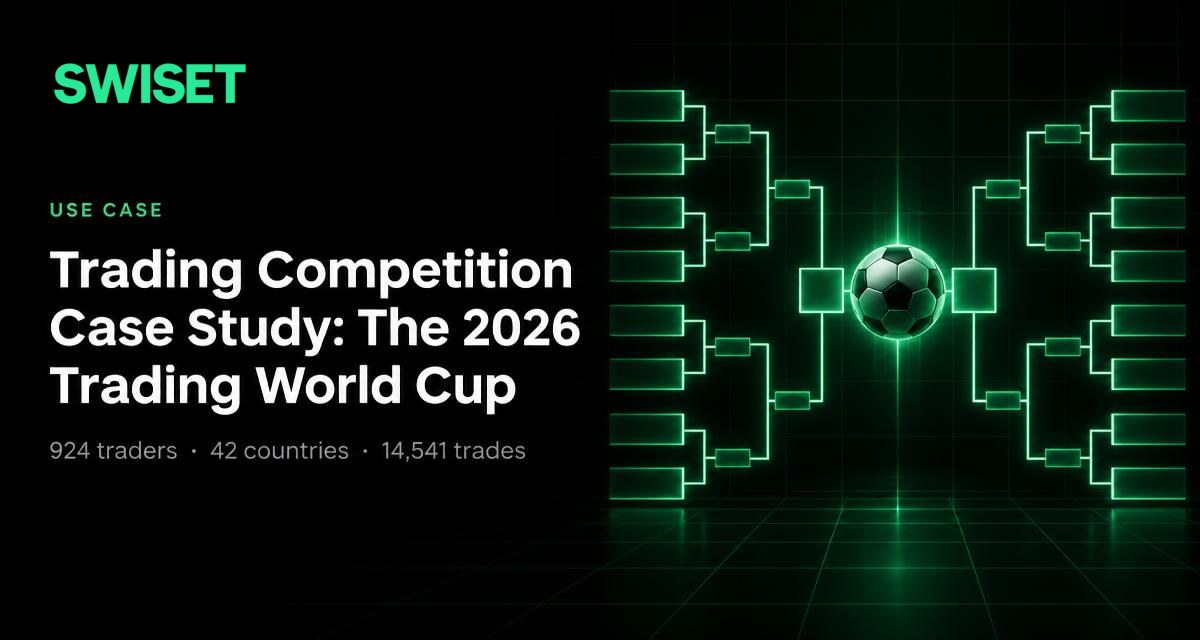
Over five and a half weeks, the Trading World Cup brought 924 registered traders from 42 countries into dedicated competition accounts under AvaTrade. 292 of them placed at least one trade, producing 14,541 trades and 42,740 lots across 42 instruments. A rules engine enforced a 20% drawdown limit and a minimum-activity rule for every participant, and a five-stage knockout format narrowed the field from 924 to a Grand Final of two.
The takeaway for brokers: a well-structured tournament concentrates a large volume of trading into a short, predictable window, enforces risk rules without manual review, and hands the broker a detailed map of who its most engaged traders are, where they are, and what they trade. The activation rate — roughly one in three registrants traded — is also the clearest place to improve.
/The format: a football tournament, run on trading accounts
The event was timed to run alongside the 2026 FIFA World Cup (June 11 – July 19) and borrowed its structure. Instead of a single leaderboard running for a month, it used a qualification stage followed by weekly knockout rounds:
| Stage | Dates (2026) | Registered | Traders who traded | Trades | Lots |
|---|---|---|---|---|---|
| Qualification Stage | June 10–19 | 924 | 292 | 14,004 | 41,272.6 |
| Round of 16 | June 22–26 | 16 | 13 | 238 | 769.3 |
| Quarter Finals | June 29 – July 3 | 8 | 7 | 206 | 378.7 |
| Semi Finals | July 6–10 | 4 | 4 | 69 | 252.6 |
| Grand Final | July 13–17 | 2 | 2 | 24 | 66.7 |
| Total | June 10 – July 17 | 924 unique traders | 292 unique | 14,541 | 42,739.9 |
Participants were ranked by equity percentage change, not absolute profit. Every stage applied the same two hard rules: a 20% static drawdown limit and a minimum of 10 closed trades per phase (tournament rules).
Two design decisions did most of the work here.
Percentage-based ranking puts every account on the same footing regardless of position size, so the leaderboard rewards performance relative to the account, not the biggest bet.
A knockout bracket turns a single contest into a sequence of events. Each stage had its own start date, its own stakes and its own story — which gives a broker's marketing team five moments to communicate instead of one, and gives the traders who advance a reason to come back every Monday.
/What the numbers show
1. Trading activity concentrated in a short, predictable window
The qualification stage lasted ten days. In that window, the 292 traders who participated placed 14,004 trades — an average of about 48 trades and 141 lots per active trader. For a broker, that is the core value of a tournament format: activity doesn't trickle in over months; it arrives in a defined period that can be planned for, supported and measured.
Engagement also held up where the stakes rose. In the knockout rounds, 26 of the 30 stage slots (87%) were filled by traders who actually traded, and every semi-finalist and finalist remained active through their stage.
2. Rules were enforced at scale, not by spreadsheet
Across the tournament, 614 unique traders were disqualified:
- 380 for not meeting the minimum-trades rule.
- 237 for breaching the 20% drawdown limit (241 breach events in total).
Those numbers are worth pausing on. Hundreds of drawdown breaches across a ten-day qualifier is exactly the situation that overwhelms an operations team working from exports and manual checks. Applying the rules through the platform meant the leaderboard reflected traders who stayed within the risk limits — which is what keeps a competition credible for the traders who played it straight, and defensible for the broker hosting it.
It's also a design signal. A 20% drawdown cap is a deliberate choice: it keeps aggressive, all-in strategies from dominating a percentage-based leaderboard.
3. The broker got a behavioral dataset it couldn't buy
Instruments. Gold dominated. It accounted for 69.5% of all trades and 67% of all lots, and 196 of the 292 active traders (67%) traded it. EUR/USD was a distant second at 6.6% of lots, followed by crude oil, GBP/USD and silver. Participants traded 42 instruments in total, but the appetite was clearly concentrated.
For a broker, that's actionable: it informs which instruments to feature in post-tournament campaigns, where to focus liquidity and pricing conversations, and what educational content this audience actually wants.
Geography. Among registrants who provided a country, participation clustered in three regions:
| Region | Registered | Traded | Lots |
|---|---|---|---|
| Asia (led by India, the Philippines, Indonesia) | 186 | 91 | 16,649 |
| Africa (led by Nigeria, Ghana, South Africa) | 132 | 65 | 9,880 |
| Latin America (led by Colombia, Ecuador, Argentina) | 82 | 27 | 3,358 |
India (147 registrants, 69 active) and Nigeria (86 registrants, 41 active) alone accounted for 38% of all active traders and 48% of all lots traded. A global campaign surfaced two markets with a disproportionate share of engaged traders — the kind of signal that shapes where the next acquisition budget, IB partnership or localized campaign goes.
The most engaged traders. At least five traders were active in three or more stages, and one competed in all five. These are the traders a broker most wants to keep a relationship with, and the tournament identified them inside the broker's own account base, with their full trading history attached.
4. The honest number: activation
Of 924 registered traders, 632 never placed a trade — a 31.6% activation rate. We think it's more useful to publish that figure than to hide it, because it's the most common failure point in any competition and the one with the most room to improve.
One pattern in the data stands out. Registrants who provided their country activated at 45.6%, versus 20.1% for those who didn't. That doesn't prove completing a profile causes someone to trade — more motivated traders may simply fill in more fields — but it suggests registration data quality is an early indicator of intent, and that the gap between sign-up and first trade is where onboarding effort pays off.
For a broker planning a similar event, that points to concrete levers:
- Shorten the path from registration to first trade. Every step between signing up and a funded, ready-to-trade account costs participants.
Treat the days before the start as an activation window, with reminders, platform setup guidance and a clear explanation of the rules — especially the minimum-trades requirement, which caused more disqualifications than drawdown did.
- Segment non-starters. Registrants who never traded are still warm leads, and they need a different follow-up than disqualified active traders.
- Measure by stage. Registrations, active traders, trades and lots are different stages of the funnel. Reporting them separately is what makes each one improvable.
/What brokers can take from the Trading World Cup
Pulling it together, three lessons generalize beyond this event:
- Structure creates repeat visits. A multi-stage format gives traders a reason to return and gives marketing a calendar of moments, instead of one launch and one results post.
Rules are what make the results worth anything. Percentage-based scoring, a drawdown cap and a minimum-activity rule, applied automatically to every account, protect the credibility of the leaderboard and the broker's brand.
- The data outlasts the event. Instrument preferences, regional concentration and a list of highly engaged traders are assets a broker keeps using long after the prizes are awarded.
/How Swiset powered the tournament
The Trading World Cup ran on Swiset's White-Label Trading Competitions, the same infrastructure available to brokers who want to run their own branded events.
In practice, that meant four things:
- Multi-stage tournament management: the qualification stage and four knockout rounds ran as linked tournaments, with each stage's qualifiers moving into the next.
A configurable rules engine: the 20% static drawdown limit and 10-closed-trade minimum were applied to every account, with the platform able to handle drawdown limits, minimum trade counts, lot boundaries, instrument and trading-hour restrictions, and Expert Advisor policies.
Flexible scoring: the World Cup ranked traders by equity percentage change; the platform supports multiple scoring methods, including PnL percentage, risk-adjusted return and a custom composite score.
- Competition analytics: registrations, active traders, trades, lots, instruments, countries and disqualifications were tracked as separate figures, which is what made this case study possible.
The platform works with MT4, MT5 and cTrader, and via REST API for custom platforms, so a broker can run a tournament on top of its existing trading infrastructure rather than replacing it.
/FAQs
What is a multi-stage trading competition?
A multi-stage trading competition splits one event into consecutive rounds, usually a broad qualification stage followed by smaller elimination rounds. Only the top performers in each stage advance. Compared with a single month-long leaderboard, it creates several peaks of attention and keeps top traders engaged for longer.
How many registrants in a trading competition actually trade?
It varies widely by audience, onboarding flow and account type. In the Swiset Trading World Cup, 31.6% of registered traders placed at least one trade. The most useful practice is to track registrations and active traders as separate metrics, and to design the pre-start period specifically to close that gap.
Why rank traders by percentage return instead of profit?
Percentage-based ranking compares traders on performance relative to their account rather than the size of their positions. Combined with a drawdown limit, it discourages all-or-nothing strategies from dominating the leaderboard.
Can a broker run a tournament like this under its own brand?
Yes. The Trading World Cup was built as a showcase of what a broker can run as its own branded competition, using Swiset's white-label competition infrastructure on MT4, MT5, cTrader or a custom platform via API.
What should a broker measure after a trading competition?
At minimum: registrations, active traders, trades and volume per stage, disqualifications by rule, and the instrument and regional mix of active participants. Those figures show where the funnel lost people and which traders are worth a follow-up relationship.
/Closing
The Trading World Cup delivered what a well-designed tournament should: a concentrated burst of trading activity, rules enforced across hundreds of accounts, and a clear picture of who the broker's most engaged traders are and what they want to trade. It also showed, in plain numbers, where the next event can do better: the space between registering and placing a first trade.
If you're planning a flagship or seasonal tournament, the design questions are the same ones this event had to answer — format, scoring, rules, and how you'll turn participants into lasting clients.
Related: the Swiset Trading World Cup (https://swiset.com/trading-world-cup), Swiset's White-Label Trading Competitions (https://swiset.com/competitions), and designing competitions that retain traders (https://swiset.com/blog/trading-competitions-broker-trader-retention).
Planning a flagship tournament?
Plan your tournament format, rules and post-event funnel with Swiset's team.
Book a Trading Competition Strategy Session