Your IB Program Has Outgrown the Spreadsheet. Here's How to Tell.
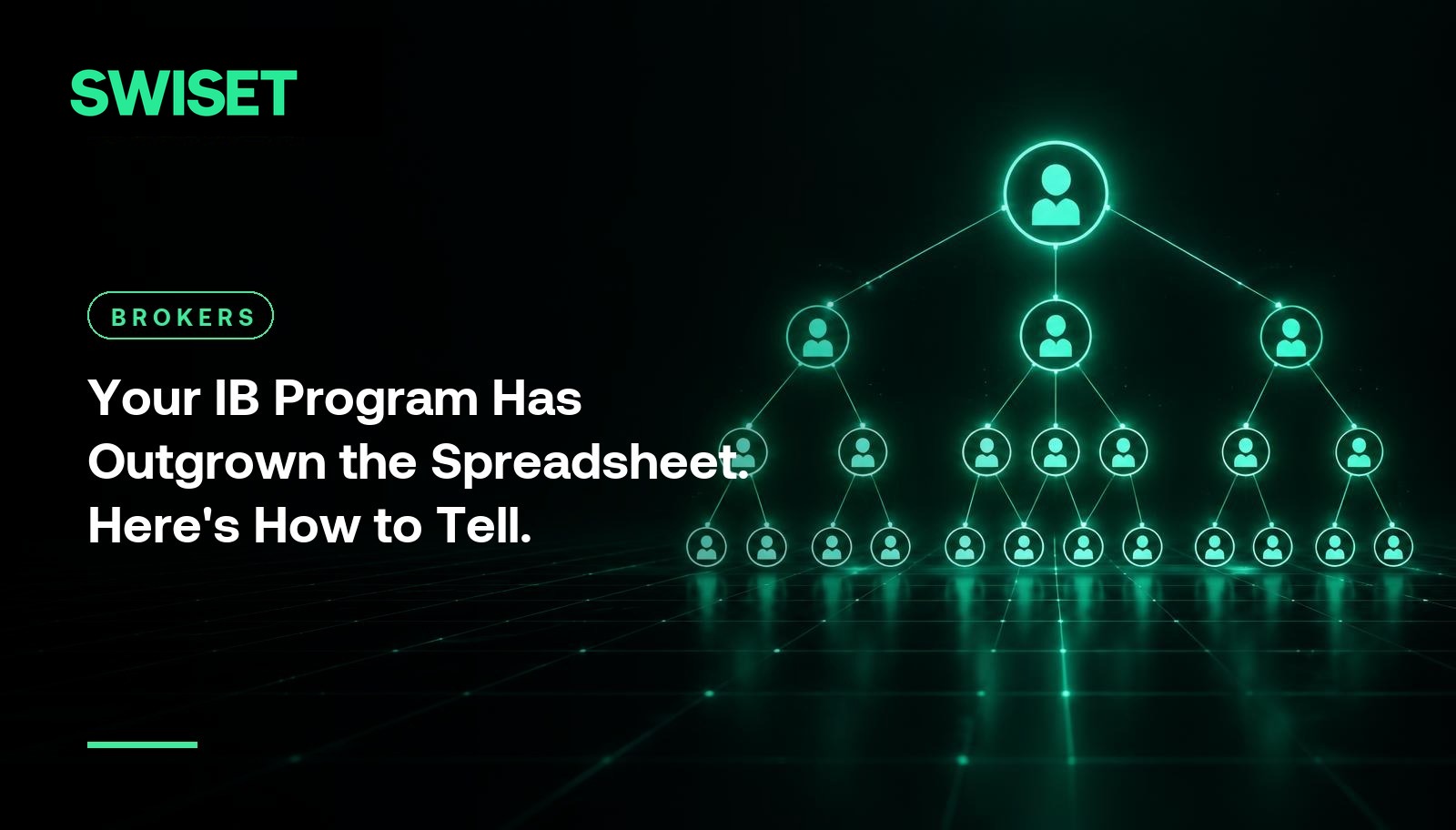
Multi-tier commissions, partner tiering, and payout accuracy are the parts of an introducing-broker program that scale worst by hand — and the first sign of trouble usually isn't a complaint. It's a partner who quietly stops sending you traffic.
Most brokers and prop firms didn't design their IB program. They grew into it. A handful of early partners got a referral link and a manual commission calculation in a spreadsheet, because at ten or fifteen partners that's genuinely the fastest way to get a program running. Nobody sits down at that stage to build tier logic and automated payout reconciliation — there's no volume yet to justify it.
The problem is that nothing forces a re-evaluation once volume arrives. The spreadsheet that worked at fifteen partners is often still the system of record at eighty, run by whoever inherited it, with tier splits added as exceptions and sub-exceptions rather than as a redesigned structure. One 2026 operator guide on multi-level IB management put a rough threshold on where this breaks down: manual tracking of multi-tier commissions in a spreadsheet becomes unworkable at around twenty active partners, not because the math is hard, but because at that scale a spreadsheet is "a full-time job to administer manually, and the kind of system that breaks down loudly when it breaks" (Kenmore Design, June 2026). That's one operator's estimate, not a universal rule — the right number depends on tier complexity and payout frequency — but the direction of the argument holds regardless of where the exact line sits.
For many brokers and prop firms, introducing brokers and trading communities are also the largest single source of new funded accounts — often ahead of any paid acquisition channel. That's precisely why a breakdown in the commission layer isn't a back-office inconvenience. It's a risk to the channel that brings in the most business.
/The short answer
An IB program is built to scale — not just to run — when commission splits across every tier are calculated automatically and identically for every partner, when payouts are visible to partners in real time rather than reconciled at the end of a cycle, when partners are segmented by tier or performance rather than treated identically regardless of volume, and when the program tracks whether referred traders actually activate and stay funded, not just how many sign-ups a link produced. Most programs that grew organically are missing at least one of these, and the gap usually isn't visible from inside the operation until a partner brings it up — or stops bringing up anything at all.
/Where manual IB management actually breaks
Three failure points show up repeatedly once a partner network moves past its earliest, simplest stage.
Commission math
Breaks the moment sub-IBs add a second tier — every tier multiplies the manual calculations.
Undifferentiated partners
Top partners and newcomers run on identical terms, so scaling up earns no visible reward.
Referral vs. activation
Sign-ups look healthy while referred traders never fund, trade, or stay.
Multi-tier commission math becomes error-prone exactly when it matters most
A flat, single-tier referral fee is straightforward to track by hand. A structure with sub-IBs — where a master partner earns a share of what their recruited partners generate — is not. Every new tier multiplies the number of manual calculations and the number of places a formula error or a stale spreadsheet row can produce a wrong payout. A wrong payout doesn't read to the partner as an honest mistake; it reads as a program that can't be trusted with money it's supposed to already owe them.
Undifferentiated treatment ignores that not all partners are worth the same
A partner sending fifty active, funded traders a month and a partner sending three demo sign-ups are, in most manual setups, running through the identical commission terms and the identical level of attention — because building tiered terms and different reporting cadences by hand for each partner is exactly the kind of work a spreadsheet-based process avoids by default, not by design. That flattens the incentive structure in a way that discourages the partners generating the most value from investing further, since there's no visible reward for scaling up.
The program measures referrals, not the trader lifecycle behind them
This is the failure that's easiest to miss because the top-line number still looks healthy. Referral counts and click-throughs measure attention, not the thing the business actually needs: traders who fund an account, keep trading, and stay active past the first month. A partner whose links convert well on sign-ups but whose referred traders churn immediately after registering is, on paper, a top performer — and in practice, close to worthless to the business.
924 registered traders. 292 ever placed a trade. A 31.6% activation rate that would have been invisible if the program had only tracked registrations.
Swiset's own published case study on the 2026 Trading World Cup made this exact distinction at the event level — why registrations and active traders are different numbers. The same gap exists inside IB programs that never separate "referred" from "referred and active" as different numbers.
/A diagnostic: ad hoc tracking vs. structured IB infrastructure
| Area | Ad hoc / spreadsheet signal | Structured infrastructure | Question to ask your own program |
|---|---|---|---|
| Commission calculation | Multi-tier splits computed manually, prone to formula drift as tiers are added | Splits calculated automatically and identically across every tier, every cycle | Could you show any partner, on request, exactly how their last payout was calculated — in under five minutes? |
| Payout visibility | Partners see their earnings only when a payout lands, sometimes after a dispute | Partners have real-time visibility into commission, volume, and performance as it accrues | Do your partners have to ask you what they've earned, or can they see it themselves? |
| Partner segmentation | All partners run on identical terms regardless of volume or tenure | Tiered terms and reporting matched to partner performance and relationship stage | Does your top-performing partner get materially different terms or attention than your newest one? |
| Referral quality | Only sign-ups or click-throughs are tracked | Referred traders are tracked through activation and retention, not just registration | Do you know which of your partners bring in traders who actually fund and stay — versus traders who sign up and disappear? |
Answering "ad hoc" on two or more rows doesn't mean the program is failing today. It means the next wave of partner growth is also the next point where the gap becomes visible — usually to the partner first, and to the operator only once that partner has already redirected their traffic elsewhere.
/Why this is a quiet failure, not a loud one
Payment processor risk and platform downtime, the kinds of infrastructure failures covered in earlier analyses of prop firm scaling, tend to announce themselves — an outage is visible, a frozen account triggers a support ticket. A struggling IB program rarely works that way. A partner who feels underpaid, under-informed, or under-valued relative to the effort they're putting in doesn't usually escalate. They quietly reduce the traffic they send, or move it to a competitor's program that answers the questions above more convincingly. The operator often doesn't notice a program problem — they notice a volume dip, months later, with no obvious cause attached to it.
That's the specific argument for building the commission and analytics layer deliberately rather than letting it stay whatever was fastest to set up early on: the cost of getting it wrong doesn't show up as an incident. It shows up as attrition that's easy to misattribute to market conditions instead of to the program itself.
/Where the infrastructure decision matters
None of the three failure points above are solved by working harder inside a spreadsheet. They're solved by moving the commission and community layer onto infrastructure built for it.
Swiset's IB & Trading Community platform handles automated commission splits and hierarchical partner structures directly through Multi-Tier IB Management, so sub-IB and multi-level arrangements are calculated the same way, every cycle, without manual reconciliation. Revenue Analytics & Commission Tracking gives partners real-time visibility into their own commission, volume, and performance rather than a number that only appears at payout time — which addresses the trust gap directly, since a partner who can see their own numbers has no reason to wonder whether they're being shortchanged.
Referral Tools & Link Tracking handle attribution with dedicated tracking links and conversion analytics instead of a shared spreadsheet column, and White-Label Branded Spaces let a broker or prop firm give higher-tier partners their own branded environment — a concrete form of the segmentation that flat, one-size-fits-all programs skip. The platform is built to scale from a handful of partners to communities in the thousands, running alongside MT4, MT5, cTrader, TradeLocker, and Match-Trader rather than replacing whatever trading infrastructure is already in place — see Swiset's technology for brokers.
This isn't a hypothetical fit. M4Markets, operated by Trinota Markets (Global) Limited, partnered with Swiset specifically to give its IB partners deeper analytics — Sam Chaney, the firm's Commercial Director, said the goal was giving partners "access to deeper insights that empower them to connect more meaningfully with traders," while Swiset's Chief Strategy Officer Santiago Valencia described the collaboration as enabling "data-driven strategies that drive performance and retention" for the partner program (Finance Magnates). That's the same underlying problem this article describes — a partner program that needed better visibility into what was actually working — solved with the analytics layer rather than a bigger spreadsheet.
For a program that recognizes itself in the "ad hoc" column above — particularly on payout visibility or referral quality — that's a specific, scoped conversation: which tiers in your current structure are still calculated by hand, what your top partners can and can't see about their own performance, and whether you can currently tell the difference between a partner who refers sign-ups and one who refers traders who stay. If competitions are part of your partner activation, see also designing competitions that retain traders.
/Closing
An IB or community program rarely fails because the partnerships were the wrong idea. It runs into trouble because the tracking behind it was built for the first fifteen partners and never revisited once the network outgrew that scale — and by the time that shows up as a volume problem, the partners it affected have often already moved on.
Review your IB program with Swiset
Walk through your current IB tiering, commission tracking, and community setup with Swiset's team.
Book a DemoSources: Kenmore Design, "Multi-Level IB Management Systems for Forex Brokers: Tracking Tiers and Payouts," June 12, 2026 (link). Finance Magnates, "M4Markets Leverages Swiset's AI for IB Acquisition and Retention" (link).
FAQs
At what point should a broker or prop firm move off spreadsheet-based IB tracking?
There's no fixed partner count that applies universally — it depends on how many commission tiers exist and how often payouts run. The more useful signal is the diagnostic above: if commission calculation, payout visibility, or referral-quality tracking are still manual, the program is already carrying risk, whether or not it's visible yet in partner volume.
Is multi-tier commission structuring only relevant for large partner networks?
No — the risk starts as soon as a sub-IB or team structure exists, even with just a few partners. A single incorrect calculation in a two-tier structure is enough to damage trust with the partner it affects; the failure mode doesn't require scale, only complexity.
How is tracking referral quality different from tracking referral volume?
Referral volume counts sign-ups or click-throughs. Referral quality tracks what happens after — whether a referred trader funds an account, keeps trading, and remains active past the first weeks. A program that reports only volume can look healthy while its actual acquisition value is declining, because the two numbers move independently.
Does giving partners real-time visibility into their commissions increase disputes?
Generally the opposite. Most commission disputes come from partners not being able to see how a number was calculated, not from disagreeing with a number they can verify themselves. Real-time visibility tends to reduce disputes because it removes the ambiguity that usually causes them.
Related posts
Prop Firm Customer Support: What Your Tickets Are Telling You
October 19, 2026
How Introducing Brokers Can Increase Their Rebate Income Without Burning Through Their Client Base
October 14, 2026