First-Deposit Trading Competitions: How Brokers Should Design a Live Competition Around FTDs

A competition can give registered clients a reason to fund their account. Whether it creates traders or just a spike of minimum deposits depends on decisions you make before launch.
Every broker has the same gap in its funnel: thousands of people who registered, maybe completed KYC, and never made a first deposit. A live trading competition looks like an obvious way to close it. Give them a leaderboard, a prize and a deadline, and some of them will fund.
Some of them will. The question is what kind of client you get. A competition ranked on percentage return, with a large prize and a low entry threshold, can produce a burst of small deposits, heavily leveraged trades from people trying to win and a wave of inactive accounts the week after the leaderboard closes. The first-time deposit count looks good in the campaign report. The clients are gone by the next month.
This guide is for marketing, growth and retention teams at brokers designing a first-deposit trading competition.
/Short answer
Treat a first-deposit trading competition as an activation campaign, not just a leaderboard event. Decide which stage of the funnel you want to move and which client you want to attract, set eligibility and deposit rules that match that client, use scoring that doesn't reward excessive risk, have compliance review prizes and messaging for every jurisdiction before launch, and measure what participants do after the campaign, not just how many funded.
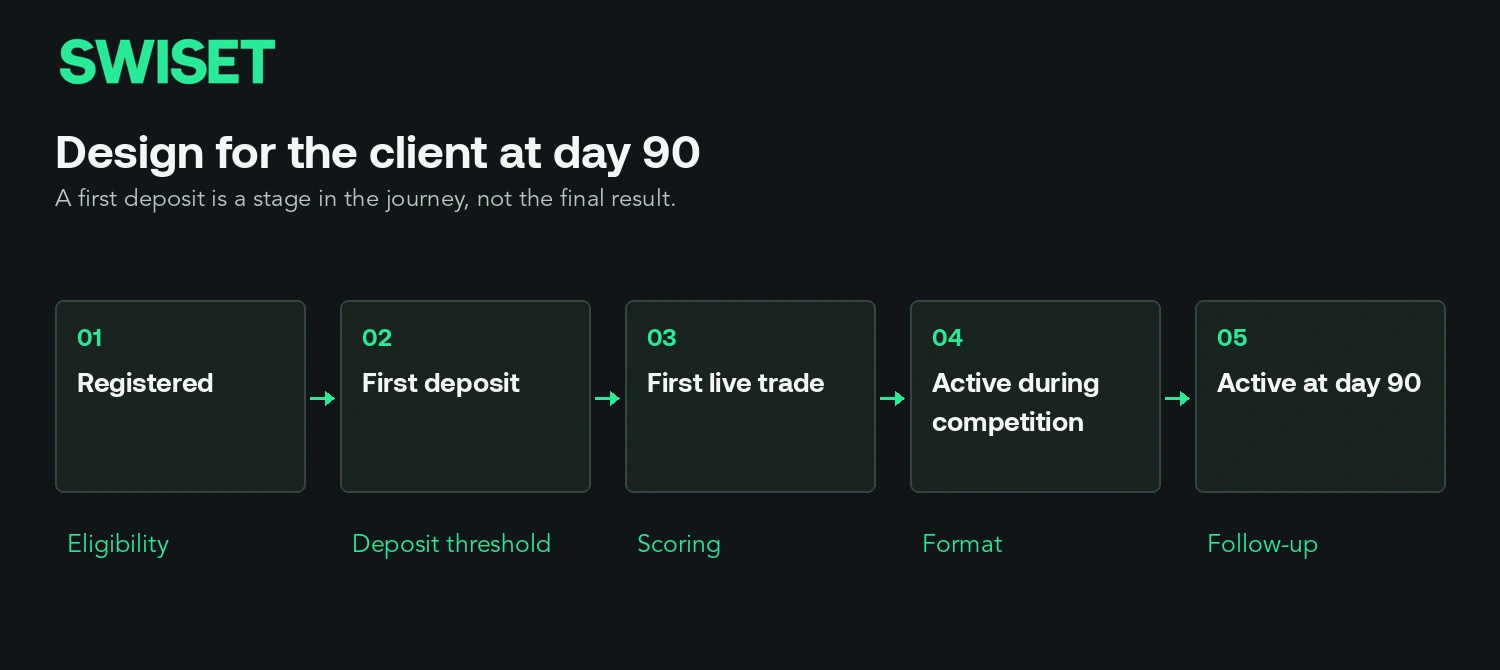
/What a first-deposit trading competition is for
A first-deposit trading competition is a live trading competition where taking part requires a first deposit into a real account, and the main goal is to turn registered but unfunded clients into funded, trading clients. That makes it different from a demo trading competition, which lowers the barrier to trying the platform, and from a competition for existing clients, which aims to increase activity.
Being explicit about the goal shapes every other decision. If the aim is first deposits from recent registrations, your audience, message and timing differ from a campaign aimed at reactivating clients who funded a year ago and stopped. Trying to do both in one competition usually means doing neither well. Our article on whether your trading competition will get you traders, not just sign-ups explains why the stage you target matters more than participation numbers.
/Choose the client you want before the prize
Start with the profile of the client you want to fund: the markets they trade, the deposit range that makes them sustainable for your business, their experience level and the regions you are allowed to market to. Then work backwards.
A competition built around gold and indices, with a moderate entry threshold and a multi-week format, attracts a different client from a one-week forex sprint with a very low threshold. Neither is wrong, but only one of them matches your target. A useful test is to imagine the winner and the median participant: would you be happy to have both as long-term clients? If the median participant is someone you would never otherwise market to, the design is pulling the wrong audience.
/Set eligibility and the deposit threshold deliberately
Eligibility rules decide who can enter: new clients only, or existing clients who have never funded; specific regions; account types; the age and suitability checks your regulation already requires. Keep them consistent with your onboarding, so that anyone who can enter the competition can actually complete it.
The minimum deposit is the most sensitive lever. Too low and you get token deposits that never become trading accounts; too high and you exclude the clients you were trying to activate. Tie the threshold to the deposit range you identified for your target client, and be clear about whether the deposit must stay in the account during the competition, whether withdrawals disqualify and whether bonus funds are excluded. These rules belong in your competition terms and conditions, written before launch.
/Design scoring and format around the behaviour you want
Use scoring that doesn't reward excessive risk
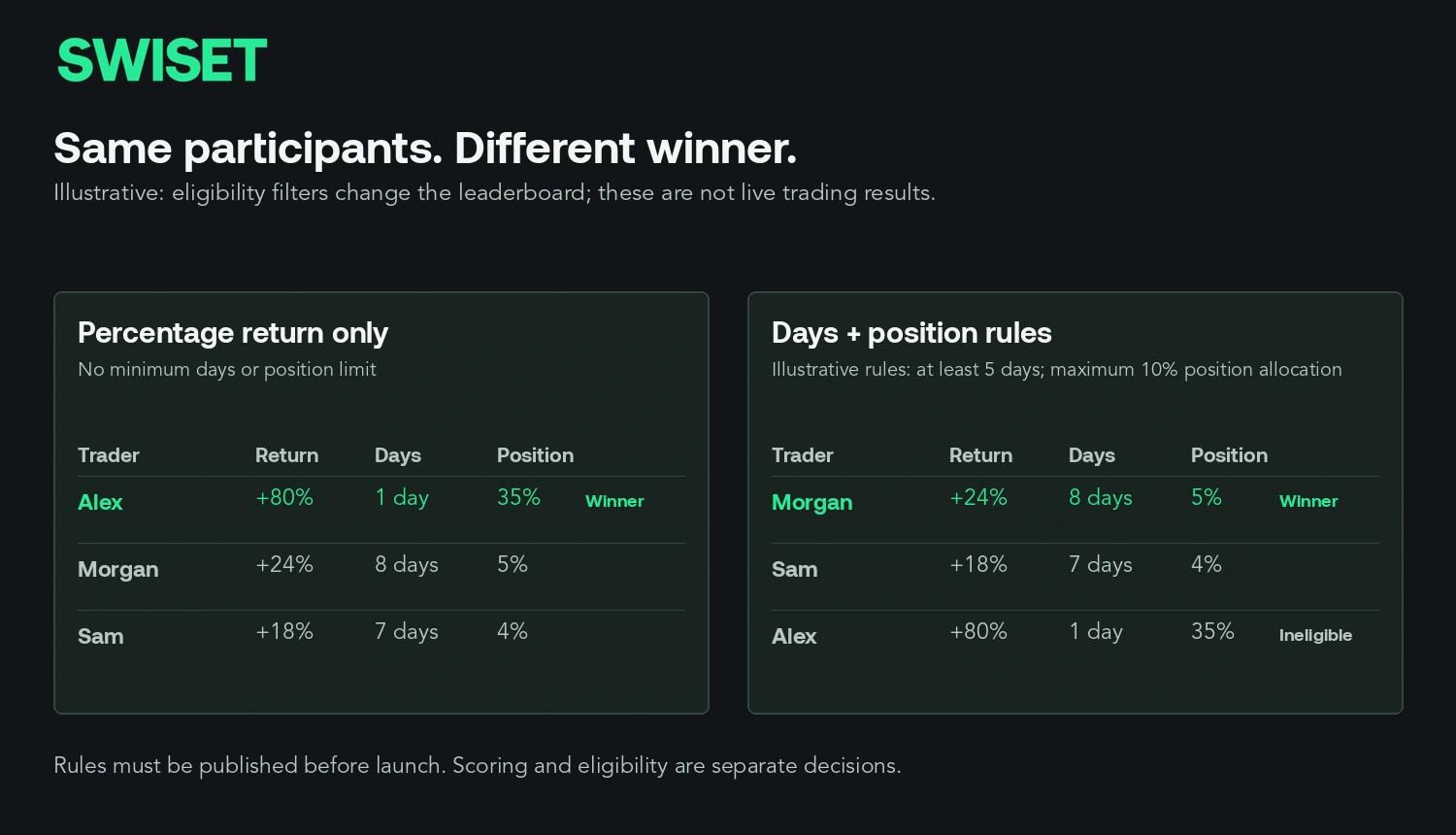
Ranking by percentage return is easy to explain, and it is often where problems start. With a small balance, a trader who takes one very large leveraged position and gets lucky can top the leaderboard. That rewards exactly the risk-taking you don't want new clients to learn on their first live account.
Alternatives exist. Ranking by risk-adjusted return, adding minimum trading days or a minimum number of trades, capping position size or leverage within the competition, limiting the instruments in scope or using a composite score all reduce the advantage of a single lucky trade. Each has trade-offs in simplicity and fairness; our guide to trading competition scoring methods compares what each one rewards. Whatever you choose, show participants their position and the rules in real time, and disqualify by rule, not by judgement after the fact.
Choose a format and duration that build a habit
A one-week competition creates urgency and is simple to run. It also ends just as a new client is getting used to the platform. Multi-stage or recurring formats keep people trading over several weeks, with qualification stages or monthly leaderboards giving them a reason to come back.
For a first-deposit campaign, a useful pattern is a short entry window followed by a longer trading period, with intermediate milestones, such as a minimum number of trading days or a volume milestone, that reward regular activity rather than one session. Regional formats help when your client base spans markets with different trading hours or instruments.
/Check whether prizes count as incentives
This is the step marketing teams most often leave to the end, and it should come first. In many jurisdictions, giving retail clients benefits to encourage them to trade leveraged products such as CFDs is restricted, and regulators may look at a competition prize the same way they look at a bonus or a gift.
The rules that apply depend on where your firm is authorised and where you market, and they differ in detail from one regulator to another. Competitions are not prohibited by definition, but the prize structure, the eligibility rules and the campaign messaging all need a compliance review for each jurisdiction before the creative is produced, not after. Our comparison of trading competitions and deposit bonuses looks at how the two mechanisms differ in engagement; whether either is permitted in your markets is a question for your compliance team.
/Plan what happens after the leaderboard closes
Most first-deposit competitions are designed up to the final ranking and stop there. But the campaign succeeds or fails in the weeks afterwards, when participants decide whether to keep trading without a prize to chase.
Plan the follow-up before launch: what participants receive when the competition ends (a summary of their trading, an invitation to the next round, educational content linked to the instruments they traded), how your retention team segments them, and what your IBs or account managers do with the participants they brought in. If you run the competition through IBs, giving each partner visibility into their own participants' activity makes this much easier; see our guide to IB trading competitions.
/Measure each stage separately
A first-deposit competition produces several numbers that are easy to confuse. Keep them apart.
| Stage | What to measure | What it tells you |
|---|---|---|
| Reach | Eligible clients who saw the campaign; competition registrations | Whether the message reached the right audience |
| Conversion | First-time deposits linked to the competition; deposit amounts versus your target range | Whether the offer moved the stage you targeted |
| Activation | First live trades; active trading days during the competition | Whether new funders actually trade |
| Behaviour | Instruments traded; consistency; disqualifications by rule | Whether the rules attracted the trading you wanted |
| Retention | Participants still active 30, 60 and 90 days after the end, compared with similar clients who did not take part | Whether the campaign created clients or a spike |
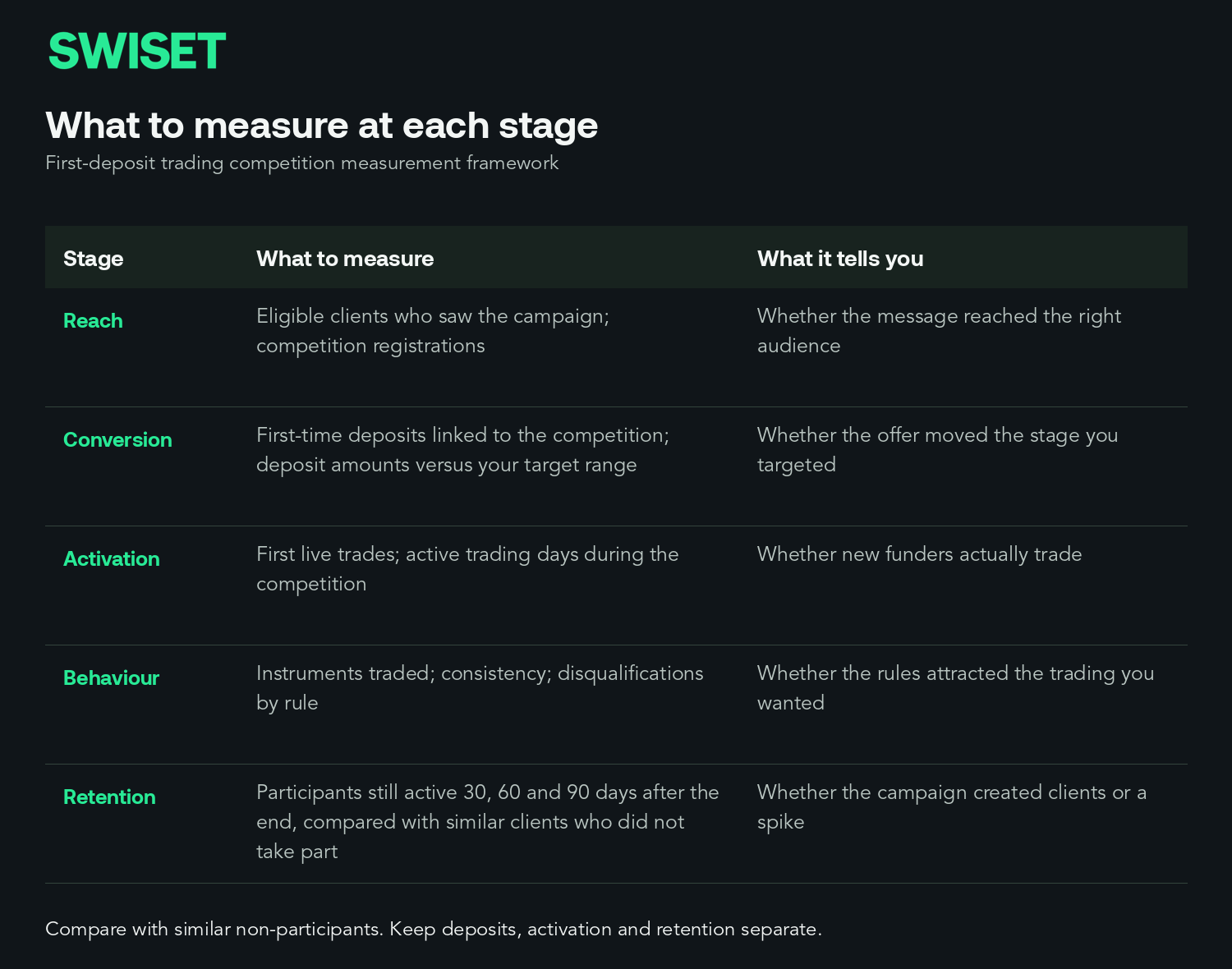
The last row decides whether to run the campaign again. Compare participants with a similar group of clients who did not take part, so you don't credit the competition with deposits that would have happened anyway. Our framework for trader performance analytics covers how to segment traders once they are active.
/Common mistakes
Most problems come from designing for the leaderboard instead of the client: choosing the prize before the target client, setting the minimum deposit so low that it attracts token funding, ranking on raw percentage return with no limit on risk, and running a one-week sprint with nothing planned for week two. The rest come from process: leaving the compliance review of prizes until the creative is done, counting first-time deposits as the result without looking at first trades or activity a month later, and crediting the campaign with deposits that would have happened anyway.
/Checklist: your first-deposit competition
- Can you describe the client you want to fund, and would you be happy with the median participant as a long-term client?
- Are eligibility rules consistent with your onboarding and regulatory requirements?
- Is the minimum deposit tied to your target client's range, with clear rules on withdrawals and bonus funds?
- Does the scoring method limit the advantage of a single high-risk trade?
- Does the format reward trading over several weeks, not one session?
- Has compliance reviewed prizes, eligibility and messaging for every jurisdiction you market to?
- Is the post-competition follow-up planned and assigned?
- Will you measure deposits, first trades, active days and retention at 30 to 90 days separately, against a comparison group?
/Where Swiset fits
Swiset provides technology for brokers to run branded live trading competitions, including first-deposit competitions. Brokers can configure eligibility requirements, deposit criteria, rules, prizes and duration, and use mechanics such as minimum deposit requirements, minimum trading days, trading-volume milestones, qualification stages, instrument and risk rules and automated disqualifications, with live leaderboards for participants. Scoring can use methods such as percentage or absolute PnL, equity growth, volume, Sharpe ratio or a composite score. Campaign analytics cover first-time deposits, first live trades, active trading days, lots traded, preferred instruments, consistency and participation, and the platform integrates with MT4, MT5 and cTrader.
In practice, a growth team can use the questions in this guide to design the campaign, then configure the same rules in Swiset so that enforcement, the leaderboard and reporting work from one setup. Target clients, prize budgets and compliance decisions remain each broker's responsibility. Swiset is a technology provider, not a broker. See how it fits your wider broker technology stack.
/Conclusion
A first-deposit competition is one of the few campaigns that can move registered clients to funded ones with a clear, time-bound reason to act. It only builds your business if the clients it attracts are the ones you want, the rules reward the trading you want them to learn, compliance has cleared the prizes and someone owns what happens after the final ranking. Design for the client on day 90, not for the leaderboard on day 7.
If you are planning a live competition around first-time deposits, plan a first-deposit competition with Swiset.
Plan a first-deposit competition with Swiset
Discuss your target clients, competition rules and measurement plan with the Swiset team.
Book a Demo/Related posts
- Your Trading Competition Will Get Signups. Will It Get You Traders?
- Trading Competition Scoring Methods: What Each One Actually Rewards
- Trading Competition Terms and Conditions: What Brokers Must Define Before Launch
- IB Trading Competitions: A Broker's Guide to Activating and Retaining Referred Traders
FAQs
What is a first-deposit trading competition?
A live trading competition where entry requires a first deposit into a real account, designed to turn registered but unfunded clients into funded, active clients.
Do trading competitions increase first-time deposits?
They can give unfunded clients a reason to deposit, but results depend on the audience, the deposit threshold, the scoring and the follow-up. Measure deposits, first trades and activity after the campaign separately, against a comparison group.
What minimum deposit should a live trading competition require?
There is no standard figure. Tie it to the deposit range of the client you want to attract; very low thresholds tend to produce deposits that never become trading accounts.
How should a live trading competition be scored?
Use a method that limits the advantage of a single high-risk trade, such as risk-adjusted return, minimum trading days or position limits, and show participants their ranking and the rules in real time.
Are trading competition prizes allowed for retail CFD clients?
It depends on where your firm is authorised and where you market. Many regulators restrict benefits linked to the marketing of leveraged products, so review prizes, eligibility and messaging with compliance for each market before launch.
How long should a first-deposit competition run?
Long enough to build a trading habit. A short entry window followed by a multi-week trading period with milestones usually serves activation better than a single one-week sprint.