Trading Competition Terms and Conditions: What Brokers Must Define Before Launch
Your competition terms are the product spec. Write them before the campaign, configure them exactly as written and publish one version, or every gap becomes a dispute at prize time.
The campaign is live, the leaderboard is filling up and the first prize is already in the ads. Then the questions arrive. Can traders from this country join? Does the contest close at midnight UTC or at server time? Is a funded account prize something the winner can withdraw? Why was the trader in third place disqualified, and who decided?
If your terms and conditions don't answer those questions, your support team will, one ticket at a time, and the answers will not always match. That is how a competition built to win trust ends with a public dispute in the week it gets the most attention.
Precision matters even in well-run events. In November 2026, Finance Magnates reported on a free education programme ending in a demo contest, noting that a promotional post gave a different end date from the event details, and that a large prize pool "consists of trading accounts rather than cash, according to the event page." Neither point is unusual. Both are exactly what traders read closely when prizes are at stake.
This guide is for marketing, growth and compliance leads at brokers. The short answer: trading competition terms and conditions should define, before launch, who can enter, the exact dates and time zone, how traders qualify and are ranked, which rules apply and what happens when they are broken, what each prize is and how it is delivered, how traders can appeal, and what you can change once the contest has started. Then your platform should enforce exactly that. This is practical guidance, not legal advice; your legal team should review the terms for every market you accept.
/Why trading competition terms are a product decision
Most brokers treat competition terms as legal boilerplate, written last and copied from the previous campaign. That is backwards. Every element of a competition that traders care about (who can join, how they win, what they get) is defined in the terms. If the terms are vague, the product is vague.
There is also an enforcement gap. Your terms describe the rules in words; your competition platform applies them in configuration. If the terms say "maximum drawdown of 10%" but don't say whether it is measured on balance or equity, or whether it resets daily, the platform will apply one interpretation and some traders will have assumed another. Write the terms in the same language your configuration uses, and check one against the other before you open registration.
/Eligibility and jurisdictions
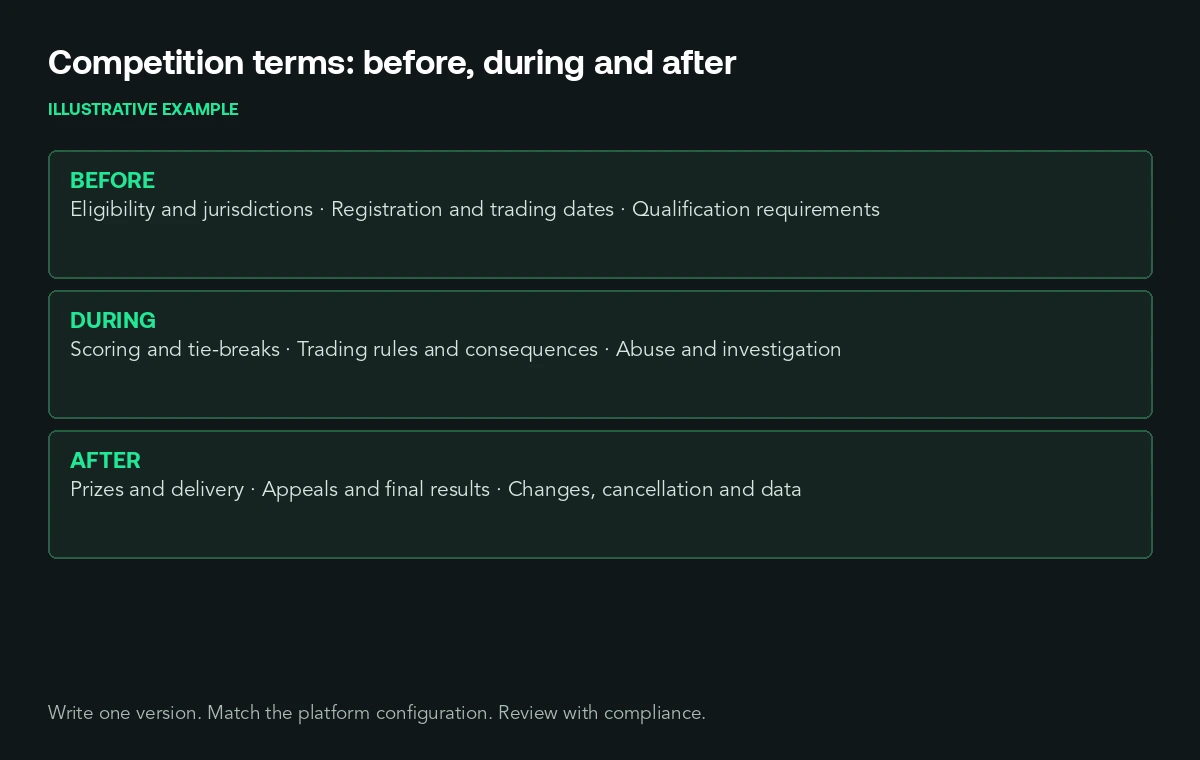
Start with who can enter. Define the minimum age, the countries and regions accepted or excluded, whether existing clients, new clients or both can join, whether employees, IBs and their relatives are excluded, and how many accounts one person can enter with.
For live competitions, eligibility is also a regulatory question. Whether you can promote a contest in a given country, offer prizes there or accept clients from there depends on your licences and on local rules on promotions and incentives. Live contests should be open only to eligible adults and remain subject to your account terms and risk controls. Decide the country list with compliance before marketing chooses where to advertise, not after.
/Dates, time zones and one source of truth
State the registration period, the trading period and the date results will be published, each with a time zone. If your trading server runs on a different clock from your marketing calendar, say which one governs. A trade opened at 23:55 on the last day needs a clear answer.
Then publish one version. Ads, social posts, emails and partner materials will all mention dates and prizes; the terms page should say it prevails over any other material, and your team should update every channel when something changes. A difference between a post and the terms is the first thing a disappointed participant will screenshot.
/Qualification, scoring and tie-breaks
Define what a participant must do to appear in the ranking: a minimum number of trades, minimum trading days, a minimum deposit for live contests, completed registration steps. Then define the ranking method precisely: percentage return, absolute profit, equity growth, volume or a composite score, and the moment it is calculated.
Most terms forget tie-breaks and edge cases. What happens if two traders finish with the same score? Are open positions at the close counted at market price, or excluded? Does a participant who withdraws funds during a live contest stay in the ranking? Our guide to trading competition scoring methods explains what each method rewards; the terms should then state the chosen one without room for interpretation.
/Trading rules and what happens when they're broken
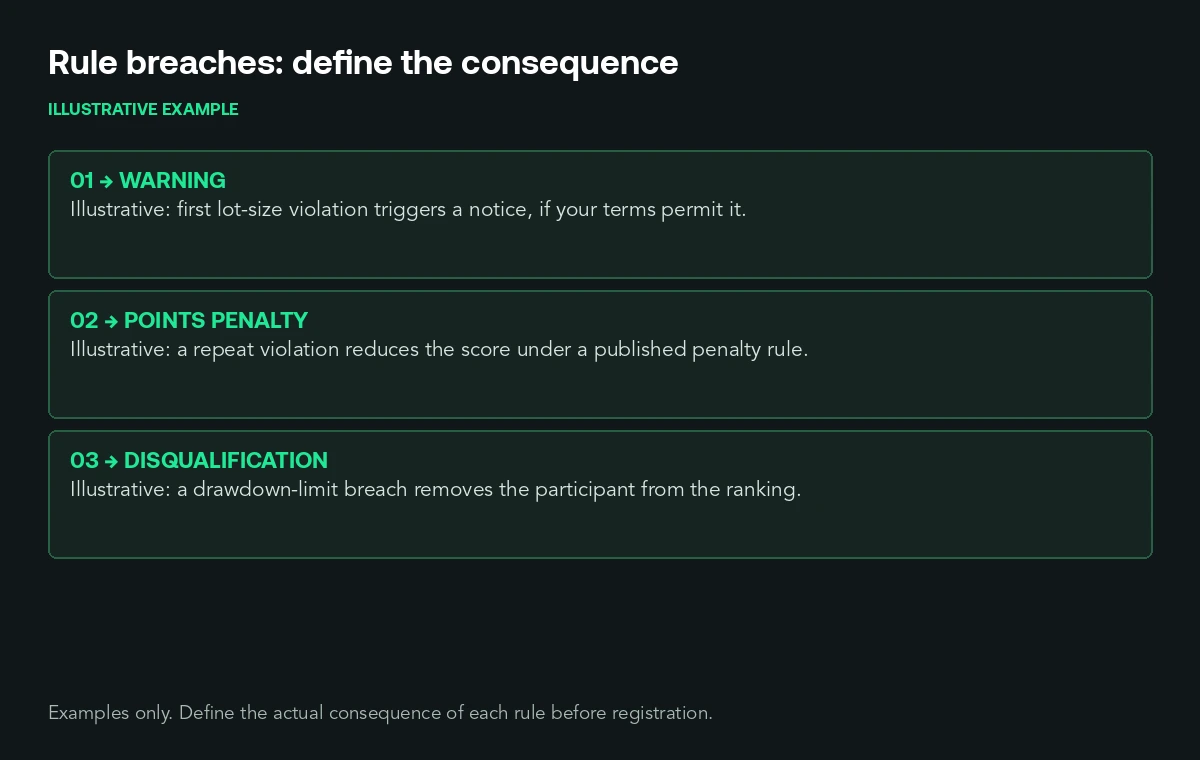
List the rules traders must follow: maximum drawdown, permitted instruments, lot size limits, trading hours, minimum holding time, news trading, expert advisors and copy trading between participants. For each rule, say what happens on a breach. Not every breach deserves the same response: a first lot-size violation might deserve a warning or a points penalty; exceeding the drawdown limit usually means disqualification.
Abuse needs its own clause. Competitions attract the same tactics prop firms see: several accounts operated by one person, opposite positions across accounts to guarantee one winner, copied trades between "independent" participants, and strategies that exploit price latency. Reserve the right to investigate and disqualify, describe the categories of behaviour you prohibit, and make sure your team can detect them during the contest, not only when the winners are announced. Our article on prop firm fraud detection covers why those decisions need human review before they become final.
/Prizes: say exactly what the winner gets
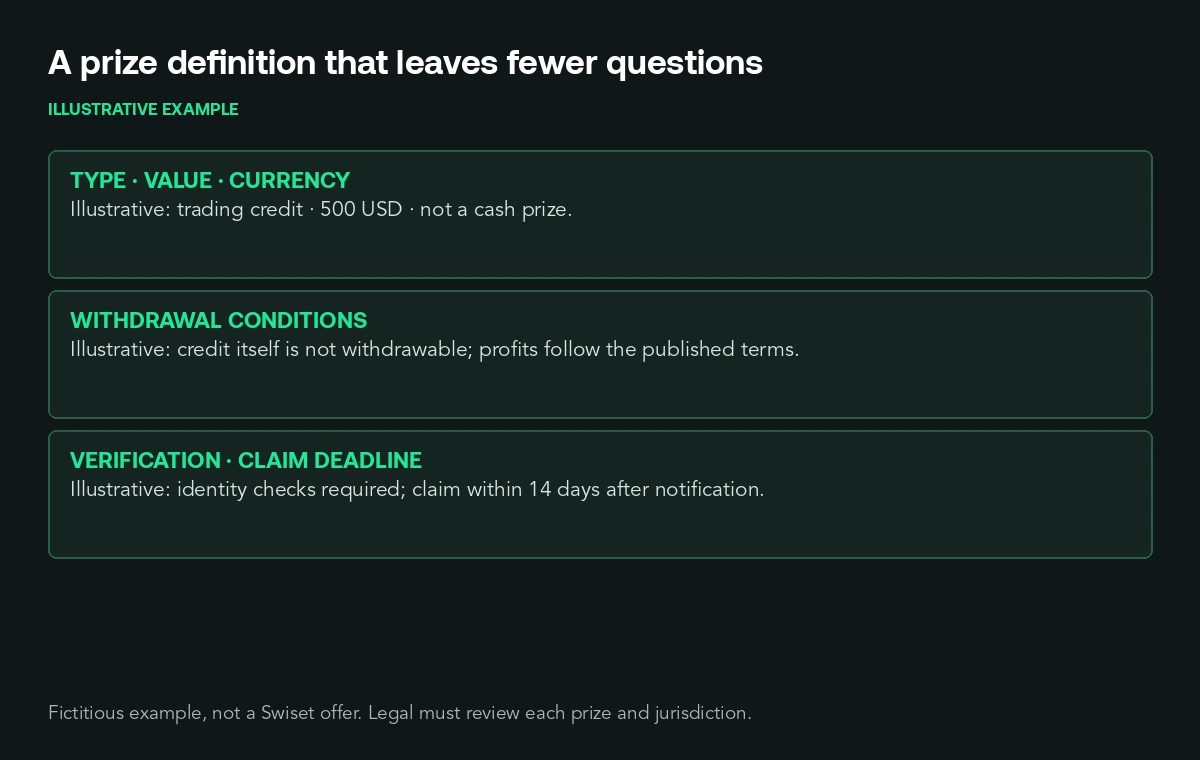
Prize wording causes more disputes than any other clause. For every prize, define what it is (cash, trading credit, a funded or prop account, a physical item), its value and currency, and the conditions attached. A trading credit that can only be withdrawn after a trading volume requirement is a different prize from cash, and the terms should say so. A funded account prize should state its size, its own rules and whether profits can be withdrawn.
Then define delivery: how winners are notified, which identity checks they must pass before receiving a prize, the deadline to claim it, how it is paid, who bears transfer costs, and what happens if a winner is ineligible or doesn't respond. If you run a draw in addition to a ranking, describe how it works and who supervises it. Taxes on prizes depend on the winner's country; at a minimum, say that the winner is responsible for their own tax obligations unless local rules say otherwise.
/Appeals and disputes
Automated enforcement is fast and consistent, which is why traders need a way to challenge it. Define how a participant can appeal a disqualification or a ranking, the deadline to do so, who reviews the appeal and when the decision is final. Publish final results only after the appeal window closes, or say clearly that results are provisional until then.
An appeal process protects you as much as the trader. It turns "you stole my prize" into a documented review with a timeline, and it gives your team a reason to keep the evidence behind every disqualification.
/Marketing, risk messages and simulated results
The terms govern the contest; your marketing governs how traders perceive it. Gamified features change behaviour: a 2024 FCA research note tested features such as leaderboards and prize draws in trading apps and found they could change how often people traded and the risk they took. The note says it may not represent the FCA's position, but the point is relevant for any broker using rankings and prizes.
In practice: keep risk warnings visible next to prizes and leaderboards, avoid implying that a demo ranking predicts live results, and be careful with rewards that encourage trading volume for its own sake. Where your marketing reaches US residents, simulated performance carries specific disclosure language (CFTC Rule 4.41 is the reference many firms use). Your compliance team should own this section with marketing, not after it.
/Changes, cancellation and data
Reserve the right to amend or cancel the contest in defined circumstances (technical failures, abuse, regulatory changes) and say how participants will be informed. Avoid open-ended discretion: "we may change any term at any time" invites distrust and may not hold up in every market. State how participants' data will be used, including whether winners' names or nicknames will be published on leaderboards, and link to your privacy notice.
/Common mistakes
Copying last campaign's terms without checking the new format. Publishing dates without a time zone. Describing prizes by headline value without conditions. Defining rules in words that don't match the platform's configuration. Treating every breach with disqualification, or with nothing. Having no abuse clause until an abuse case appears. Announcing winners before an appeal window. Letting ads, posts and the terms page drift apart. Choosing target countries for the campaign before compliance has approved them.
/Checklist: trading competition terms and conditions
- Is eligibility defined: age, countries, client type, excluded persons and accounts per person?
- Are registration, trading and results dates stated with a time zone, and does the terms page prevail over other materials?
- Are qualification requirements, the scoring method, the calculation moment and tie-breaks defined?
- Is every trading rule listed with the consequence of a breach (warning, penalty or disqualification)?
- Is there an abuse clause covering multiple accounts, hedging across accounts, coordinated copying and latency exploitation?
- Is every prize defined by type, value, currency, conditions and delivery, including identity checks and claim deadline?
- Is there an appeal process with a deadline, a reviewer and a final decision date?
- Are risk warnings visible next to prizes and rankings, and has compliance approved the marketing?
- Do the platform's configured rules match the terms word for word?
/Where Swiset fits
Swiset provides trading competition technology for brokers, with demo, live and combined formats. Teams can configure rules such as maximum drawdown and minimum trades, set entry requirements and participant limits, and choose how each breach is handled: a warning, a points penalty or disqualification. The platform includes an appeal system so traders can dispute automated disqualifications, suspicious activity detection for patterns such as copy trading, hedging abuse and latency arbitrage, with admin alerts and violation reports, and connections to payment gateways for prize distribution. Live competitions can be limited to eligible adults and remain subject to the broker's terms, risk controls and applicable regulations. In practice, a team can write its terms with the checklist above and configure the same rules in the platform, so what traders read and what the system enforces match. The terms themselves, eligible markets and prize policies remain each broker's decisions. Swiset is a technology provider, not a broker.
/Closing
A competition is judged at the end, when prizes are paid and rankings are final. The terms decide whether that moment builds trust or starts a dispute. Write them before the campaign, in the same language your platform uses for its rules, with clear prizes, consequences and an appeal path, and publish one version that every channel points to. If you are planning a demo or live competition and want to see how rules, enforcement, appeals and prize distribution can be set up together, plan your next competition with Swiset.
Plan your next competition with Swiset
Review how rules, enforcement, appeals and prize distribution fit together.
Book a DemoFAQs
What should trading competition terms and conditions include?
Eligibility, dates with a time zone, qualification and scoring rules, trading rules with the consequence of each breach, an abuse clause, prize definitions and delivery conditions, an appeal process, rules for changes or cancellation, and data use.
Can a broker disqualify a trading competition participant?
Yes, if the terms define the rules, the behaviours that lead to disqualification and how the decision is made. An appeal process makes those decisions easier to defend.
Are demo trading competitions regulated?
It depends on the market and on how the contest is promoted and rewarded. Prizes, marketing and the link to live accounts can bring promotion and conduct rules into play. Check with compliance for each country you target.
Should a funded account count as a prize?
It can, as long as the terms state its size, its rules and whether and when profits can be withdrawn, so winners don't expect cash.
How do you prevent abuse in a trading competition?
Limit accounts per person, prohibit hedging across accounts and coordinated copying in the terms, monitor for those patterns during the contest and review flagged cases before results are final.