IB Trading Competitions: A Broker's Guide to Activating and Retaining Referred Traders
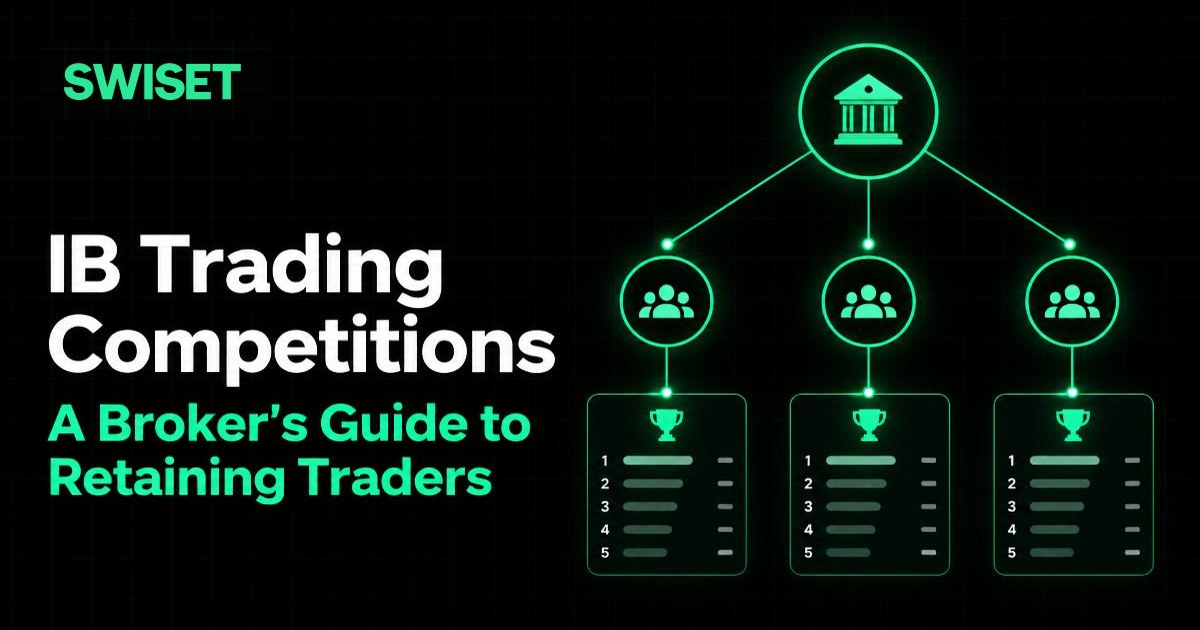
Most brokers measure an IB by what arrives: referrals, first deposits, early volume. Far fewer measure what happens in the weeks after. A referred trader opens an account, makes a deposit, trades a few times and goes quiet. The IB, who owns the relationship, has little to offer beyond a reminder, and the broker has little to offer the IB except a commission report.
Trading competitions look like a natural fix. They give the IB a reason to talk to their audience every week and give the trader a reason to come back. But a competition run by an IB is also a promotion carrying your brand, your rules and your risk. This guide is for brokers who want IB trading competitions to activate referred traders without handing control of the experience to someone else. It covers what to decide, what to delegate and what to measure.
/The short answer
An IB-led competition works when the broker sets the frame and the IB runs the community. The broker decides the objective, the rules, the prizes, the scoring method and what traders are offered when the contest ends. The IB decides who to invite, how to promote it and how to keep the group engaged. Measure results by referral source, not by total participants, so you can see which IBs produce traders who stay active and which only produce entries. Review the promotion and prize design with your compliance team before launch, because requirements vary by jurisdiction.
/Why referral volume and referred-trader retention are different problems
An IB program usually grows by adding referrals. Retention is a separate problem with a separate owner. The broker controls the product and the rules; the IB controls the audience and the conversation. When a referred trader stops trading, neither side sees it quickly: the broker sees an inactive account, the IB sees a lower commission, and each assumes the other is responsible.
A competition changes who has something to say. It gives the IB a scheduled event, a leaderboard to discuss and a result to celebrate. It gives the broker a structured way to bring a referred trader back to the platform. That only helps if both sides agree on what the competition is for. A competition meant to re-activate dormant referrals needs different rules from one meant to introduce new ones.
A competition does not retain traders. A clear next step after the competition does.
| IB goal | Format that usually fits | What the broker should control |
|---|---|---|
| Introduce new referrals to the platform | Demo competition with simple rules | Rules, branding, and the offer shown after the contest |
| Move demo participants to live trading | Hybrid competition | Scoring method and the path to a funded account |
| Re-activate existing referred traders | Live competition with a defined period | Prize structure, eligibility and risk limits |
| Reward a large IB's own community | Sub-competition inside the IB's network | Parameters, prizes and what is shown under your brand |
This is a starting point, not a benchmark. Your own funnel and the profile of each IB's audience decide the right mix.
/A broker's playbook for IB-led competitions
If your partner program still runs on manual reports, check first whether it has outgrown the spreadsheet. Then work through these five decisions.
01 Start with the objective, per IB
Different IBs bring different audiences, so the same competition will not serve all of them. Write one sentence for each IB or tier: what behavior do you want this competition to produce? A first deposit, a second week of trading, a return after a quiet month? If you cannot state it in one sentence, the format will not follow from it.
02 Decide what the broker controls and what the IB controls
Draw the line before the first event. The broker sets the rules, scoring method, prize pool and branding. The IB sets the invitation list, the promotion and the community around it. Brokers using Swiset keep control over competition parameters, prizes and branding for each IB space, according to Swiset's broker page. Whatever tooling you use, write the split down, so an IB cannot promise a prize you did not approve.
The broker defines
Objective, rules, scoring method, prizes and the next step after the contest.
The IB defines
Who is invited, how the competition is promoted and how the community stays engaged.
Both review
Results by referral source, so the next event improves on the last one.
03 Choose the format and the scoring that match the goal
Demo competitions suit introduction. Live competitions suit retention. Hybrid formats suit conversion between the two. The scoring method matters as much as the format: a leaderboard based on raw profit rewards the largest risk, while one based on risk-adjusted return rewards consistency. We cover this in detail in our guide to what each scoring method actually rewards.
04 Plan what happens after the leaderboard closes
The weeks after a competition decide whether it retained anyone. Before launch, define the next step for each type of participant: the finalist, the mid-table trader, the one who dropped out on day three. That step might be a follow-up event, a feedback message, an offer or a conversation with the IB. Without one, participants leave when the leaderboard does. Our earlier piece on whether a competition gets you signups or traders explains why this stage matters most.
05 Measure by referral source
Total participants tell you attention. They do not tell you which IB's audience stayed. Track entrants, active trading days after the event, deposits and retention separately, and break each one down by referral source. That view lets you compare IBs on the traders they activate, not just the traders they bring, which connects directly to how you structure partner rewards as covered in our article on IB rebate income and client retention.
/Design for the trader, not only for engagement
Engagement features can change how people trade, not only how often they log in. The FCA published a research note on digital engagement practices in trading apps in June 2024, based on an online experiment with more than 9,000 consumers. It tested features including leaderboards, points and prize draws, and found that such practices can change both trading frequency and investment risk. The note does not state its scope as CFD or forex trading, and it does not represent the FCA's position, so treat it as a reason to design carefully, not as a rule that applies to your business.
For a broker working with IBs, the practical lesson is about incentives. A prize that rewards the highest profit invites the riskiest behavior, and an IB with a commission stake has a reason to promote it enthusiastically. Choose scoring that rewards discipline, set sensible limits in the rules, avoid language that suggests guaranteed outcomes and review the promotion and prize design with compliance in your jurisdictions.
/A diagnostic checklist before an IB runs a competition
Answer these about your current setup. Each "no" is a gap to close before launch.
- Can you state, in one sentence, what behavior this competition should produce for this IB's audience?
- Are the rules, scoring method and prizes set by you, and written down where the IB cannot change them?
- Do you know what a participant is offered the day after the competition ends?
- Can you report entrants, active days, deposits and retention by referral source?
- Has compliance reviewed the promotion, prize design and IB messaging for each jurisdiction you serve?
/Common mistakes
- Letting each IB write their own rules. Inconsistent rules produce disputes you have to settle under your brand.
- Rewarding raw profit. It teaches referred traders that the way to win is to take the most risk.
- Counting entries as success. Participation measures attention. Retention shows up in the weeks that follow.
- Running the event without a next step. Participants who finish are your warmest audience, and the energy fades quickly if nothing follows.
If you cannot compare two IBs by what their referred traders did after the competition, you ran an event, not a program.
/Where this fits for a broker lead
If you manage an IB program at a broker, the question is whether you can run competitions with your partners without losing control of the rules, the brand or the data. That is the use case behind Swiset's competition tools for brokers. According to Swiset's competitions page, IBs and affiliates can create sub-competitions within their own networks, with referral and participant-source tracking, while brokers configure rules, scoring methods, prize pools and white-label branding. Competition analytics track deposits, volume, retention and engagement, and competitions connect to MT4, MT5 and cTrader.
In practice, that means an IB can run an event for their audience inside a framework you set, and you can see the results by source. The expected benefit is more control over the trader experience and a clearer view of which partners activate traders. Your team still defines the objective, the rules and the follow-up, and the quality of the program depends on those choices. Swiset is a technology provider, not a broker. For the partner side of the program, see Swiset for IBs and communities.
/Closing
Referrals are the start of the relationship, not the end of it. Competitions give IBs and brokers a shared reason to bring traders back, but only when the broker defines the frame, designs for trader behavior and measures by source. Start with the checklist above: your first "no" tells you what to fix before the next event.
Design an IB competition program that retains traders
Walk through your IB structure, your objectives and your rules with the Swiset team to see how IB-led competitions could fit your program.
Book a DemoFAQs
Should a broker let IBs run their own trading competitions?
It can work if the broker sets the objective, rules, scoring and prizes, and the IB runs the invitation and the community. Without that frame, rules and promises drift between IBs, and the broker carries the risk.
Which type of competition is best for referred traders?
It depends on the goal. Demo competitions suit introduction, hybrid formats suit moving traders toward live accounts, and live competitions suit retention. Match the format to the behavior you want from each IB's audience.
How do you measure whether an IB competition worked?
Track entrants, active trading days after the event, deposits and retention as separate measures, broken down by referral source. Compare IBs on what their referred traders did afterward, not on how many entered.
Do IB trading competitions create regulatory risk?
They can, depending on how prizes, promotions and incentives are designed and promoted. Requirements vary by jurisdiction, so have compliance review the design and the IB's messaging before launch.
Related posts
Prop Firm Customer Support: What Your Tickets Are Telling You
October 19, 2026
How Introducing Brokers Can Increase Their Rebate Income Without Burning Through Their Client Base
October 14, 2026