Running a Futures Prop Firm: Five Design Decisions Before You Launch
A founder decides to launch a futures prop firm and starts where most people start: by reading how other firms set up their challenges. Profit target, drawdown, contract limits. Within a week there is a rulebook that looks like everyone else's. Then the operational questions arrive. Is the drawdown measured on closed trades or on open equity? What happens to a position held through the end of a session? Which system actually knows the answer, and can your team check it at three in the morning?
Copying a rulebook is easy. Operating one is where a futures prop firm is won or lost, because every rule becomes a calculation that someone, or something, has to run on live data. This article is for founders and operations leads planning or running a futures prop firm. The short answer: treat the evaluation model as five design decisions, write each as a rule a system could check, and confirm that your trading platform and data sources can supply what the rule needs.
/The short answer
A futures prop firm sells access to funded trading accounts after a trader passes an evaluation. The firm's real product is the rulebook and the operation that enforces it. Five decisions shape that operation: how drawdown is measured, how position size is limited, how sessions and time are handled, where the data comes from, and how payouts are verified. Make each decision explicitly, in writing, before you sell the first challenge. A rule you cannot measure on your own data is a dispute waiting to happen, and automation will only apply that dispute faster.
/Why copying another firm's rulebook is the wrong starting point
A rulebook is the visible tip of an operating model. Two firms can publish similar profit targets and still run very different businesses, because they differ in what they are trying to measure, how much risk they are willing to fund, and what their systems can verify. A rule that is easy to explain on a website may be hard to compute, and one that is easy to compute may not measure what you care about.
A rule is only as good as the data behind it and the clarity of its definition.
The sequence matters. Decide what the evaluation should prove about a trader, then pick the rules that measure it, then check that your platform and data can supply the numbers. Reversing that order is how firms end up with rules their own team applies differently.
/Five decisions that define a futures prop firm
Each decision below should end as a written rule, an owner and a data source. Treat the table as a starting point, not a benchmark.
| Decision | Question to answer | Where it usually goes wrong |
|---|---|---|
| Drawdown | Measured on closed results or open equity? Fixed or trailing? Reset when? | Two definitions in circulation: the website's and support's |
| Position size | Limit by contracts, by exposure or by risk per trade? | Limits written for one contract and unclear for another |
| Sessions and time | What happens at session close, over holidays, at contract rollover? | Rules silent on positions held between sessions |
| Data and platform | Which system holds the account data the rules read? | The rule exists but the data arrives late or incomplete |
| Payouts | Which checks run before payment, and in what order? | Eligibility confirmed by hand from several tools |
01. Drawdown: define the measurement, not only the number
"Maximum drawdown" is not a rule until it says what it is measured on and when it resets. Closed-trade drawdown and open-equity drawdown produce different verdicts on the same account, and a trailing limit behaves differently from a fixed one. Choose the version that matches the risk you want to fund, then write the measurement, the moment it is evaluated and what happens when it is breached. If a trader, a support agent and a risk analyst would not reach the same verdict on one account, the rule is not finished.
02. Position size: pick the unit that fits the instruments you list
Futures are traded in contracts, and contract specifications differ by instrument. A limit written as "maximum contracts" can mean very different exposure from one product to the next. Decide whether you limit by contract count, by notional exposure or by risk per trade, and state how the limit applies when a trader scales in or holds several products at once. Keep it simple enough that a trader can check it before placing the order, not after a breach notice.
03. Sessions and time: write down the edges
Markets have sessions, holidays and contract expiries, and your rules touch all three. Decide what is allowed over the close, over weekends and holidays, and around contract rollover. Fix the time zone in which daily limits are calculated. These are the edges where a perfectly ordinary account produces an unexpected rule outcome, and where support tickets tend to start — see what your support tickets are telling you. This article does not specify what a good answer is; it says each edge needs one, in writing.
04. Data and platform: the rule can only see what the platform exposes
Every rule above reads account data: fills, positions, balances, timestamps. Before finalizing a rule, confirm which system supplies that data, how quickly, and how complete it is. If your enforcement runs on a different system from the one the trader trades on, define the integration path: where the data originates, what reads it, and what acts on a breach. A rule that depends on data you receive late is a rule you enforce late, and traders will notice.
05. Payouts: a chain of checks, not a transfer
A payout request is a set of decisions: has the account met the conditions, does identity match, did anything breach a rule that was missed in real time, what is owed under the profit split, and how is it paid. Put each check in writing and decide which are automatic and which go to a person with evidence attached. The more precisely drawdown, size and session rules are defined, the more of the payout chain can run without manual review.
/Is your futures prop firm ready to enforce its own rules?
Five questions, one per decision. If you answer "it depends who you ask" to any of them, fix that before launch:
- Can you state your drawdown measurement and reset moment in two sentences, and would your support team repeat them identically?
- Does every position-size limit say what it applies to, for every instrument you list?
- Is there a written answer for what happens at session close, over holidays and at rollover?
- Can you name the system that supplies each rule's data and how quickly it arrives?
- Do you have a written payout checklist with an owner for each step?
/Common mistakes
- Publishing a rule you cannot compute. The rule reads well on the website but the platform does not expose the data. Check feasibility before publishing.
- Leaving consequences unwritten. A breach with no defined outcome becomes a judgment call, and judgment calls become disputes.
- Ignoring the edges. Sessions, holidays and rollover are rare but memorable. Define them once, up front.
- Detecting too late. Checking at payout time penalizes an issue from week one in week five. Monitoring continuously avoids that.
- Automating before defining. An engine that enforces an ambiguous rule enforces the ambiguity at scale.
That last mistake is also the signature of an infrastructure built only to launch.
Automation applies your rulebook faster. It does not fix it.
/Where this fits for a prop firm lead
For a firm that has made the five decisions, the next question is how to enforce them without a growing manual queue. Swiset's prop firm infrastructure includes a challenge and evaluation engine that enforces drawdown, breach and consistency rules automatically across every challenge phase, using the rules your firm defines. It also includes risk management with continuous position monitoring and daily loss and maximum drawdown limits, and automated payouts and KYC, covering performance verification and profit-split calculation. Swiset connects with existing trading infrastructure rather than replacing it, and lists MT4, MT5, cTrader, TradeLocker and BlackArrow among its integrations.
In practice that means a firm can write its rules once and have the same account data drive monitoring, breach decisions and payout checks, instead of copying results between tools. The expected benefit is consistency and a record of why each decision was made. Which trading platform and data source your futures accounts run on, and how each rule maps to them, is something to confirm in the design conversation rather than assume. Swiset is a technology provider, not a prop firm or a broker, and your firm remains responsible for its rules, its terms and its compliance in the jurisdictions where it operates.
/Closing
A futures prop firm is a rulebook plus the operation that enforces it. Make five decisions in writing, check that your data can support them, and keep people on the cases that need judgment. When the decisions are made, move on to the prop firm launch checklist. The firms that struggle are rarely missing a rule; they are missing a definition.
Pressure-test your futures prop firm design
Bring your drawdown, sizing, session and payout rules and walk through how each would be enforced on your platform.
Book a DemoFAQs
What is a futures prop firm?
A futures prop firm evaluates traders on futures markets and, when they pass, gives them access to funded accounts under the firm's rules and profit-split terms. The firm's terms, not the market, define what a trader must do to qualify and to be paid.
What rules does a futures prop firm need to define?
At minimum: how drawdown is measured and reset, how position size is limited, how sessions, holidays and contract rollover are handled, and what checks precede a payout. Each should be written so it can be measured on your account data.
How do you start a futures prop firm?
Define your evaluation model and rules, confirm the trading platform and data that will supply them, set up identity verification and payout processes, and test the full trader journey end to end. Legal structure and requirements depend on your jurisdiction and should be confirmed with qualified advisers.
Can a prop firm technology provider support futures?
It depends on the provider and the platform your accounts run on. Ask which trading platforms and data sources are supported for futures accounts, and how rules are read from them, before committing.
Related posts
IB Trading Competitions: A Broker's Guide to Activating and Retaining Referred Traders
October 20, 2026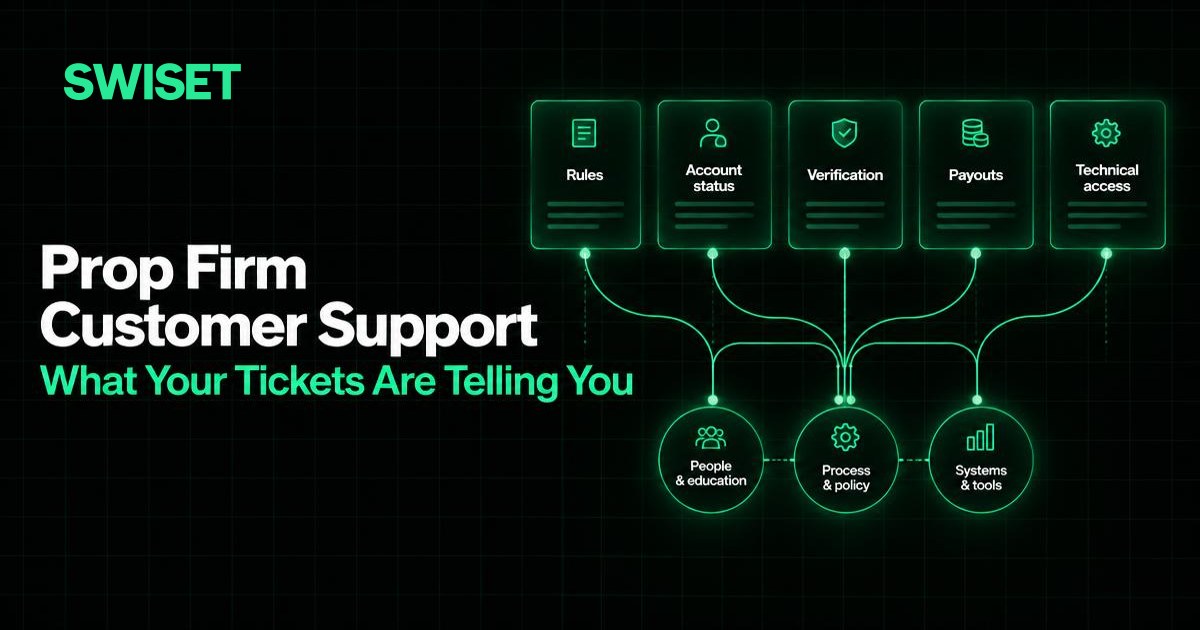
Prop Firm Customer Support: What Your Tickets Are Telling You
October 19, 2026