How to Choose a Prop Firm Technology Provider: 10 Questions to Ask Before You Sign
Most provider proposals look alike on the feature list. The differences that decide whether your firm can grow, change course or leave show up in the questions most founders don't ask until it's too late.
Every prop firm technology provider will show you a challenge builder, a trader dashboard, KYC, payouts and a promise that you can launch quickly. On a comparison spreadsheet, three proposals can look almost identical, and the decision ends up being made on the entry price.
The differences appear later. Your next challenge model needs a rule the engine doesn't support. A trading platform changes its terms and you have nowhere to move traders. A feature you assumed was included arrives with a new invoice. Or you decide to leave and discover that your trader data isn't as portable as you thought.
This guide is for founders and CEOs of prop firms choosing a technology provider for the first time, or reconsidering the one they have.
/Short answer
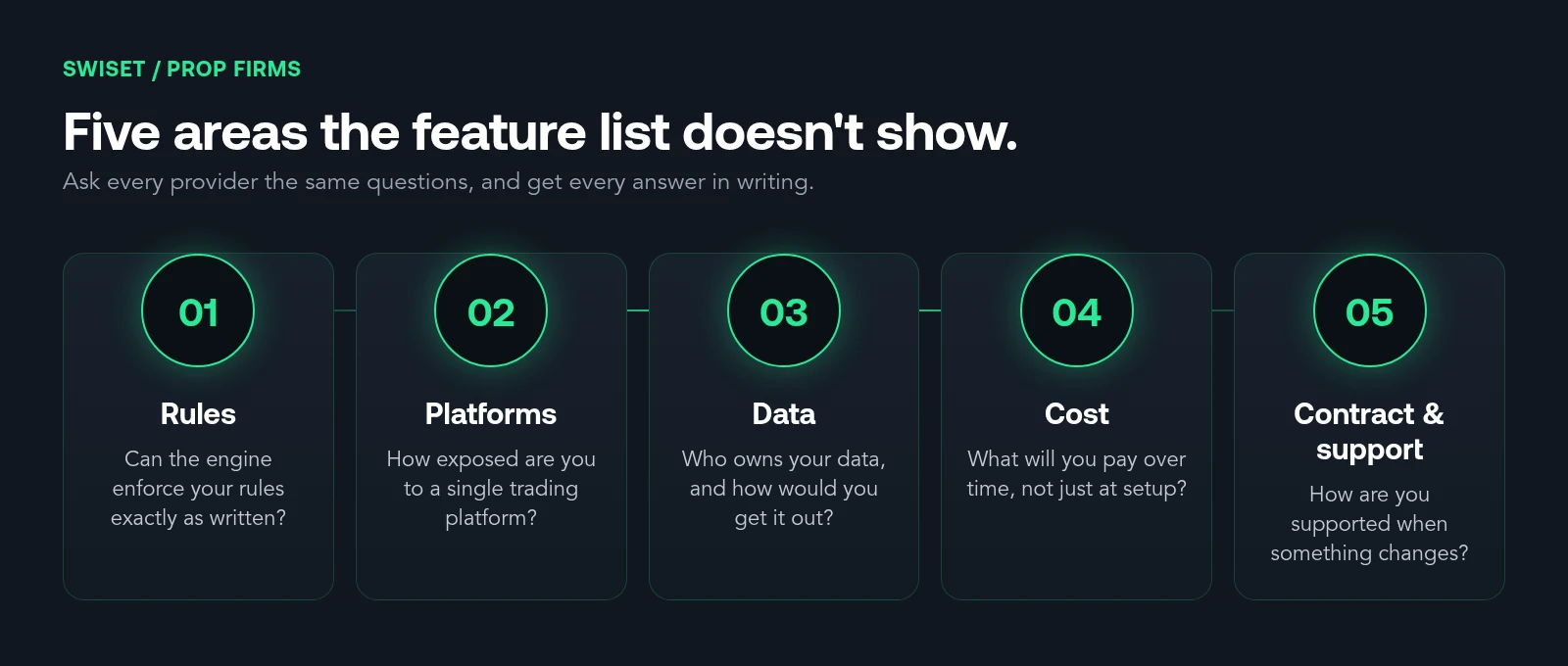
Choose a prop firm technology provider on five things the feature list doesn't show: whether it can enforce your rules exactly as written, how exposed it leaves you to a single trading platform, who owns your data and how you'd get it out, what you'll pay over time (not just at setup), and how it supports you during change. Ask the ten questions below, and ask for every answer in writing.
/What a prop firm technology provider actually does
A prop firm technology provider supplies the systems that sit between your brand and the trading platform: challenge configuration and the rules engine that enforces it, account creation, trader and admin dashboards, KYC, payout workflows, risk and fraud monitoring, and the integrations that tie them to your website, CRM and payments. Some deliver all of it as a white-label platform; others let you build your own front end on their back end through an API; many offer both.
Whichever model you choose, you are delegating the part of your business that decides who passes, who fails and who gets paid. That's why the selection deserves more than a demo and a price.
/Rules: can the engine run your model as written?
1. Which rule types does the engine support, and how exactly is each one calculated?
Your evaluation model is your product. Ask for the list of supported rule types and, for each one, the calculation details: static or trailing drawdown, balance or equity, intraday or end-of-day, how the trailing floor behaves, when the daily reset happens and in which time zone, and how consistency is measured. Two providers can both claim a "trailing drawdown" and calculate it differently.
2. How do you add a rule you don't support today?
Your model will change. Ask how new rules reach the product, how long similar requests have taken, and whether new rules are a paid customisation or part of the roadmap. A public release history is useful evidence: it shows what the provider has actually shipped, not just what it plans.
3. Are rules enforced in real time, and what does the trader see?
Rules enforced at the end of the day, or only when a trader requests a payout, produce disputes. Ask where enforcement happens, how quickly breaches are detected, and what the trader sees about their distance from each limit. Our guide to the prop firm trader dashboard covers what that view should include.
/Platforms: how exposed are you to one trading platform?
4. Which platforms are supported today, and how hard is it to add or switch one?
Trading platforms can change their terms for prop firms with little notice. A 2026 Finance Magnates analysis noted that MetaQuotes' 2024 action against prop firms "almost put several platforms out of business overnight" until they relaunched with alternatives. You can't remove that risk, but you can reduce it. Ask which platforms are live today (not "coming soon"), whether the same rules engine runs across them, and what moving traders from one platform to another would involve.
5. Where does the risk engine run?
If rules are evaluated inside a platform plugin, your risk logic depends on that platform. If they're evaluated on the provider's servers, from the trading activity the platform sends, the same rules can follow you to another platform. Ask the question directly and ask what happens to enforcement if a platform connection fails.
/Data: who owns it, and how would you leave?
6. What data can you export, in what format, and how often?
Trader records, KYC status, challenge history, every breach decision and its evidence, payout requests and approvals: this is the record you'll need for disputes, audits and any future migration. Ask for an export sample before you sign, not after. If the answer is "on request" with no format defined, treat it as a risk.
7. What happens if you leave?
Ask for the exit process in writing: notice period, what data you receive, in what format, within what time and at what cost. A provider that is confident in its product should have no problem describing how you would stop using it. If you are already operating, our guide to prop firm platform migration explains what has to carry over for traders.
/Cost: what will you pay in year two?
8. What is included, and what triggers a new charge?
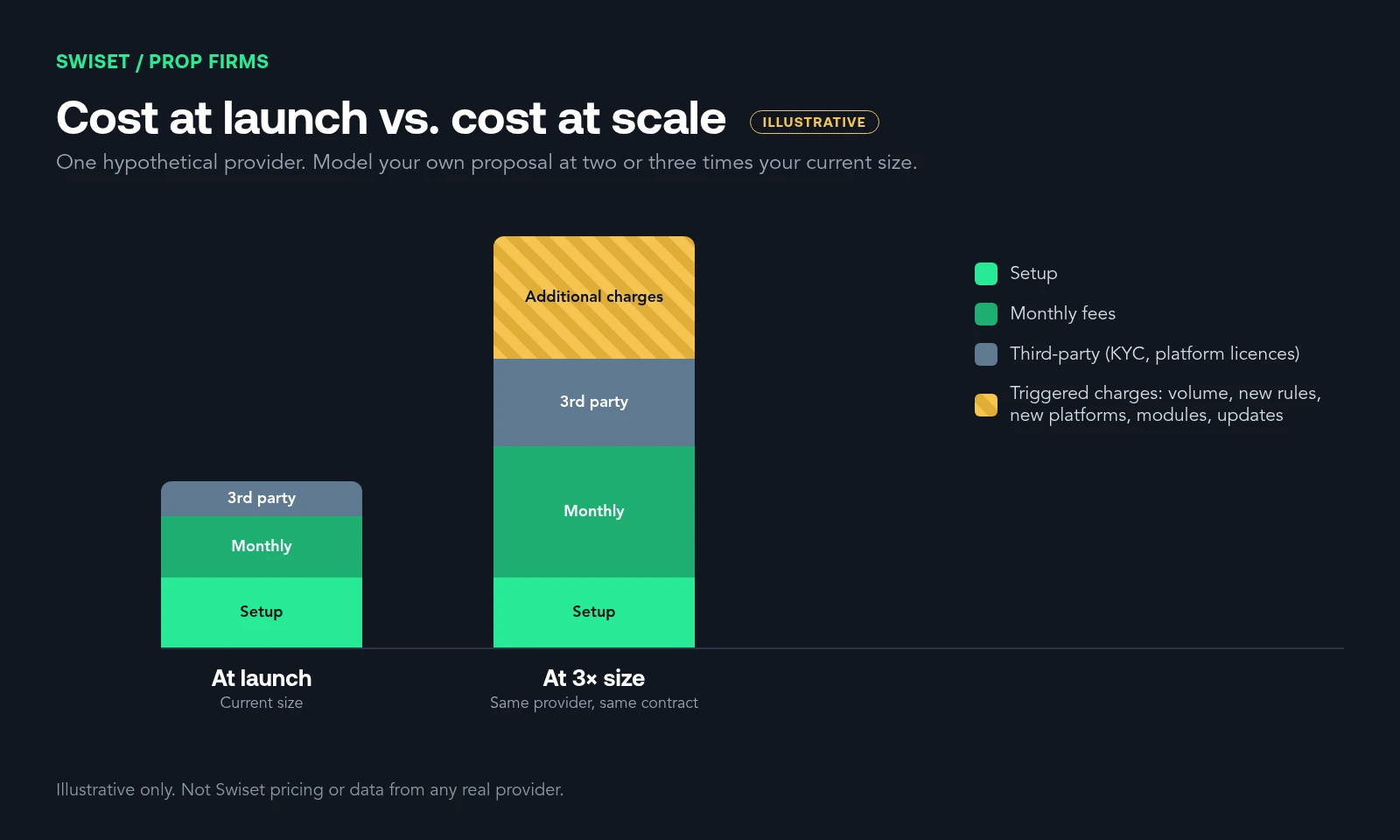
Entry prices are easy to compare and rarely the full picture. Ask for a proposal that separates setup, monthly fees and third-party costs such as KYC providers and platform licences, and ask what triggers additional charges: account volume, new rules, new platforms, new modules or product updates. Then model your costs at two or three times your current size, because the structure that's cheap at launch can be expensive at scale.
/Contract and support: what happens when something changes?
9. How long is the contract, and what keeps you there?
Long commitments make sense for some firms, especially if they come with better terms. But you should know what you're trading for them. Ask about minimum terms, renewal conditions and penalties for leaving, and compare them with your own plans: a firm that expects to change its model or its platform within a year needs flexibility more than a discount.
10. Who supports you, and how do they handle change?
Ask who your day-to-day contact is, what support hours apply to operational incidents, and how the provider handles a change you request, from a new challenge model to a platform switch. Ask for an example of a change they've handled recently and how long it took. If you're migrating from another provider, ask for the migration plan step by step, including how traders in the middle of a challenge or a payout will be treated.
/How to run the evaluation
Questions only help if the answers are comparable. Three practices make that easier.
First, write your rulebook before the demos. Send each provider the same model, including two or three edge cases (a position open at the daily reset, a payout followed by a drawdown check), and ask them to show how their engine decides each one.
Second, separate what's live from what's planned. For every answer, ask whether it's available today, available through a third-party integration or on the roadmap. Roadmap items are fine; they just aren't the same as features.
Third, check the claims behind the numbers. Launch times, uptime, client counts and growth figures are common in proposals. Ask how each one is measured, over what period and for which clients. A number without a method is marketing, not evidence.
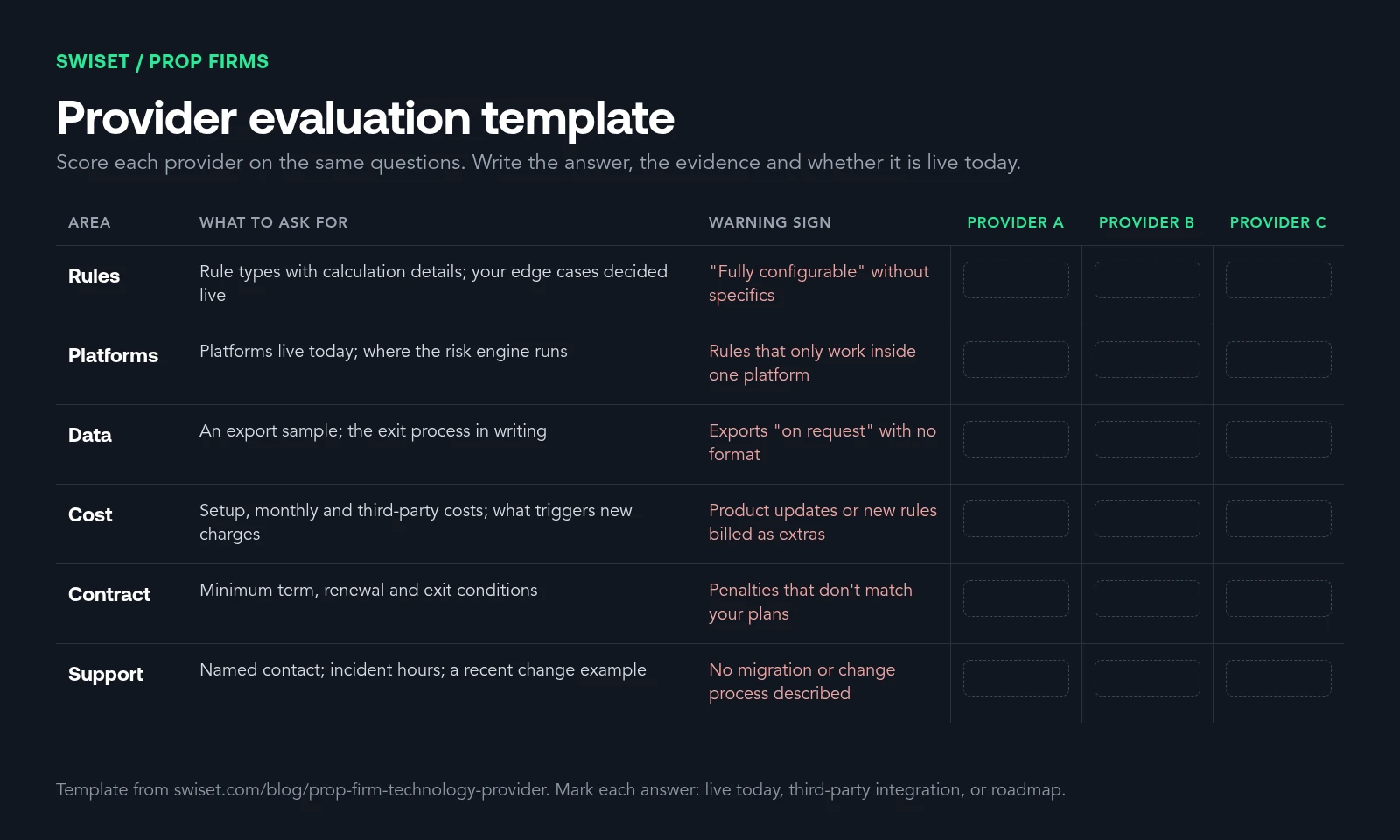
| Area | What to ask for | Warning sign |
|---|---|---|
| Rules | Rule types with calculation details; your edge cases decided live | "Fully configurable" without specifics |
| Platforms | Platforms live today; where the risk engine runs | Rules that only work inside one platform |
| Data | An export sample; the exit process in writing | Exports "on request" with no format |
| Cost | Setup, monthly and third-party costs; what triggers new charges | Product updates or new rules billed as extras |
| Contract | Minimum term, renewal and exit conditions | Penalties that don't match your plans |
| Support | Named contact; incident hours; a recent change example | No migration or change process described |
/Common mistakes
Most poor choices come from comparing the wrong things: entry price instead of cost at scale, feature lists instead of how rules are calculated, and promised launch times instead of what happens in month six. The rest come from skipping the uncomfortable questions: never asking how you would leave, accepting "configurable" without testing your own edge cases, and treating roadmap items as available features.
/Checklist: before you sign
- Have you sent every provider the same rulebook, with edge cases, and seen how each engine decides them?
- Do you know which platforms are live today and where the risk engine runs?
- Have you seen an export sample and the exit process in writing?
- Does the proposal separate setup, monthly and third-party costs, and list what triggers new charges?
- Have you modelled costs at two or three times your current size?
- Do the contract terms match your plans for the next 12 to 24 months?
- Do you know who supports you, and how a change or migration is handled?
- Have you asked how every number in the proposal was measured?
/Where Swiset fits
Swiset is a prop firm technology provider, so read this section with that in mind, and ask us the same ten questions.
Swiset gives prop firms a challenge and rules engine that supports static, trailing and end-of-day drawdown, consistency, lot consistency, overnight and payout-timing rules, with rules enforced automatically in real time, alongside risk and fraud controls, an admin dashboard with roles for your team, a trader dashboard, KYC and payout workflows. Firms can use it as a complete platform or build their own experience on Swiset's prop firm API, where the risk engine runs server-side and events are delivered through webhooks. Swiset publishes its release history, and its commercial terms state no lock-in contracts, product updates included without a per-feature fee, and setup, monthly and third-party costs agreed before signing. For firms already operating, Swiset's migration process carries over traders, challenge progress, funding status and rules, validated with your team before go-live.
Which model, rules and platforms you choose remain your decisions. Swiset is a technology provider, not a prop firm or a broker. See the full platform for prop firms.
/Conclusion
Choosing a prop firm technology provider is choosing who enforces your product, who holds your data and how easily you can change course. The feature list is where every proposal looks the same. The ten questions above are where they differ. Ask them early, ask for the answers in writing and test your own rules before you sign.
If you're evaluating providers for a new or existing prop firm, talk to Swiset about your prop firm stack.
Talk to Swiset about your prop firm stack
Bring your rulebook and edge cases. We'll answer the same ten questions, in writing.
Talk to Swiset about your prop firm stack/Related posts
- White Label Prop Firm Software: How to Launch and Scale Your Funding Business
- Prop Firm API: How to Build a Custom Prop Firm Without Developing the Entire Backend
- Prop Firm Platform Migration: How to Switch Without Losing Traders
- Is Your Prop Firm's Infrastructure Built to Scale — or Just to Launch?
FAQs
What does a prop firm technology provider do?
It supplies the systems behind a prop firm: challenge configuration and rules enforcement, account creation, trader and admin dashboards, KYC, payouts, risk monitoring and integrations with trading platforms, websites, CRMs and payments.
Should I choose a white-label platform or build on an API?
A white-label platform is faster to launch and suits firms that want a complete product. An API suits firms that want their own front end and customer experience while relying on specialised back-end infrastructure. Many providers offer both; the right choice depends on your team and how much you want to customise.
What's the most important question to ask a prop firm software provider?
Whether its engine can enforce your rules exactly as written. Send the same rulebook, with edge cases, to every provider and compare how each one decides them.
How do I compare prop firm software pricing?
Ask each provider to separate setup, monthly fees and third-party costs, and to list what triggers new charges. Then compare total cost at two or three times your current size, not just the entry price.
Can I switch prop firm technology providers once I'm operating?
Yes, but plan it carefully. Trader data, active challenges, funded accounts, rules and pending payouts all need to carry over, and rule parity should be tested on real accounts before anyone moves.
How do I reduce dependence on a single trading platform?
Choose a provider that supports several platforms today and evaluates rules on its own servers, so the same rules can follow your traders if you add or change a platform.
Related posts
White Label Prop Firm Software: How to Launch and Scale Your Funding Business
July 21, 2026
Prop Firm API: How to Build a Custom Prop Firm Without Developing the Entire Backend
August 21, 2026