Prop Firm Customer Support: What Your Tickets Are Telling You
Every prop firm reaches the same point. Traders multiply, tickets multiply, and the support team starts working evenings. It is one of the first places where an infrastructure built only to launch shows its limits — the difference between infrastructure built to scale, not just to launch. The first reaction is usually to add agents, write more templates or put a bot in front of the inbox. Those moves help, but they treat tickets as volume.
A ticket is also a report. A trader tried to do something, and your rules, your product or your communication did not let them. This article is for operations leads and founders who want prop firm customer support to improve without simply getting bigger.
/The short answer
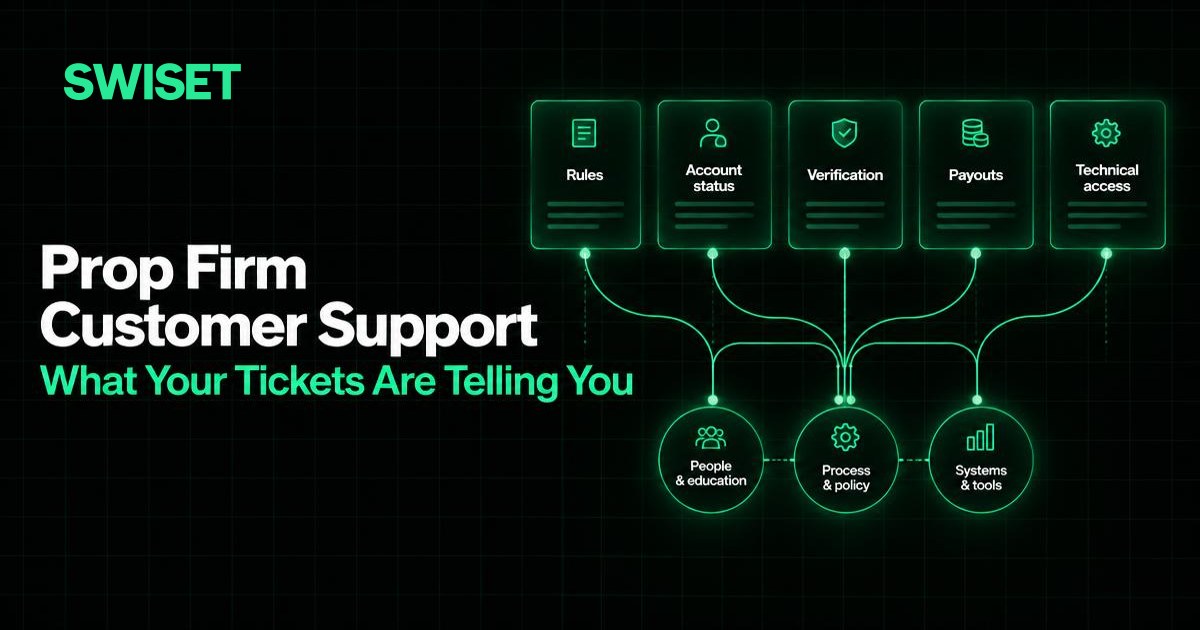
Sort tickets by cause, not by channel or urgency. Five groups cover most of what a prop firm receives: rules, account status, verification, payouts and technical access. Within each group, mark which tickets were avoidable, fix the cause that repeats most, and only then automate what remains. Answering faster keeps the same causes alive; fixing the cause removes the question for every trader who would have asked it next.
/Why "more agents" and "better templates" are both the wrong first move
Most support teams are measured on speed: first response time, tickets closed per agent. Those numbers are useful, but they reward answering a question, not preventing it. A team can get faster every month while the same ten questions arrive every week.
Prop firm support also differs from broker support in one respect. Many questions are not requests for information; they are requests for a judgment. A trader whose account was closed, or whose payout is under review, is asking whether the firm is being fair. The speed and tone of the answer shape trust as much as the answer itself.
A faster answer to the same question is still the same question.
| Ticket category | Typical question | What it usually signals | First fix |
|---|---|---|---|
| Rules | "Was this trade allowed?" | Terms unclear or hard to find | Plain-language rule summary where the trader sees their limits |
| Account status | "Why was my account closed?" | Decisions without visible reasons | Notice that states the reason and the rule it refers to |
| Verification | "Why do you need this again?" | Unclear requirements, repeated submissions | Requirements list before the trader submits |
| Payouts | "Where is my payout?" | No visible stage or expected window | Visible status and a stated review window |
| Technical access | "I can't log in" | Onboarding gaps | Setup guide and a named owner for fixes |
This table is a starting point, not a benchmark. Your own ticket history should decide which row matters first.
/The three steps that turn a ticket backlog into a fix list
Classify by cause
Tag one month of tickets by what actually went wrong, not by what the trader typed.
Mark what was avoidable
Could the trader have found the answer without contacting us?
Fix the largest avoidable group
Change something upstream so the question disappears permanently.
01 Classify by cause
Take one month of tickets and tag each with one of the five categories. Do not tag by what the trader typed; tag by what actually went wrong. A message that says "my payout is late" may be a payout ticket, or it may be a verification ticket because the payout waited on a document nobody asked for clearly. If verification is a large share of your inbox, how much KYC friction is actually protecting you is the next question to ask.
02 Mark what was avoidable
For each ticket, ask one question: could the trader have found the answer without contacting us? A rules ticket asked after an account breached was probably avoidable with clearer communication earlier. A payout ticket sent on day one of a review window was probably avoidable with a visible status. The share of avoidable tickets in each category tells you where upstream work pays off.
03 Fix the largest avoidable group first
Pick the category with the highest volume and the highest avoidable share. The fix is rarely a better reply. It is usually a change upstream: a clearer rule statement, a notice that includes the reason, a status page, a requirements list. Each removes a question permanently instead of answering it repeatedly — ticket, cause, upstream fix, fewer repeat tickets.
/A diagnostic checklist before you change anything
- Do tickets get tagged by cause, or only by channel and urgency?
- Can an agent see the rule that applied to an account without asking another team?
- Does every account-status notice state the reason and the rule it comes from?
- Does a trader waiting on a payout or verification see a stage and an expected window?
- Do we count repeat contacts on the same issue, or only tickets closed?
- Were the rules and terms defined before launch, as in a prop firm launch checklist, or are they still being written in support replies?
If the last answer is uncertain, revisit the prop firm launch checklist: rules defined before going live prevent a whole category of tickets.
/Common mistakes
- Counting by channel instead of cause. Email, chat and social tell you where tickets arrive, not what to fix.
- Adding agents before fixing the top cause. Headcount absorbs the problem; it does not remove it.
- Using templates for judgment cases. A trader told "your account has been closed" by a template, with no person to talk to, remembers that moment.
- Reading fewer tickets as success. Fewer tickets can mean traders gave up. Pair volume with repeat contacts and complaints about the same decision.
Two other habits are worth dropping. Rules that live in support replies instead of in the terms the trader accepted make every answer dependent on whoever is on shift. And closing a ticket without recording its cause throws away the one piece of information you needed.
/What to automate and what to keep human
Automate answers that are factual and identical for every trader: where to find a rule, which documents verification needs, what stage a payout is in. Keep a person on tickets about judgment: a closed account, a disputed decision, an unusual payout. A person should also review patterns across tickets, because patterns are where the upstream fixes come from.
The order matters. Automating the judgment cases first is the most common error, and the one traders remember longest.
/How to measure whether it is working
Define a few measures with fixed definitions before you start: tickets by cause, share judged avoidable, time to first response, time to resolution, and repeat contacts on the same issue. Compare against your own earlier months. Volume alone is a weak signal; a drop in avoidable tickets together with fewer repeat contacts is a stronger one. This article makes no benchmark claims, because the right level depends on your model, traffic and payment methods.
/Where this fits for an operations lead
Support gets easier when the systems behind it agree with each other. If a rule is enforced in one place, a trader's record lives in another and a payout status in a third, every answer requires a manual relay between teams, and each relay is a chance to give a trader a different answer.
Swiset provides infrastructure for prop firms that includes a challenge and rules engine, trader CRM and lifecycle tools, and operations automation. If you are still deciding what a CRM for prop firms should have, start from the questions your traders ask. The practical link to support is that rules, account status and trader records sit in connected systems, so a notice or an answer can reference the same data the rules used. The expected benefit is fewer tickets caused by unclear or inconsistent information. The quality of your rules and your communication still depends on your firm.
/Closing
Your support inbox is the most direct feedback you have on how the firm looks to traders. Sort it by cause, fix the largest avoidable group and automate only what remains.
Support will always be a human function in a business built on judgments about trust. The goal is not an empty inbox. It is an inbox that contains only the questions that need a person.
Find out what your tickets are really asking for
Walk through how your rules, trader records and operations connect to the questions traders send.
Book a DemoFAQs
What are the most common prop firm support tickets?
They tend to fall into five groups: rules, account status, verification, payouts and technical access. Your own ticket history will show the mix and which group is largest.
How do I reduce prop firm support tickets?
Tag tickets by cause, mark which were avoidable and fix the upstream issue behind the largest avoidable group. Clearer rules, notices with reasons and visible payout or verification stages remove questions instead of answering them.
Should a prop firm use a chatbot for customer support?
For factual, repeatable questions, possibly. For judgment cases such as a closed account or a disputed decision, keep a person involved and give the trader a way to reach one.
What should a prop firm measure in support?
Tickets by cause, the share judged avoidable, first response and resolution time, and repeat contacts on the same issue. Define each before changing anything and compare against your own history.
Related posts
How Introducing Brokers Can Increase Their Rebate Income Without Burning Through Their Client Base
October 14, 2026
Trading Competition Scoring Methods: What Each One Actually Rewards
October 13, 2026