MCP for Prop Firms: What to Decide Before Traders Connect Their Accounts to AI Assistants
A trader opens an AI assistant and types: "How much drawdown do I have left, and can I request a payout this week?" The assistant answers in seconds, with confidence. Whether that answer is right depends on decisions your firm made, or didn't make, months earlier: which data you exposed, how you described your rules and what the assistant was allowed to do with them.
This is no longer hypothetical. In September 2026, Finance Magnates reported that a prop firm had launched an integration letting traders connect evaluation and funded accounts to AI tools such as ChatGPT and Claude, read-only, with access to performance, risk parameters, drawdowns, evaluation requirements and payout eligibility conditions. According to the same report, another prop firm had launched a similar read-only server in July, and a charting platform released one in beta. All of them use the Model Context Protocol, or MCP.
This guide is for CTOs, product leads and technical founders at prop firms. The short answer: MCP for prop firms is a new access layer to trader data, and it should be designed like one. Start read-only, expose statuses your own system has calculated rather than rules for the model to interpret, grant the narrowest permissions possible, log every call, and make clear that your dashboard and terms, not the assistant, are the reference.
/What MCP is, in one paragraph
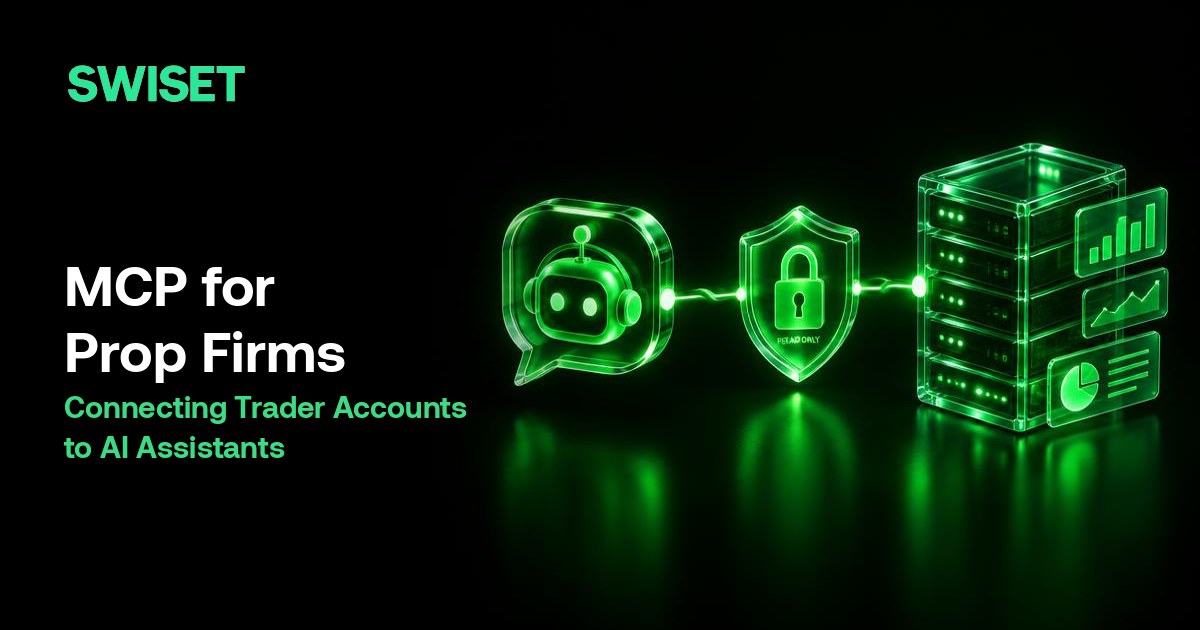
The Model Context Protocol is an open standard that lets AI applications connect to external systems through "servers" that expose tools and data. A prop firm that runs an MCP server could, for example, offer a tool that returns an account's current drawdown or evaluation progress. The trader's AI assistant (the "client") discovers those tools and calls them when the trader asks a relevant question. In the protocol's own words, tools "enable models to interact with external systems, such as querying databases, calling APIs, or performing computations" (MCP specification, Tools). For a prop firm, the server sits in front of the same back office that powers your trader dashboard; the difference is who asks the question and who phrases the answer.
1. Trader
Asks a question in plain language.
2. AI assistant (MCP client)
Discovers the tools and calls them.
3. Prop firm MCP server
Read-only. Excludes KYC, payments and risk flags.
4. Back office / rule engine
Calculates the status that is returned.
/Why this is a business decision, not just a feature
A trader who asks an assistant about your rules is receiving an explanation of your product that you didn't write. If it is clear and correct, you have reduced friction: fewer support tickets asking where the drawdown floor is, faster answers outside business hours, traders who understand their position. Our analysis of prop firm support tickets shows how many contacts are rule and status questions, which is exactly what an assistant can answer.
If it is wrong, you have a new kind of dispute: "Your assistant integration told me I was eligible." The model may have summarised a rule loosely, combined two rule versions or calculated a figure itself. And you have a new attack surface: a server that returns account data on request needs the same care as any other API that touches customer information. Getting this right involves product, risk, support, legal and security, which is why it shouldn't be launched as a growth experiment owned by one team.
/Decision 1 — Start read-only, and keep actions in your own interface
The integrations reported so far are read-only: according to the firm's announcement, connected assistants cannot place or modify orders, request payouts or change account settings. That is a sensible default. Every action an assistant can take on a trader's behalf is an action a model may trigger by mistake, or that someone may trigger by manipulating the model.
The MCP specification itself says there "SHOULD always be a human in the loop with the ability to deny tool invocations", and that clients should prompt for confirmation on sensitive operations. But you don't control the client. Different assistants implement confirmation differently, and the specification warns that clients must treat a server's descriptions of its own tools as untrusted unless the server is trusted. If you later consider actions such as requesting a payout, keep the final step inside your platform, where you control identity checks, confirmation and the record of the decision.
/Decision 2 — Expose calculated statuses, not raw rules to interpret
This is the decision with the biggest effect on disputes. You can give an assistant your rules as text and the account's raw numbers, and let the model work out whether the trader is close to a breach. Or you can give it the answers your engine has already calculated: "current drawdown floor: X", "profit distribution check: passing", "minimum trading days: 3 of 4 completed", "payout eligibility: not yet, reason: minimum days".
| Raw rule + raw data | Calculated status | |
|---|---|---|
| What the assistant receives | Rule text and account numbers | "Payout eligibility: not yet — minimum trading days 3/4 — rule v2 — updated 14:02 UTC" |
| Who decides | The model interprets the rule | Your rule engine |
| Rule version | Often unclear | Stated with each status |
| Dispute risk | Higher | Lower |
The second approach is safer. Your rule engine is the system that decides; the assistant should report its decisions, not reproduce them. That only works if your engine and your published terms agree, and if each status says which rule version it applies. A model that reads a rule written for accounts opened after a change and applies it to an older account will produce a confident, wrong answer. Clear statuses with a reason, a version and a timestamp give the assistant less room to improvise.
/Decision 3 — Decide which data is in scope
List what a trader would reasonably ask about: balance and equity, drawdown and limits, evaluation progress, rule statuses, payout eligibility and history. Then list what should stay out: identity documents and KYC status details, payment and wallet details, internal risk flags and notes, and anything about other accounts, including accounts your risk team has linked to this one. Internal fraud signals in particular should never reach an assistant; our guide to prop firm fraud detection explains why those signals need human review before they affect a trader.
| In scope | Out of scope |
|---|---|
| Balance and equity | Identity documents and KYC status details |
| Drawdown and limits | Payment and wallet details |
| Evaluation progress | Internal risk flags and notes |
| Rule statuses | Other accounts, including linked accounts |
| Payout eligibility and history | Internal fraud signals |
Treat the outputs as personal data leaving your systems at the trader's request, into a third-party service with its own data handling. Your privacy notice and terms should say so, and your legal team should confirm what that means in the markets you serve.
/Decision 4 — Authorization: least privilege and tokens issued for your server
Authorization is where general security practice meets this new protocol. The official MCP security guidance is explicit on a few points that apply directly to a prop firm:
- Tokens: "MCP servers MUST NOT accept any tokens that were not explicitly issued for the MCP server." Don't let your MCP server forward a token meant for your trader app or back-office API (MCP Security Best Practices).
- Scopes: start with a minimal set containing only low-risk read operations, and avoid "wildcard or omnibus scopes". A token that can only read one account's rule statuses limits the damage if it leaks.
- Server duties: the specification says servers must validate all tool inputs, implement access controls, rate limit tool invocations and sanitise outputs.
In practice, that means a consent screen the trader understands, per-account scoping so a token can never read another trader's data, short-lived tokens with easy revocation from the trader's dashboard, and rate limits that protect your back office from an assistant that calls a tool in a loop. Have your security lead review the design against the specification before launch.
/Decision 5 — Log every call and connect it to support
When a trader disputes something an assistant said, your team needs to know what your server actually returned. Log each tool call with the account, the tool, the timestamp, the response and the rule version behind it. The specification recommends that clients log tool usage for audit purposes; you should not rely on the client's logs, because you can't access them.
Then give support a simple position: the assistant reports what your system returned at that moment; the dashboard and the terms are the reference. Put that in your terms and in the integration's description so traders hear it before they rely on it.
/Decision 6 — Separate data access from your rules on AI-driven trading
Connecting an account to an assistant for questions is different from a trader using AI to decide or execute trades. The first is about access to account data; the second is a trading-rules question that your rulebook should already answer, alongside your rules on expert advisors, copy trading and third-party tools. Launching a read-only integration doesn't change that policy, but traders may assume it does. Say explicitly what the integration is for, and what your rules say about automated or AI-assisted trading.
/Build, wait or skip?
Not every firm needs an MCP server now. It makes more sense if your traders already ask many status and rule questions, your rule engine can return clean statuses with reasons, and your back office exposes them through an API you control. It makes less sense if your rule logic is partly manual, your published terms and your configuration haven't been reconciled recently, or you can't yet log and support a new channel. In that case the better investment is upstream: clean, calculated statuses in your own trader dashboard first. An MCP server built on those statuses is then a thin layer; one built without them is a new source of errors.
/Common mistakes
- Giving the model your full terms and raw account data and letting it decide eligibility.
- Launching with write actions because the client "will ask for confirmation".
- Reusing your app's tokens or broad API keys for the MCP server.
- Exposing internal risk flags or linked-account data.
- Returning statuses without a rule version or timestamp.
- Keeping no server-side log of what was returned.
- Not telling traders that the dashboard and terms prevail.
- Treating the integration as a marketing launch without risk, legal and support involved.
/Checklist: MCP for prop firms
- Is the first version strictly read-only, with any future action completed inside your platform?
- Does every tool return a status calculated by your rule engine, with a reason, rule version and timestamp?
- Have you defined which data is in scope and explicitly excluded KYC, payment details and internal risk signals?
- Are tokens issued specifically for the MCP server, scoped to one account and to read operations, short-lived and revocable by the trader?
- Do you validate inputs, rate limit calls and sanitise outputs on the server?
- Do you log every call with the response returned?
- Do your terms and the integration description say the dashboard and terms are the reference?
- Have risk, legal, support and security reviewed the design before launch?
/Where Swiset fits
An assistant integration is only as reliable as the back office behind it. Swiset provides prop firm infrastructure in which challenge rules are configured in one engine (phases, profit targets, drawdown limits, time restrictions and scaling rules) and drawdown, breach and consistency rules are enforced automatically and in real time across every phase. Traders get a real-time dashboard with challenge tracking and AI-driven insights, and payouts run through approval flows with a full audit trail. For firms that want to build their own trader experiences, Swiset offers backend infrastructure through an API, which is the layer any external integration, including an MCP server, would sit on.
In practice, a team can start by making sure its own dashboard shows calculated, consistent statuses, then decide whether and how to expose them to assistants. Swiset is a technology provider, not a prop firm or a broker; data, access and rule policies remain each firm's decisions.
/Closing
AI assistants will become one of the places where traders read your rules, whether you build for it or not. The firms that handle it well will treat MCP as an access layer to sensitive data: read-only first, narrow permissions, statuses calculated by their own engine, a log of every answer and a clear statement of which source prevails. That work starts in the back office, not in the assistant.
Discuss your trader data architecture with Swiset
Decide how your trader data, rule statuses and APIs should fit together before opening a new channel.
Book a DemoFAQs
What is MCP in prop trading?
The Model Context Protocol is an open standard that lets AI assistants connect to external systems. Some prop firms use it to let traders connect their accounts to assistants and ask about performance, rules and payout eligibility.
Can an AI assistant place trades or request payouts through a prop firm's MCP server?
Only if the firm exposes tools that allow it. The prop firm integrations reported in 2026 were described as read-only. Keeping actions inside the firm's own platform is the safer default.
Is it safe to connect a funded account to ChatGPT or Claude?
It depends on how the firm's server is built and what it exposes. Look for read-only access, clear consent, access limited to your own account and the ability to revoke it. Data shared with an assistant is also subject to that assistant's own data policies.
Who is responsible if the assistant gives a wrong answer about a rule?
The firm's terms and dashboard should be the reference, and the firm should say so. Exposing statuses calculated by the firm's own rule engine, rather than raw rules for the model to interpret, reduces the risk of wrong answers.
Does a prop firm need an MCP server?
Not necessarily. It is most useful when traders ask frequent status and rule questions and the firm's back office already produces clean, calculated statuses through an API.