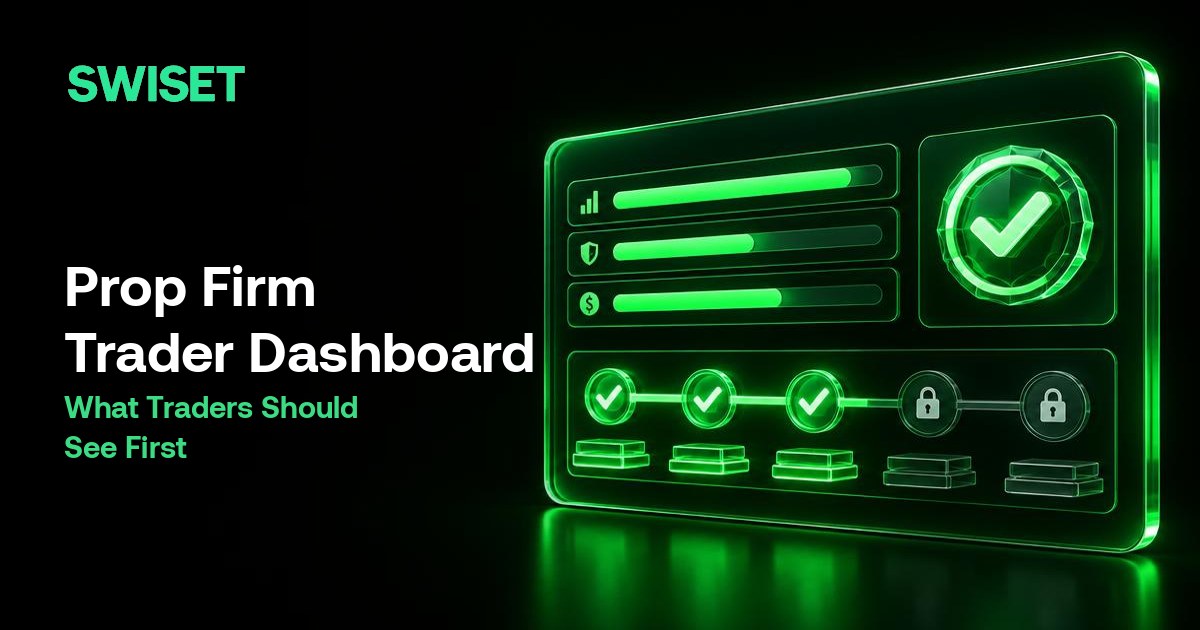
Prop Firm Trader Dashboard: What Traders Should See Before They Ask Support
A funded trader opens your dashboard on a Friday afternoon. Balance: up. Equity curve: up. Profit: clearly above the payout minimum. They request a payout. On Monday they receive a reduced amount, because one day accounted for too large a share of the profit under your profit distribution rule. The rule was in the terms. The status was nowhere on the screen they used every day.
That gap between what the dashboard shows and what your rules decide is where a large share of support tickets and payout disputes begin. In 2026, one challenge provider told Finance Magnates that its profit distribution rule generates more disputes than any other rule it has. Around the same time, another prop firm launched a panel that, according to the firm, shows funded traders which rules have been triggered and their expected financial effect before they request a payout.
This guide is for product and operations leads at prop firms. The short answer: a prop firm trader dashboard should answer, before the trader asks, where they stand against every rule, whether they can request a payout and why or why not, where a pending payout is, and what to do next. Those answers should come from the same engine that makes the decisions. Charts and analytics come after.
/What a prop firm trader dashboard is for
A prop firm trader dashboard is the screen where a trader follows their challenge or funded account: balance, equity, progress against targets, rule limits, payouts and account history. It is different from your internal admin dashboard, which helps your staff decide; the trader dashboard helps the trader understand decisions before and after they happen.
Most dashboards are designed for motivation: equity curves, win rates, leaderboards. Those have their place. But a trader's most important questions are not "how am I doing?" in general. They are specific and binary: am I about to breach? Does today count? Can I withdraw? A dashboard that answers the first kind of question and not the second sends the trader to support, or worse, lets them find out at the payout decision.
/Start from the questions your support team answers
The best specification for a trader dashboard is already in your support inbox. In our analysis of prop firm support tickets, status questions tend to cluster in a few categories. For most firms, five questions cover most of them:
| Trader question | What the dashboard should show |
|---|---|
| How much room do I have before a breach? | Distance to each drawdown and loss limit, in currency and percent, with the basis (balance or equity, intraday or end of day) |
| Does today count toward my requirements? | Trading days completed vs required, with your definition of a trading day and the time zone |
| Can I request a payout? | Eligibility status, the conditions met and not met, and the earliest date if not yet |
| Why is my payout amount what it is? | The calculation: profit, split, any rule-based adjustment and the clause behind it |
| Where is my payout or verification? | Current stage, the date it entered that stage, and what, if anything, the trader must do |
Pull a sample of last month's tickets, tag them by question, and check how many your dashboard answers today. That gap is your roadmap. This is a method, not a benchmark: your categories will depend on your rules and markets.
/Show rule status, not just account numbers
Balance and equity tell a trader what happened. Rule status tells them what it means. For every rule that can end an account or reduce a payout, show three things: the current value, the limit and the distance between them. "Daily loss: $1,200 of $2,500 used" is a status. A red line on a chart is not, because the trader still has to work out where the line is and which rule it belongs to.
Rules that depend on the whole history of the account need the same treatment. A consistency or profit distribution rule should show the current share of the largest day against the limit, updated as the trader trades, not only when they request a payout. If a rule has a definition that traders often misread, such as what counts as a news event or a trading day, put the definition next to the status, with a link to the full rule.
/Calculate statuses with the engine that decides
The most common way to create disputes with a dashboard is to calculate the numbers twice. If the dashboard computes drawdown one way and the rule engine that breaches accounts computes it another, sooner or later a trader will show you a screenshot that contradicts your decision, and they will be right about what you showed them.
Rule engine
One configuration calculates every status, with a timestamp.
Trader dashboard
Shows the same statuses the engine enforces.
Admin dashboard
Your team decides on the same numbers.
External integrations
Assistants and APIs read the same calculated statuses.
Every status a trader sees should come from the same engine and the same configuration that enforce the rule, with a timestamp. When rules differ by account version, for example when limits changed for accounts opened after a certain date, the dashboard should state which version applies to this account. The same principle matters beyond your own interface: some prop firms now let traders connect their accounts to AI assistants, which read the statuses you expose, as we cover in MCP for prop firms. A clean, calculated status serves your dashboard, your support team and any future integration at once.
/Make the payout path visible
Payout requests are where trust is tested. Before a trader requests, show eligibility and the expected calculation, including any reduction a rule would apply. After they request, show the stage: received, under review, approved, sent, with the date each stage started. If a request is held for additional checks, say so and say what happens next, even if you cannot share every detail of a risk review.
One prop firm, in a payout review it presented in 2026, attributed delays mainly to additional validations, incomplete information and operational exceptions; those are the firm's own statements. Whatever your causes, a visible stage turns "where is my money?" into "my request is under review since Tuesday", which is a status, not a ticket. The same applies to identity verification: show what is pending, what is missing and who needs to act, as we discuss in our piece on KYC onboarding friction.
/Warn before the rule acts
A breach notice after the fact is a record. A warning before it is a service. Decide which rules deserve a proactive alert (approaching a daily loss limit, a consistency share close to the threshold, a minimum-days requirement not yet met near a payout date) and how the trader receives it: on the dashboard, by email or in the trading platform.
Two cautions. First, warnings must use the same calculation as enforcement, or they become a new source of disputes. Second, a warning is not a promise: your terms should say that the rule applies whether or not an alert was received. Keep the tone factual; the goal is to help the trader follow your rules, not to nudge them into trading more.
/Keep internal signals out of the trader's view
Transparency has limits. Fraud and risk signals under review, links your team has drawn between accounts, notes from staff and the details of how your detection works should not appear on the trader's screen. Showing them early can alert someone gaming your rules and can expose a trader to an accusation before a person has reviewed the evidence. Our guide to prop firm fraud detection explains why those decisions need human review first. The rule is simple: show traders the status of rules they agreed to; keep investigations internal until there is a decision to communicate.
/Analytics: useful, but second
Performance analytics (equity curves, win rate, average holding time, instrument breakdown) help traders improve and can keep them engaged through a challenge. They also help your team: analytics on trader behaviour feed retention and segmentation decisions, as covered in our framework for trader performance analytics. Place them below the statuses, not instead of them. A trader who understands their position will use analytics; a trader who doesn't will open a ticket.
/Common mistakes
- Showing charts without limits, so the trader must work out distance to a breach.
- Calculating statuses in the front end with a different formula from the rule engine.
- Showing consistency or profit distribution status only at payout time.
- Hiding which rule version applies after a rule change.
- Showing a payout as "pending" for days with no stage or date.
- Sending warnings with a calculation that differs from enforcement.
- Exposing internal risk flags to the trader.
- Designing the dashboard around the data available rather than the questions traders ask.
/Checklist: your prop firm trader dashboard
- Does the trader see current value, limit and distance for every rule that can end an account or reduce a payout?
- Are trading days, time zone and drawdown basis stated next to the status?
- Does every status come from the same engine and configuration that enforces the rule, with a timestamp?
- Does the dashboard show which rule version applies to the account?
- Can the trader see payout eligibility, the expected calculation and the reason if not eligible?
- After a request, is the payout stage visible with dates?
- Are proactive warnings calculated the same way as enforcement, and do the terms say rules apply regardless?
- Are internal risk signals and investigations kept out of the trader's view?
- Have you checked last month's tickets against what the dashboard answers?
/Where Swiset fits
Swiset's prop firm platform includes a trader dashboard that gives traders a real-time view of their account, and a trader panel with real-time analytics, challenge tracking and AI-driven insights, on a white-label portal under the firm's own domain. Behind it, drawdown, breach and consistency rules are enforced automatically and in real time across every challenge phase from a configurable rule engine, and payouts run through performance verification, profit split calculation and approval workflows with a full audit trail.
In practice, a team can use the checklist above to decide which statuses traders should see, then make sure what the trader sees and what the engine enforces come from the same configuration. Which rules apply, what traders are shown and how payouts are decided remain each firm's decisions. Swiset is a technology provider, not a prop firm or a broker.
/Closing
Every question a trader can't answer on your dashboard becomes a ticket, a delay or a dispute. The fix is rarely more charts. It is a handful of clear statuses: distance to each limit, eligibility with reasons, a visible payout path and a warning before a rule acts, all calculated by the engine that makes the decision. Start from last month's tickets, and build the screen that would have answered them.
Review your trader experience with Swiset
Look at how your trader experience, rule engine and payout flow fit together.
Book a DemoFAQs
What should a prop firm trader dashboard show?
At minimum: balance and equity, distance to each rule limit, progress on trading-day and target requirements, payout eligibility with reasons, and the stage of any pending payout or verification. Analytics are useful but secondary.
How can a prop firm reduce support tickets?
Tag recent tickets by the question behind them and make the dashboard answer the most frequent ones, especially rule status, payout eligibility and payout progress, using the same calculations the firm uses to decide.
Should traders see consistency rule status before requesting a payout?
Yes, if the rule can reduce or block a payout. Showing the current share against the limit throughout the account's life avoids discovering it at payout time.
Should a prop firm show risk or fraud flags to traders?
No. Investigations and internal signals should stay internal until a person has reviewed the evidence and there is a decision to communicate.
Does a trader dashboard replace the trading platform?
No. The trading platform is where the trader executes; the dashboard is where they follow their account against the firm's rules and payouts.