Prop Firm Gamification: How to Build a Retention System That Rewards the Right Traders
Leaderboards, milestones and competitions can keep traders engaged between challenges and after funding. Whether they build a healthier trader base or just more activity depends on what you choose to reward.
Most prop firms have the same retention problem at two points in the journey. The first comes after a failed challenge: the trader leaves, and the only tool the firm reaches for is a discount code. The second comes after funding: the trader takes a payout or two, loses momentum and quietly stops trading.
Gamification looks like an answer to both. Add a leaderboard, some milestones and a monthly competition, and traders have a reason to come back. Sometimes that works. But in a prop firm, gamification sits right on top of trading behaviour, and that changes the stakes. A mechanic that rewards the wrong thing doesn't just fail to retain traders. It can teach them to take more risk, push them to buy challenges they aren't ready for and fill your funded book with exactly the profiles your risk team is trying to filter out.
This guide is for founders, growth and retention leads at prop firms who are considering prop firm gamification as part of their retention strategy, and for the risk teams who need to approve it.
/Short answer
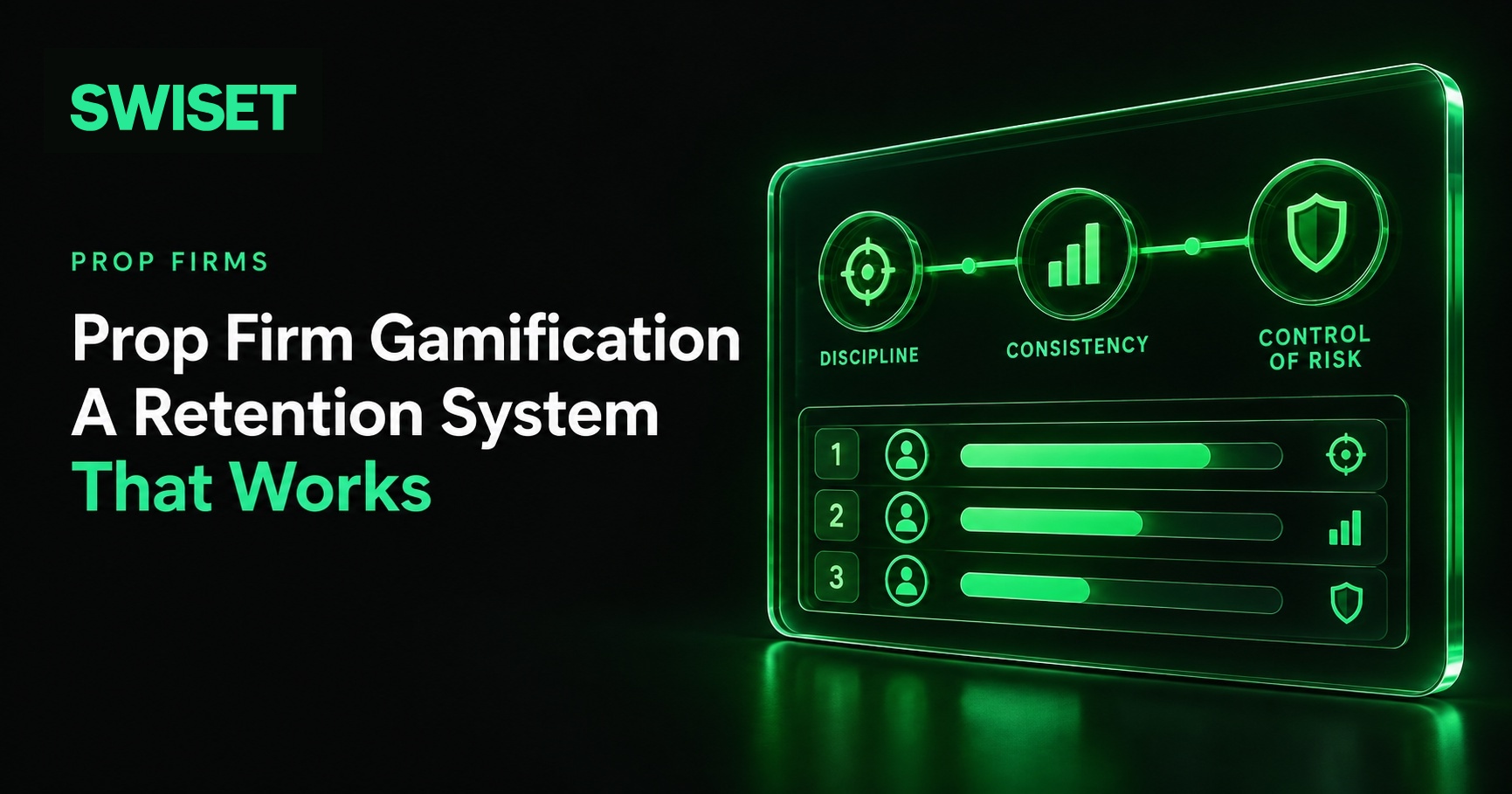
Prop firm gamification works as a retention system when it rewards the same behaviour you want to fund: following the rules, trading consistently and controlling risk. Use milestones, progress views, risk-adjusted leaderboards and competitions to make that behaviour visible and recognised. Don't gamify trading frequency, raw returns, challenge purchases or near-breach situations. Measure it stage by stage against a comparison group, with guardrail metrics that tell you if engagement is coming at the cost of risk.
/What gamification means in a prop firm
Gamification is the use of game mechanics (progress, goals, recognition, competition, rewards) in a non-game product to shape behaviour. In a trading app, it often means badges, streaks, points and leaderboards.
A prop firm is different in one important way: the product is already a game with rules. Traders have a profit target, loss limits, phases and a reward at the end. That structure is why gamification can fit naturally, and also why it needs care. Every mechanic you add either reinforces the evaluation's purpose or competes with it.
The useful question isn't "how do we make the platform more engaging?". It's "which behaviours predict a trader we'd want to fund and keep, and how do we make those behaviours more visible, more rewarding and easier to repeat?".
/Why prop firms lose traders
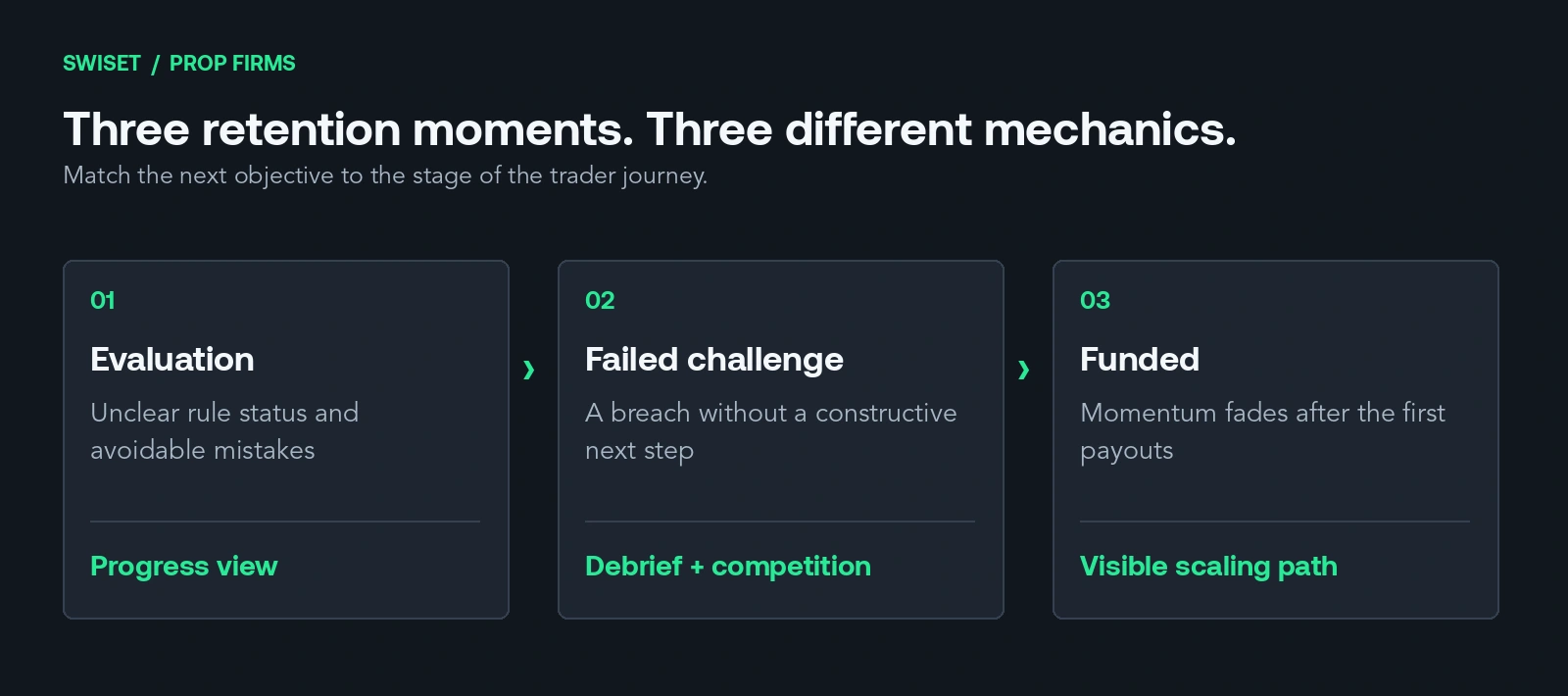
Retention problems tend to cluster at three moments, and each needs a different response.
During the evaluation. Traders who can't see where they stand against each rule trade blind, make avoidable mistakes and drop out frustrated. Many of the tickets described in our article on prop firm customer support start here.
After a failed challenge. The trader's last experience with your firm is a breach. If nothing in their journey showed them what went wrong, they have little reason to believe the next attempt would go differently, and a discount doesn't change that.
After funding and the first payouts. The goal they worked towards has been reached. Without a next objective (a scaling milestone, a new account size, recognition for consistency), the relationship becomes transactional and fades.
Gamification can help at each moment, but only if it's designed for that moment rather than layered on as a generic engagement feature.
/What to gamify: behaviours you want to fund
Start from your risk model, not from a feature list. The behaviours worth rewarding are the ones your evaluation is designed to detect.
Rule discipline
Recognise traders for staying within daily loss and drawdown limits over time, not for avoiding a breach on a single day. A milestone such as "20 trading days without approaching your daily limit" says more about a trader than any single profitable trade. It also turns the rules into something the trader works with, rather than a trap they discover at the end.
Consistency
Milestones based on trading across several days, steady position sizing or a balanced spread of profitable days reward the pattern most firms want in a funded trader. They also discourage the one-big-day approach that consistency rules exist to filter out.
Progress visibility
The simplest and often most effective mechanic is a clear view of progress: distance to the profit target, remaining room on each limit, days traded, phase status. It isn't flashy, but it's what keeps a trader oriented. Our guide to the prop firm trader dashboard covers what that view should include.
Next objectives after funding
Scaling plans are already a form of gamification: a defined set of conditions that unlock a larger account. Make those conditions visible as a progress path, and add recognition for consistency between payouts. A funded trader who can see the next level has a reason to stay engaged that doesn't depend on another purchase.
Competitions with the right scoring
Competitions can bring back traders who failed a challenge and give funded traders a change of pace. The scoring method decides what they reward. Ranking by raw percentage return favours a single high-risk trade; risk-adjusted or composite scoring, minimum trading days and drawdown rules favour traders who manage risk. Our guide to trading competition scoring methods compares what each method rewards.
/What Not to Gamify
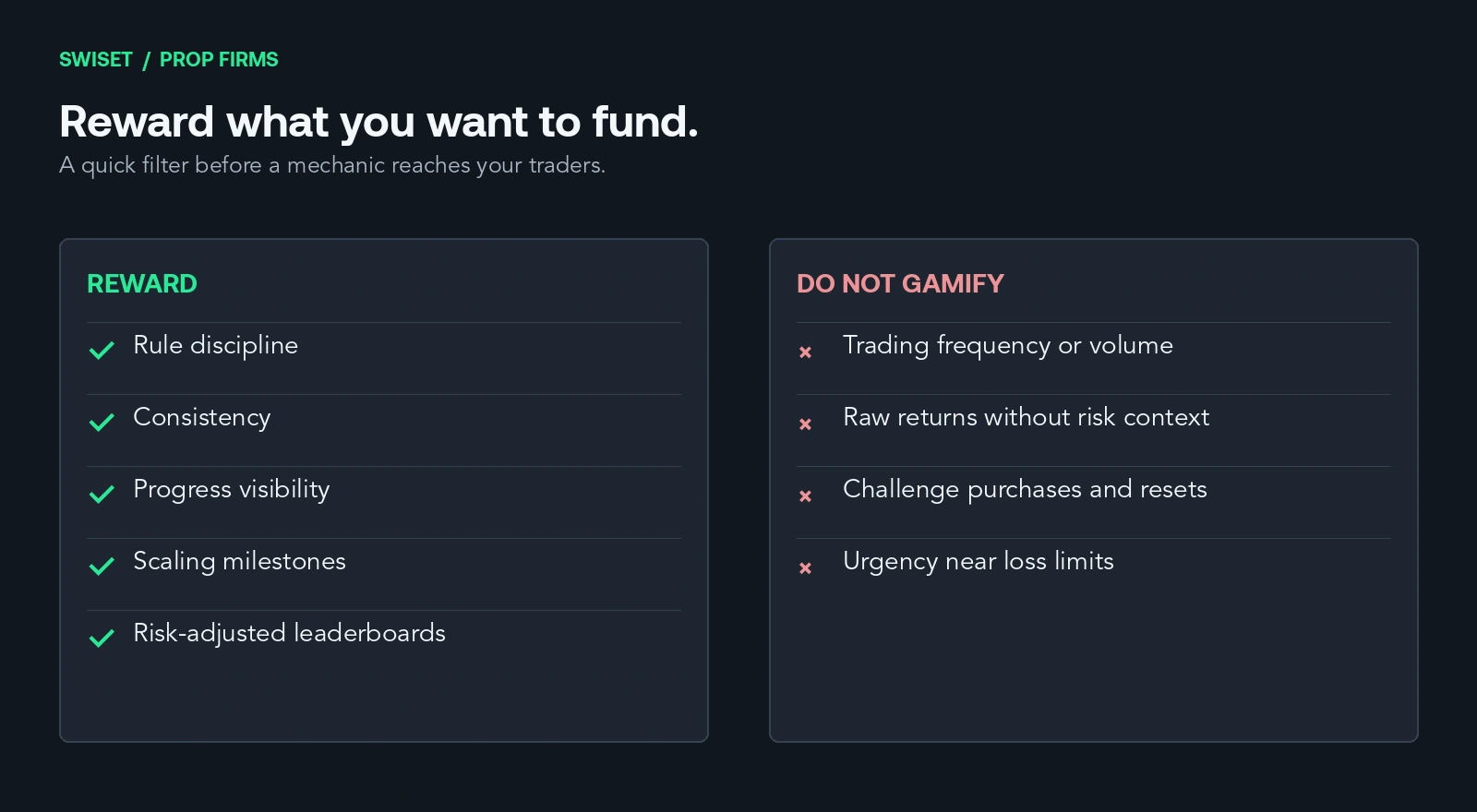
| Reward | Do not gamify |
|---|---|
| Rule discipline | Trading frequency or volume |
| Consistency | Raw returns without risk context |
| Progress visibility | Challenge purchases and resets |
| Scaling milestones | Urgency near loss limits |
| Risk-adjusted leaderboards | Rewards without precise written terms |
The mechanics that make trading apps engaging are also the ones regulators look at most closely. In a research note published in June 2024, the UK Financial Conduct Authority reported an online experiment with more than 9,000 consumers that tested digital engagement practices in trading apps, including a trader leaderboard and points with a prize draw, and found that these practices "can lead to changes in both trading frequency and investment risk". The note is written in a UK retail investment context and states that it may not represent the FCA's position, but its lesson applies directly to prop firms: engagement features change how people trade.
That gives you a practical rule. If a mechanic would make a trader trade more often, take more risk or spend more money than they otherwise would, it doesn't belong in your retention system. Specifically, avoid gamifying the following.
Trading frequency and volume
Streaks for trading every day, points per trade or rewards for lots traded encourage overtrading. In an evaluation, overtrading is one of the fastest routes to a breach. You'd be paying, in prizes or recognition, for the behaviour that makes traders fail.
Raw returns without risk context
A leaderboard of the highest percentage returns this week celebrates whoever took the largest bet and got lucky. It signals to everyone else that this is what success looks like at your firm. If you show returns, show them next to drawdown, or rank by a risk-adjusted measure.
Challenge purchases and resets
Badges for buying a third challenge, points for resets or streaks tied to repeat purchases turn retention into a sales funnel built on failure. They may lift short-term revenue, but they reward traders for not being ready and invite accusations that the firm profits from repeated losses. A trader who comes back should come back because something in their journey improved, not because a counter told them to.
Near-breach moments
Countdown timers, "one more trade to recover" prompts or celebratory animations when a trader climbs back from close to their limit all add pressure at the moment a trader is most likely to make a bad decision. Alerts near a limit should inform, calmly and in the words of your rulebook, never motivate.
Anything you wouldn't put in your terms
Every reward needs written criteria, an end date and a clear definition of what the trader receives. A prize described one way in a campaign and another way in the rules becomes a dispute. If a mechanic can't be described precisely in your terms and conditions, it isn't ready.
Before launch, have risk and compliance review each mechanic, any prize that is cash, credit or a funded account, and the messaging around it for every market you promote in.
/Design gamification as a system, not a set of features
Individual mechanics rarely change retention on their own. What works is a coherent path: progress views during the evaluation, a constructive debrief and a reason to try again after a failure, a clear next level after funding, and periodic competitions that reward the same behaviours throughout.
Three principles keep that system healthy. First, one set of rules: the behaviours you reward in milestones and competitions should be the ones your evaluation and funded-account rules require. Second, automatic and visible enforcement: traders should see their status in real time, and rewards or disqualifications should follow written criteria, not manual review after the fact. Third, abuse controls: wherever there's a prize, some participants will try multiple accounts, coordinated trading or other tactics. Our guide to prop firm fraud detection covers the patterns to check.
/Measuring Gamification ROI
Gamification is easy to launch and hard to evaluate. Engagement metrics go up almost by default, because any new feature gets clicks. The question is whether the business improved, and whether it improved without making your trader base riskier.
Define retention by stage
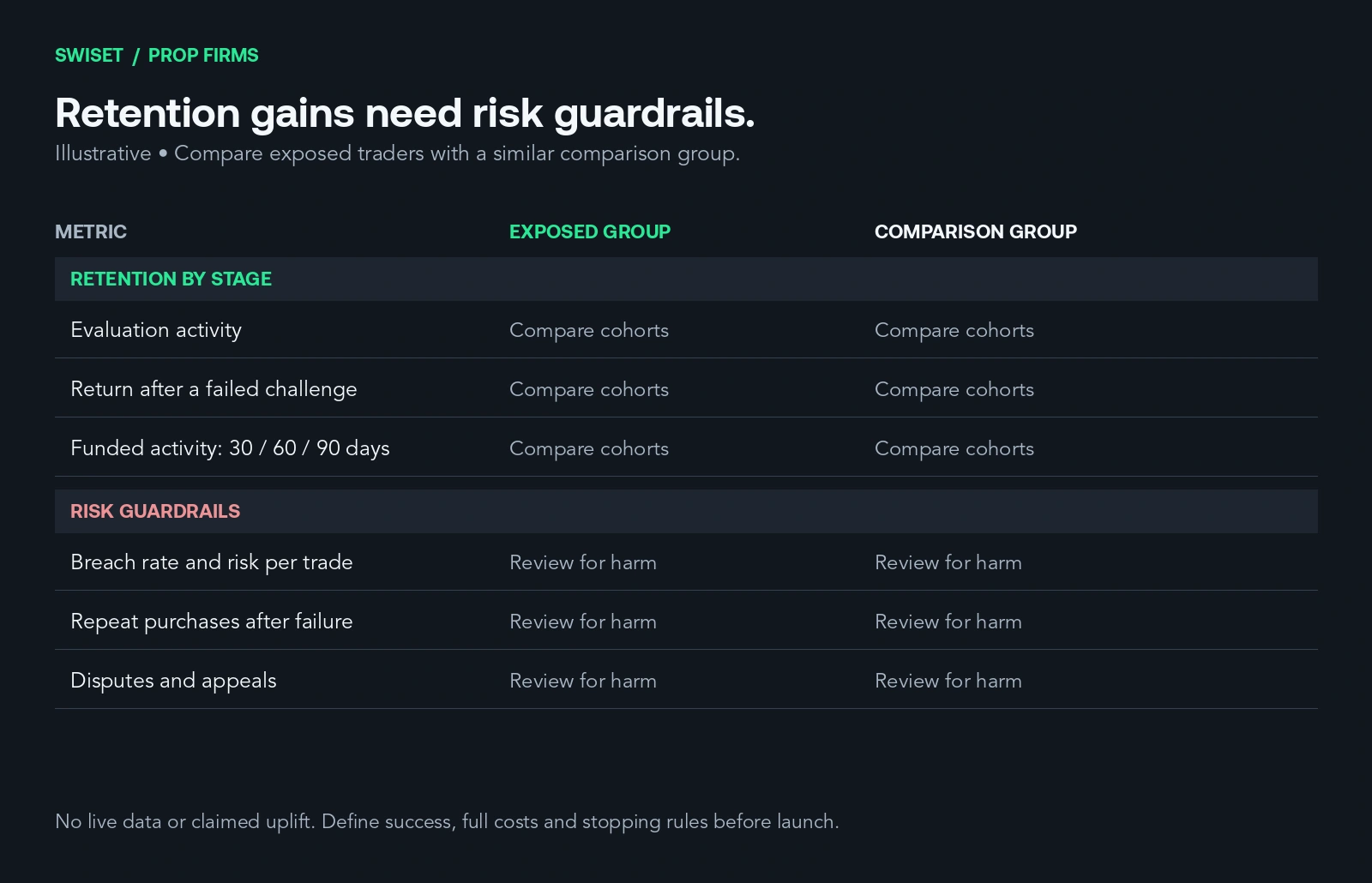
"Retention" means different things at different points in a prop firm, and mixing them hides what's happening. Measure each stage separately:
| Stage | What to measure | What it tells you |
|---|---|---|
| Evaluation | Share of traders active across the evaluation period; share completing each phase; time to breach | Whether mechanics keep traders engaged and oriented while they're tested |
| After a failed challenge | Share of traders who return within a defined period, and how their next attempt compares with their first | Whether returning traders come back better prepared, not just whether they buy again |
| Funded stage | Funded traders still active after 30, 60 and 90 days; share reaching scaling milestones; consistency between payouts | Whether the relationship lasts beyond the first payout |
| Competitions | Participation, completion, and what participants do in the following weeks | Whether competitions create ongoing activity or a one-off spike |
Keep each stage as its own number. A participant, a returning buyer, a funded trader and an active funded trader are different outcomes.
Use a comparison group
The most common mistake is crediting gamification with behaviour that would have happened anyway. Traders who opt into competitions or engage with milestones are often more motivated to begin with. Where possible, roll out a mechanic to part of your traders first, or compare similar cohorts before and after launch, and look at the difference between groups rather than the raw numbers. Our framework for trader performance analytics covers how to segment traders for this kind of comparison.
Track guardrail metrics
Every gamification report should include metrics that would show harm, not just benefit:
- Breach rates and how quickly breaches happen after a mechanic launches
- Average position size and risk per trade among participants versus non-participants
- Repeat purchases within short periods after a failure
- Rule-related support tickets, complaints and disputes
- Disqualifications and appeals in competitions
If engagement rises while these worsen, the mechanic is buying activity with risk. Pause it.
Count the full cost
The cost side includes prizes, the operational time to run campaigns and review edge cases, technology, and the support load that new mechanics generate. Set those against the benefit you can attribute through the comparison group: additional active funded months, more traders reaching scaling milestones, or returning traders whose second attempt shows better risk control. Be cautious with revenue from repeat purchases; a mechanic that mainly increases how often traders rebuy after failing isn't a retention success, even if it shows up as revenue.
Decide in advance what success looks like
Before launch, write down which metric should move, in which direction, over what period and what guardrails would stop the test. That turns gamification from a feature that's hard to switch off into an experiment you can evaluate.
/Common mistakes
Most problems come from copying trading-app mechanics without adapting them to a prop firm: streaks and points that reward trading frequency, leaderboards of raw returns, rewards tied to challenge purchases, and urgency prompts near loss limits. The rest come from measurement: reporting engagement instead of stage-by-stage retention, crediting the feature without a comparison group, ignoring guardrail metrics and treating repeat purchases after failure as retention.
/Checklist: prop firm gamification
- Does every mechanic reward a behaviour your evaluation is designed to detect?
- Have you excluded mechanics that reward trading frequency, raw returns, purchases or near-breach recovery?
- Do traders see their progress against every rule in real time?
- Is there a clear next objective after funding, such as a visible scaling path?
- Do competitions use scoring that limits the advantage of a single high-risk trade?
- Are all rewards defined in written terms, with abuse controls and an appeal route?
- Have risk and compliance reviewed mechanics, prizes and messaging?
- Will you measure retention by stage, against a comparison group, with guardrail metrics and full costs?
/Where Swiset fits
Swiset provides technology for prop firms that supports several of the building blocks in this guide. Its trader panel gives traders real-time analytics and challenge tracking, and firms can configure challenge phases, profit targets, drawdown limits and scaling rules, with drawdown, breach and consistency rules enforced automatically in real time. For competitions, Swiset supports formats designed for prop firm evaluation and recruitment, scoring methods including risk-adjusted return, real-time leaderboards, achievements and milestones, suspicious activity detection, configurable enforcement with an appeal process, and analytics on retention and engagement.
In practice, a firm can use the principles in this guide to decide which behaviours to reward, then configure rules, competitions and progress views from the same platform, so that what traders are rewarded for matches what the evaluation requires. Which mechanics to use, prizes and compliance decisions remain each firm's responsibility. Swiset is a technology provider, not a prop firm or a broker.
/Conclusion
Gamification won't fix a prop firm's retention on its own, and the wrong mechanics will make it worse. Used as a system, it can make your rules easier to follow, give traders a reason to come back after a failed challenge and a next objective after funding. The test is simple: reward what you'd want to fund, never what makes traders fail, and measure the result against a comparison group with guardrails in place.
If you're designing an engagement and retention strategy for your prop firm, discuss your prop firm's engagement strategy with Swiset.
Discuss your prop firm's engagement strategy
Talk with Swiset about rules, progress views and competitions that support your retention strategy.
Discuss your prop firm's engagement strategy/Related posts
- Prop Firm Trader Dashboard: What Traders Should See Before They Ask Support
- Trading Competition Scoring Methods: What Each One Actually Rewards
- Prop Firm Fraud Detection: What to Check Before You Approve a Payout
- Which Traders Deserve Your Retention Budget? A Framework for Trader Performance Analytics
FAQs
What is gamification in a prop firm?
The use of game mechanics such as progress views, milestones, leaderboards and competitions to encourage traders to stay engaged. In a prop firm, it works best when it rewards the same behaviours the evaluation is designed to detect.
Does gamification improve trader retention?
It can, but results depend on what is rewarded and how it's measured. Measure retention by stage (evaluation, after a failed challenge, funded stage) against a comparison group, and track guardrail metrics such as breach rates and risk per trade.
Which gamification mechanics should prop firms avoid?
Mechanics that reward trading frequency or volume, raw returns without risk context, challenge purchases or resets, and urgency near loss limits. They encourage the behaviours that make traders fail and create reputational and regulatory risk.
Are leaderboards a good idea for prop firms?
They can be, if they rank by risk-adjusted performance or consistency rather than raw percentage return, and if the rules behind them are written and enforced automatically.
How do you measure gamification ROI?
Compare traders exposed to a mechanic with a similar group that wasn't, at each stage of the journey. Count the full cost (prizes, operations, technology, support) and check guardrail metrics so that engagement gains don't come at the cost of higher risk.
Do gamification features raise regulatory concerns?
They can. A 2024 FCA research note found that engagement features such as leaderboards and prize draws can change trading frequency and risk-taking. Review mechanics, prizes and messaging with compliance for each market you operate in.