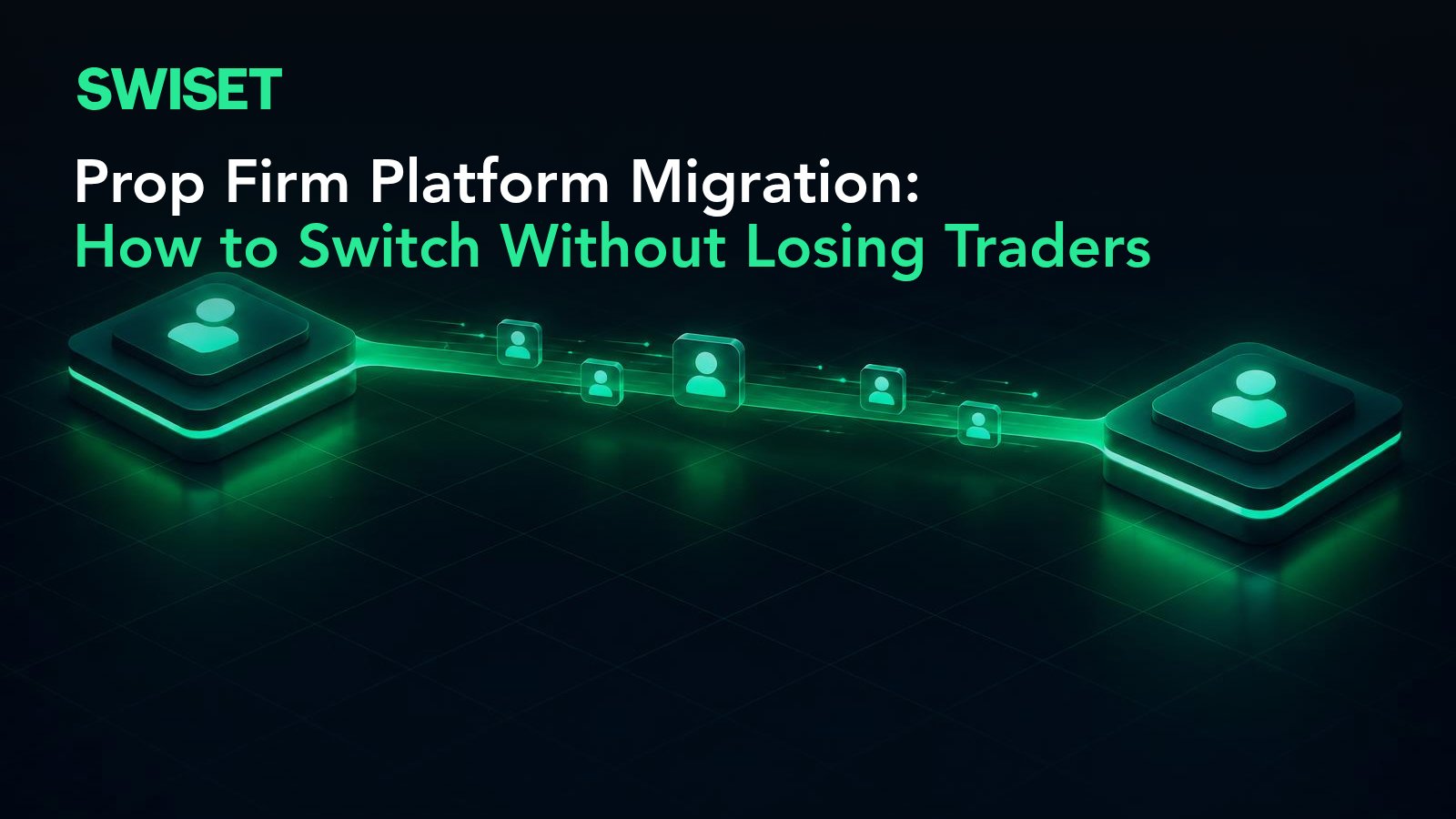
Prop Firm Platform Migration: How to Switch Without Losing Traders
Your rules engine cannot express the challenge you want to launch next quarter. Payouts depend on a spreadsheet that one person understands. Support answers the same question every day because the data lives in three places. Everyone agrees the technology has to change. Everyone also agrees this is not the right month, because hundreds of traders are mid-challenge and a payout cycle is a week away.
That reluctance is reasonable. A prop firm platform migration touches what traders care about most: their progress, their money and their identity records. It is also the point where an infrastructure built only to launch stops being a technical limitation and becomes a business one.
This article is for founders and operations or technology leads weighing a platform change. It does not argue that you should migrate. It shows how to decide, and how to do it so traders barely notice.
/The short answer
Treat migration as a continuity project, not a technology project. Inventory what your current system actually does, decide in advance how accounts already in flight will be treated, prove that the new setup reaches the same verdicts as the old one before any trader is moved, and announce the change with a date, a plain-language explanation and a written way back. The technology matters less than the order in which you do these four things.
/What does a prop firm platform migration involve?
It is the replacement or reconnection of the systems that run your funded-trader business: the connection to the trading platform, the challenge rules and how they are enforced, account and phase state, identity and KYC records, payout workflows, CRM and communication, and affiliate or IB tracking.
The definition matters because firms usually scope the project as "moving the platform" and discover the rest during cutover. A migration succeeds when every function the old setup performed, including the informal ones, has a defined home in the new one.
/Signs it is time to migrate, and signs it is not
Migration is justified when the constraint is structural: rules you cannot express, a workflow that needs manual steps for every account, integrations you cannot add, or an operating cost that grows with every trader. It is rarely justified by a single recurring annoyance that a configuration change could solve.
One question separates the two: if we fixed this inside the current system, would the same limit come back next quarter? If yes, the problem is the foundation. If no, patch first and revisit later. Switching to escape a symptom only moves the symptom.
/Three steps before any trader moves
Inventory what the old system really does
Functions, not features — including the informal duties nobody documented.
Decide how accounts in flight are treated
New cohort, phase boundary or full cutover, chosen by volume and risk.
Prove rule parity before moving anyone
Same data, same verdict, tested on real historical accounts.
01 — Inventory what the old system really does
Write down functions, not features. Which rules are enforced automatically and which are checked by hand? Who approves payouts, and on what evidence? What does a support agent look up, and where? Which reports does finance rely on? Which export does someone run every Friday?
The informal duties are the ones that disappear in a migration, because no requirement document mentions them. Interview the people who run the current system, not only the people who bought it. If you have a launch checklist, use it as a starting map, then add everything that grew around it. The finished inventory becomes the acceptance list for the new setup.
02 — Decide how accounts in flight will be treated
The hardest question is what happens to traders who are mid-challenge or waiting for a payout. There are three common approaches, and each has limits.
- New cohort only. New purchases go to the new platform while existing accounts finish on the old one. It is the lowest-risk path for traders, but you operate two systems, and reporting, support and payouts stay split until the last old account closes.
- Phase boundary. Accounts move when they finish a phase or request a payout, natural points where state is simple. The work is spread out, but you need a clear rule about who moves when, and a message that explains it.
- Full cutover. Everything moves on a set date. It ends the dual-running period fastest and concentrates the risk in one window, so it demands the strongest preparation and a tested way back.
None of these is best in general. A firm with few accounts in flight may prefer a single cutover. A firm with thousands of open challenges usually cannot afford one. Choose by the number of accounts in flight, the complexity of your rules and how much parallel operation your team can sustain.
03 — Prove rule parity before you move anyone
A trader who was 0.4% from the drawdown limit yesterday must be in the same position today. Rule parity means the new system reaches the same verdict as the old one on the same data.
Build a test set from real historical accounts, including the awkward ones: accounts that touched a limit by a hair, weekend gaps, disqualified accounts, accounts that passed on the last day. Run them through the new configuration and compare outcomes line by line. Every difference is one of three things: a configuration error, an ambiguity in your own rules, or something the old system did that nobody documented. All three are cheaper to find before traders do.
A migration is judged by what traders notice. The best one is dull.
/Move data deliberately
Decide what must move, what can be archived and what stays behind. The usual core is account identifiers, phase and rule state, the trade history you need for disputes and payouts, and verification status. Map each field from old to new and check what happens to anything with no equivalent.
Identity and KYC records need a separate conversation. Where the data may be stored, what the trader agreed to and what your jurisdictions require are decisions for your privacy and compliance owners, not for the migration team, and they should be involved from the start. The same applies to how verification status is carried over; our article on how much friction is actually protecting you covers what that step is protecting. Keep the old records reachable for as long as you may need them for disputes. If the old and new systems exchange data through an interface, an API for prop firms can simplify the handoff, but only if the data model has been mapped first.
/Tell traders what changes, and what does not
Traders worry about three things: my progress, my money, my access. Say before the change, in plain language, what stays the same (rules, balances, progress, payout terms), what changes (login, dashboard, support channel) and on which dates. Give them one place to ask questions.
Expect a spike in tickets and staff for it. What your tickets are telling you will show quickly whether the notice answered the right questions. If traders hear about the change first from a rumor, the technology can be perfect and trust will still dip.
/Plan the way back
Before cutover, define what would make you reverse it: a rule mismatch above a threshold you set, payouts that cannot be processed, accounts that cannot connect. Decide who makes the call, within what time, and what reversing means for accounts that have already traded on the new system. A rollback plan you never use is cheap insurance, and a team that knows it exists makes calmer decisions on cutover day.
/A migration readiness table
Questions to answer before cutover, and the evidence that shows you have answered them.
| Area | Question to answer before cutover | Evidence |
|---|---|---|
| Functions | Does every function in the inventory have a home? | Signed-off inventory |
| Rules | Do old and new reach the same verdict on the test set? | Parity report |
| Accounts | How is each account in flight treated? | Rule per segment |
| Data | What moves, what is archived, who approved it? | Field map, privacy sign-off |
| Payouts | Can pending payouts complete without a gap? | Dry run |
| Communication | Do traders know the date and what changes? | Notice sent, FAQ live |
| Rollback | What triggers reversal and who decides? | Written plan |
This table is a starting point, not a benchmark. Your rules, volumes and jurisdictions shape the plan.
/A diagnostic checklist before you commit
- Can you list every function your current system performs, including manual ones?
- Does the problem you want to solve come back next quarter if you patch it?
- Do you know how many accounts are in flight, and in which phase?
- Have you chosen a strategy for them: new cohort, phase boundary or full cutover?
- Do you have historical accounts ready to test rule parity?
- Has someone accountable for privacy approved what data moves?
- Is the cutover scheduled away from a payout cycle?
- Is there a written reversal trigger and a named decision-maker?
/Common mistakes
- Scoping the project as "the platform." Payouts, reporting and support are part of it.
- Migrating during a payout cycle. Pending payouts need a defined path, or a date that avoids them.
- Skipping the parity test because "the rules are the same." The same words can produce different verdicts in a different engine.
- Copying data before deciding who owns the privacy decision. Moving identity records is not an engineering call.
- Announcing after the fact. Traders should hear it from you, in advance.
- Having no criterion for reversing. Without one, the team decides under pressure.
- Judging the new system on features. Judge it on how it behaves with your own accounts.
/How to tell whether the migration worked
Compare against your own history, not a benchmark. Look at ticket volume and categories in the weeks after the change, payout requests resolved on time, disputes about rule outcomes, accounts that failed to connect and traders who stopped trading after the date. Use the same measures before and after, over a period you set in advance.
A temporary rise in tickets is normal. A rise in rule disputes is a signal that parity was incomplete.
/Where Swiset fits
Swiset positions its infrastructure for prop firms to launch, migrate and scale, and it connects with existing trading infrastructure rather than requiring you to replace the trading platform. Its integrations include MT4, MT5 and cTrader. Its prop firm infrastructure includes a challenge and evaluation engine that enforces drawdown, breach and consistency rules across every challenge phase, which is the function a rule parity test checks. For firms comparing setups, see also white label prop firm software.
In practice, the inventory and the parity test in this article can serve as the agenda for a conversation with any provider, Swiset included: which functions would move, which would be connected, and what the cutover would look like for your accounts in flight. The expected benefit is a plan traders do not notice. Your firm still decides the cutover strategy, how accounts in flight are treated and which data moves. Swiset is a technology provider, not a prop firm or a broker.
/Closing
The decision to migrate is easy to justify and hard to schedule, because the risk sits with traders in the middle of a challenge. Inventory what the old system really does, choose how accounts in flight will move, test rule parity on real history and write the way back before you set the date.
If you are weighing a change, start with the readiness table above. It is the shortest way to find out whether the problem is the technology or the plan.
Review your migration plan
Walk through your current setup, the accounts you have in flight and what a cutover would involve.
Book a DemoFAQs
How long does a prop firm platform migration take?
It depends on how many accounts are in flight, how complex your rules are and how many systems are involved. This article makes no timing claims; build the schedule from your own inventory.
Can I migrate without pausing challenges?
Many firms keep existing accounts on the old system and move only new cohorts. Others move accounts at phase boundaries or payout requests. The right path depends on volume and risk.
What is the biggest risk when switching prop firm software?
Rules that behave differently for the same account. A parity test on historical accounts exposes this before traders are affected.
Should I migrate during a payout cycle?
Usually not. Schedule the cutover so pending payouts complete, or give them a defined path.
What happens to KYC data when I change provider?
That is a privacy and compliance decision based on your jurisdictions and on what traders agreed to. Involve those owners before moving any identity data.