How Introducing Brokers Can Increase Their Rebate Income Without Burning Through Their Client Base
Most IBs start the same way: refer clients, earn a rebate on their trading volume, refer more clients, repeat. That works, for a while. It also has a ceiling, because it's optimizing exactly one of the three things that actually determine rebate income. An IB who's hit that ceiling usually reaches for the lever that's easiest to pull next — encouraging referred clients to trade more, more often — without asking whether that's actually a growth strategy or just a faster way to burn out the client base they spent months building.
/The short answer
Rebate income is the product of three variables: how many active, funded clients you have, how much volume each of them actually trades, and what rate you earn per unit of that volume. Most IBs manage only the first variable deliberately — acquisition — and leave the other two mostly to chance. A sustainable growth path works all three levers at once: growing the client base, understanding and climbing the rebate tier structure your broker actually offers, and building a network of sub-IBs so growth doesn't depend entirely on how many people you personally can refer. The lever that undercuts all three, regardless of which ones you pull, is not being able to see clearly which clients, which sub-IBs, and which rebate tier are actually driving your income — because you can't optimize what you can't track.
/The three levers, and why most IBs only pull one
Active client volume
More referred clients trading more volume — best grown through longevity, not just more top-of-funnel referrals.
Rebate rate and tier structure
Knowing where your broker's tier thresholds sit and how close your current volume already is to the next one.
Network depth
Sub-IBs referring their own clients, so growth no longer depends on one person's referral capacity.
Active client volume. This is the lever every IB understands instinctively: more referred clients trading more volume means more rebate. It's also the lever most IBs try to grow by adding more top-of-funnel referrals, when the faster and more durable gain is usually increasing the trading activity and longevity of the clients already referred — a client who stays active for two years is worth more than two clients who churn after two months each.
Rebate rate and tier structure. Most brokers pay IBs on a tiered structure, where the rebate rate per lot increases once an IB's referred volume crosses a threshold. An IB who doesn't know exactly where those thresholds sit, and how close their current volume is to the next one, is leaving a rate increase on the table that has nothing to do with acquiring a single new client — it's already available in the volume they're generating today. This is a conversation to have directly with your broker or platform partner, since tier structures vary and aren't something a technology provider sets.
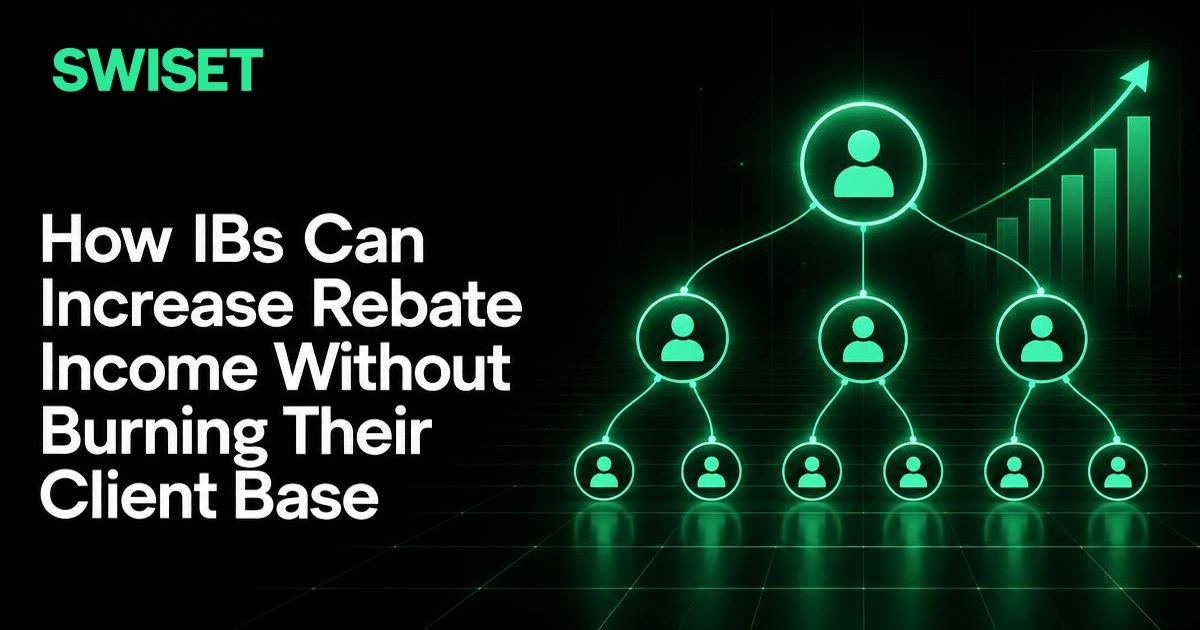
Network depth. A single-tier IB's income is capped by how many clients one person or team can personally refer and service. A multi-tier structure — sub-IBs referring their own clients, with commission flowing up through the network — breaks that cap, because growth no longer depends on the top IB's own referral capacity. This is the lever most individual IBs never pull, not because it isn't available, but because tracking commission accurately across multiple sub-IBs by hand becomes unmanageable past a handful of people.
/The wrong way to pull the first lever
There's a version of "grow active client volume" that works by actually serving clients well — better support, more useful market education, tools that help them trade with more discipline, not less. There's another version that works by nudging clients toward more frequent or larger trades purely because that's where the rebate comes from. The second version isn't hypothetical; it's the natural pull of an incentive structure where the IB's income scales with volume regardless of whether that volume is good for the client.
It's also a short-term trade that tends to lose. A client who over-trades on an IB's encouragement is more likely to blow through a drawdown, lose confidence, or churn out of the market entirely — at which point the IB has converted a few extra months of inflated rebate into the permanent loss of that client's long-term volume. The IBs who grow rebate income sustainably are the ones whose volume growth comes from genuinely engaged, retained clients, not from clients trading past their own judgment because someone had a reason to want them to.
A client who stays active for two years is worth more than two clients who churn after two months each.
/What actually happens when network depth is the missing lever
An IB running a single-tier operation has, at most, as many active clients as they can personally recruit and retain. A multi-tier network changes the shape of that growth entirely: instead of one person's referral capacity being the ceiling, each sub-IB brings their own referral capacity, and commission from their activity flows up through the structure. The arithmetic is straightforward — ten sub-IBs each referring twenty active clients produces a referred base ten times larger than one IB referring the same twenty clients alone, without the top IB doing any more personal outreach.
What makes this lever hard to pull without the right infrastructure isn't the concept — it's the tracking. Once commission is flowing through more than one layer, an IB needs to know, accurately and in real time, which sub-IB generated which volume, at which rate, so payouts are correct and so effort can go toward the sub-IBs and client segments actually producing results. Without that visibility, a multi-tier network either requires manual reconciliation that doesn't scale, or runs on trust that eventually gets tested by a sub-IB disputing their payout.
/A diagnostic checklist before trying to grow rebate income
- Do you know your current rebate tier, and how much additional volume would move you into the next one? If the honest answer is no, there may be a rate increase available in volume you're already generating, before any new acquisition effort.
- Can you say, with actual numbers, which of your referred clients or segments produce most of your current volume? An IB who can't answer this is optimizing acquisition blindly, spending equal effort on client types with very different lifetime value.
- If you run or are considering a multi-tier structure, can you see each sub-IB's contribution separately, or only the combined total? A combined total hides exactly the information that would tell you which sub-IB relationships are worth investing more in.
- Is any part of your current volume growth coming from encouraging clients to trade more than they otherwise would? This is worth answering honestly before it becomes a retention problem — volume gained this way tends to be the most expensive volume an IB ever earns, once the client it came from stops trading entirely.
- Would you notice quickly if a payout was calculated incorrectly, or would you find out only if a sub-IB or client raised it? A network that depends on someone complaining to catch an error is a network running on borrowed trust.
/Common mistakes
- Treating acquisition as the only lever worth managing. Tier structure and network depth are usually the faster path to more income once a client base already exists, and they don't require finding a single new referral.
- Growing volume by encouraging more trading instead of better-retained trading. The rebate looks the same in the short term; the client relationship behind it does not survive it as well.
- Building a multi-tier network without the tracking to run it. A sub-IB network that can't show each layer its own numbers accurately is a network that will eventually lose a sub-IB to a dispute, not to a competitor.
- Not knowing the broker's own tier thresholds. This is information the IB is entitled to and usually already qualifies for part of, well before any growth initiative starts.
/Where this fits for an IB leader
This is the layer Swiset's IB and community infrastructure is built to support directly. Multi-Tier IB Management, part of Swiset's multi-tier IB management and commission tracking infrastructure, is built specifically for running a network of sub-IBs with commission flowing through multiple layers, rather than tracking it by hand as the network grows past what a spreadsheet can reasonably hold. Revenue Analytics & Commission Tracking gives that visibility down to the segment and sub-IB level, so effort can go toward the relationships actually producing volume instead of being spread evenly across all of them. Referral Tools & Link Tracking keeps attribution accurate as clients move through the funnel, so volume generated by a specific referral doesn't get lost or miscredited by the time a payout is calculated. White-Label Branded Spaces supports the acquisition and retention side of the first lever — a professional, consistent presence for referred clients that doesn't depend on a broker's own branding.
None of this sets the rebate rate or tier structure itself — that's a commercial relationship between the IB and the broker or platform they're referring into, not something a technology provider determines (how IB program management works at the broker level). What the infrastructure settles is the layer underneath that relationship: whether the IB can actually see, accurately and by segment, what's producing its income, and whether a multi-tier structure can be run without the tracking problem that usually stops IBs from building one in the first place.
For an IB leader who's grown as far as single-tier acquisition will take them and wants a second opinion on network structure or commission visibility, that's a specific, scoped conversation — not a generic pitch to "refer more clients" (when an IB's growth path points toward operating a prop firm instead).
/Closing
An IB who's only ever pulled one lever — refer more people — has a growth strategy with a visible ceiling, and a tempting shortcut sitting right next to it that costs more than it earns over time. The more durable path runs through the two levers most IBs never touch: knowing exactly where the next rebate tier sits, and building a network deep enough that growth doesn't depend entirely on one person's referral capacity. Neither works without being able to see, clearly and by segment, what's actually producing the income in the first place.
Map your multi-tier structure and commission visibility
Book a Demo with Swiset's IB and community team to walk through what a multi-tier structure and commission visibility would actually look like for your network.
Book a DemoFAQs
What's the fastest way to increase rebate income without acquiring new clients?
Usually, checking where your current volume sits relative to your broker's next rebate tier. A rate increase on existing volume doesn't require a single new referral — it requires knowing the threshold exists and how close you already are to it.
Is building a multi-tier network worth it for a smaller IB?
It depends on whether you can track it accurately. A multi-tier structure multiplies referral capacity, but it also multiplies the complexity of calculating and verifying commission correctly across layers. It's worth pursuing once you have, or can get, the tracking to run it — not before.
Does encouraging clients to trade more actually grow rebate income sustainably?
Only up to the point where it starts affecting client retention, and that point usually arrives faster than expected. Volume driven by genuine engagement and retention tends to last; volume driven by encouragement to over-trade tends to end with the client leaving the market, taking their future volume with them.
Who sets the rebate rate and tier thresholds — the IB, the broker, or a technology provider?
The broker or platform the IB is referring clients into. A technology provider's infrastructure can track and report on volume and commission accurately, but the commercial rebate structure itself is negotiated directly between the IB and that broker or platform.