Copy Trading vs. Telegram Signals: What Your Members Actually Get
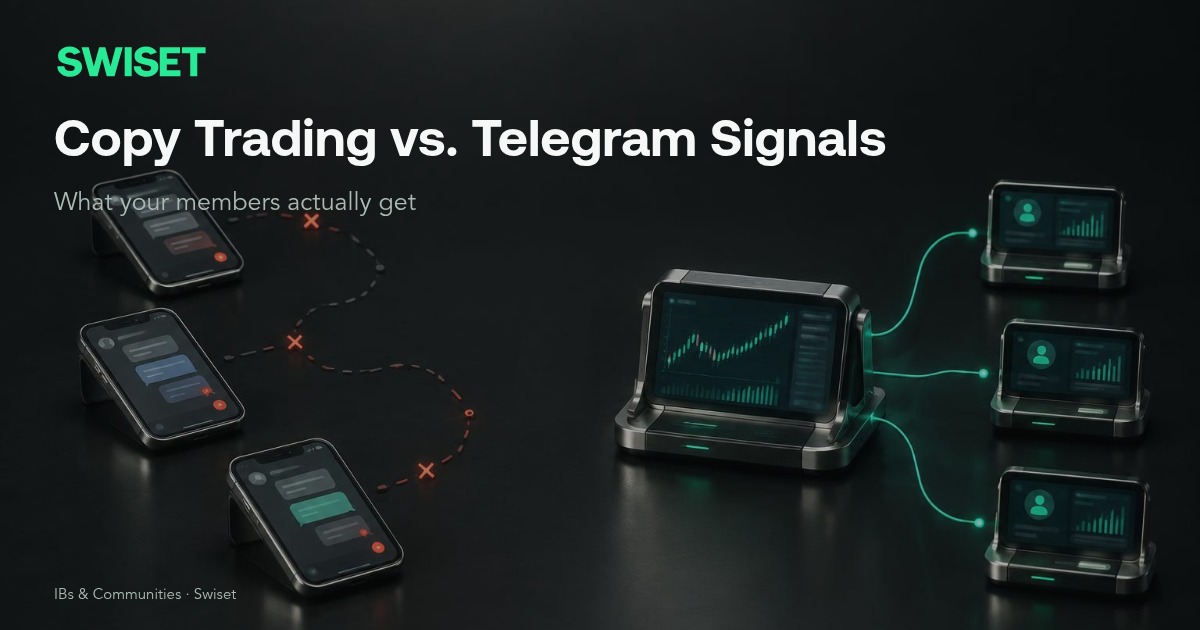
You post a trade in your channel. Some members see it in seconds, some an hour later, and a few never open the message. Each enters at a different price, sizes the position by feel and closes whenever they notice your update. Then they tell you the signals "don't work like they do for you."
That gap is the problem copy trading was built to close. This article is for community leaders, educators and IBs who share trades with members today and are weighing copy trading vs signals. It covers what changes when trades are copied automatically, what does not change, and what to check before you switch.
/The short answer
Copy trading replaces the manual step between your trade and your members' accounts. Instead of posting a signal and hoping each member acts on it, your trade is replicated into the accounts of members who have connected, scaled to their balance and risk settings. That removes delay, mismatched entries and guessed sizing. It does not remove trading risk, and it does not make copied results identical to yours: latency, slippage, liquidity and leverage can still create differences. For a leader, the real decision is whether you are ready to run a group of members whose accounts follow yours.
/Why signals break once the group grows
A signal channel works while the group is small. A dozen members, a leader who answers every question, and trades that last for days leave plenty of room for human delay. As the group grows, each weakness compounds. Late entries mean members pay different prices for the same idea. Guessed sizing means one member risks half a percent while another risks a quarter of the account. Updates to stops and targets reach people at different times.
The leader pays for this too. A member who loses more than you did is rarely angry at their own sizing; they are angry at the signal. Activity drops, the chat goes quiet and the people who stay are those who have time to watch the channel all day.
A signal tells members what you did. Copy trading does it for them, and that raises your responsibility for how it is set up.
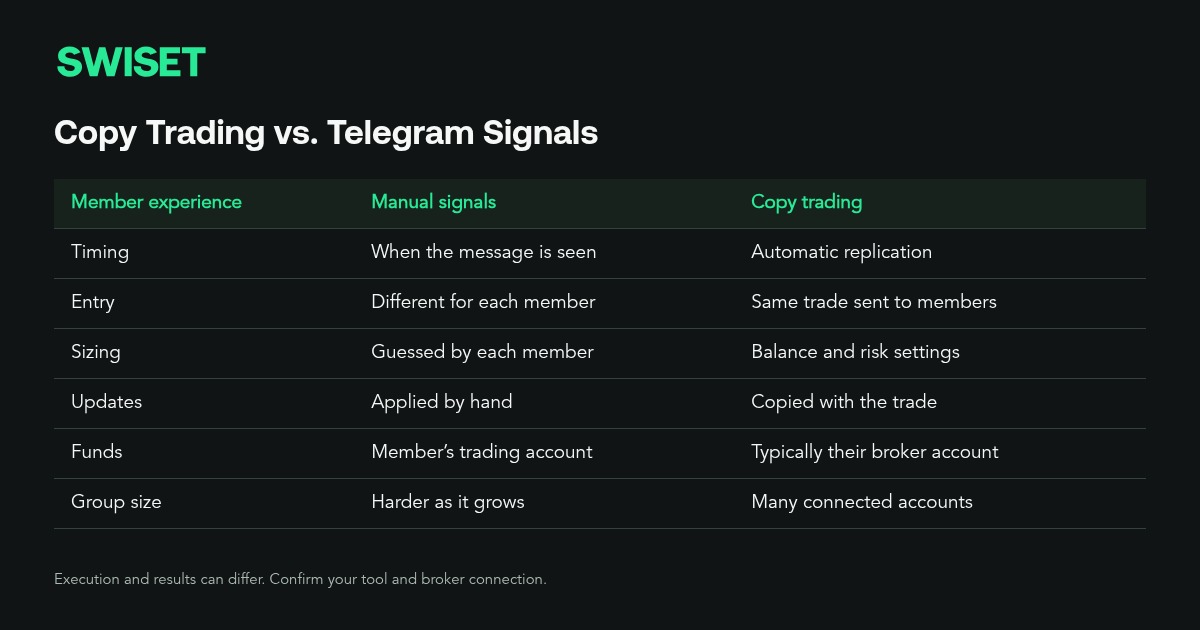
| What members experience | Manual signals | Automated copy trading |
|---|---|---|
| Timing | Depends on when each member sees the message | Trade is replicated automatically |
| Entry price | Different for each member | Same trade sent to every connected member |
| Position size | Guessed by each member | Scaled to each member's balance and risk setting |
| Updates (modify, close) | Posted, then applied by hand | Copied with the trade |
| Where the money sits | Wherever each member trades | Typically the member's own broker account |
| Group size | Gets harder as it grows | Designed to handle many connected accounts |
This table describes how the two approaches generally differ. Exactly what a given copy trading tool does depends on the tool and the broker connection, so confirm details before you promise anything to members.
/Three things that decide whether copy trading works for your community
01 Sizing
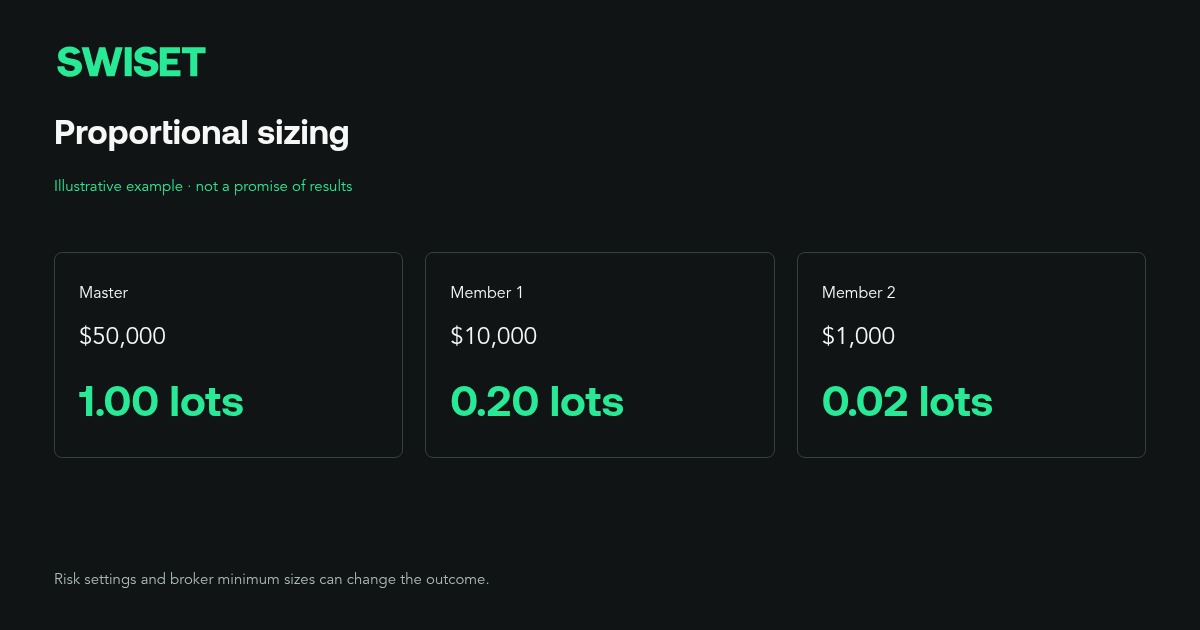
Proportional sizing is the main difference members feel. As an illustration only: if you open a position of 1.00 lot on a $50,000 account, a member with $10,000 would be copied at roughly 0.20 lots, and a member with $1,000 at roughly 0.02. Everyone carries the same relative exposure to your trade, whatever their balance. This is a hypothetical example, not a promise of results; each member's risk settings can change the outcome, and a smaller account may be limited by the minimum size its broker allows.
02 Custody and trust
Members will ask where their money sits. A tool that is non-custodial leaves funds in each member's own broker account and only replicates trades. That does not make copy trading risk-free, but it changes the question members have to answer before they join: they are not handing money to you or to the software provider. Say plainly what your setup does, and let members stop copying at any time.
03 Visibility
A signal channel gives you almost no data. You cannot see who followed which trade, who stopped copying or how much volume the group generates. With copy trading, a dashboard can show how many members are copying and whether each is active or paused. That visibility helps you run the community, and it helps IBs understand the volume behind their rebates. Rebates depend on your broker agreement and on member activity, so treat any projection as an estimate, not an income. Explore IB program management for the reporting side.
/A checklist before you switch from signals to copy trading
- Does your broker allow copy trading under your IB or partner agreement, and in the jurisdictions where your members live?
- Can you explain, in two sentences, how members' sizes are calculated?
- Do members keep their funds in their own broker accounts, and can they stop copying whenever they choose?
- Have you written down what you will do if copied results differ from yours?
- Does your risk warning say, in plain language, that copying does not remove risk?
/Common mistakes
Presenting copy trading as a way to match your results. Latency, slippage and account settings mean copied results can differ from yours.
Skipping the compliance conversation. Whether you can offer copy trading, and how you can describe it, depends on your broker and your jurisdiction. Leaders and IBs remain responsible for their own compliance.
Promoting rebates instead of the experience. Members stay for how the community works, not for your commission.
Leaving members without a way out. A copy trading setup that is hard to pause erodes trust faster than a bad month.
/Where this fits for a community leader or IB
If you already run a Telegram, Discord or WhatsApp group, the practical step is to add copy trading without leaving the channel your members already use. Swiset Copy is software for community leaders and IBs built for that: you set up your community with your own name, logo and colors, connect the broker account you trade from as the master, and share an invitation link in your channel. Members connect their own broker accounts and your open, modify and close orders are copied to them. The software is non-custodial, and a dashboard shows volume, members copying and each member's status.
The benefit is a more consistent experience for members and visibility for you. The limits are the ones above: trading risk stays, results can differ, and your broker agreement and local rules decide what you can offer. Swiset is a technology provider, not a broker or an advisor.
/Closing
Moving from signals to copy trading changes what you promise your members. Before, you shared ideas and they did the work. Afterward, you run a system that acts on your trades, so sizing, custody and honest risk language matter more.
Start with the checklist, decide what you will and will not claim, and confirm what your broker allows. Then choose a tool that lets members keep their funds and leave when they want. Explore technology for IBs and trading communities, whether an IB or community should launch its own prop firm, and trading competitions as another engagement format.
See how copy trading would look under your community's brand
Walk through the setup for your community or IB network and what to confirm with your broker before you launch.
Book a Demo/Related reading
Should Your IB or Trading Community Launch Its Own Prop Firm? · Your IB Program Has Outgrown the Spreadsheet · Your Trading Competition Will Get Signups. Will It Get You Traders?
FAQs
What is the difference between copy trading and trading signals?
With signals, you share a trade and each member decides whether and how to follow it. With copy trading, your trades are replicated automatically into the accounts of members who have connected, scaled to each balance and risk setting.
Does copy trading remove trading risk?
No. It removes manual delay and sizing errors, but latency, slippage, liquidity, leverage and account settings can still make copied results differ from yours. Past performance does not indicate future results.
Do members have to give me or the software provider their money?
Not with a non-custodial setup, where funds stay in each member's own broker account and only trades are replicated. Check how any tool you use is set up before you describe it to members.
Can an IB earn from copy trading?
An IB may earn rebates or commissions from the broker on the volume members trade, if the broker agreement provides for it. The amount depends on that agreement and on how actively members trade, so avoid presenting it as guaranteed income.