How to Offer Copy Trading to Your Trading Community: A Leader's Guide
Copy trading changes what you promise your members. Decide five things before you choose a tool.
You post a trade in your channel and a few minutes later a member writes: "I'm in. Where's your stop?" Another enters an hour later at a different price. A third never saw the message. Next month someone asks why their results are nothing like yours.
Copy trading looks like the obvious fix: your trades are replicated into your members' accounts, so nobody has to catch the message. It is a fix, but it also turns a conversation into a service. This guide is for community leaders, educators and IBs who share trades today and are considering how to offer copy trading to their community. The short answer: settle five decisions first (what your broker allows, how sizing works, what you say about risk, how members leave and what you will measure), then pick technology that fits them.
/What does it mean to offer copy trading?
Offering copy trading means that trades opened, modified and closed on your own broker account, the master, are automatically replicated on the broker accounts of members who have connected to you. Each member's position is usually scaled to their own balance and risk settings. Funds stay with each member's broker in a non-custodial setup; the technology replicates trades rather than holding money.
That sounds like a feature. In practice it is a commitment: members now expect their accounts to behave like yours, and they will hold you responsible when they do not.
/Decision 1: What does your broker allow?
Before anything else, read your broker or IB agreement. Whether copy trading is permitted, how it may be described to members, and which jurisdictions you may serve are questions for your broker and, where needed, your legal adviser. Leaders and IBs remain responsible for their own compliance; the technology does not take that over. Ask in writing, and keep the answer.
If you earn rebates, understand how they are calculated and paid under your agreement. Rebates depend on the broker's terms and on how much your members actually trade, so treat any projection as an estimate, never as income you can promise.
/Decision 2: How will sizing work, and can you explain it in two sentences?
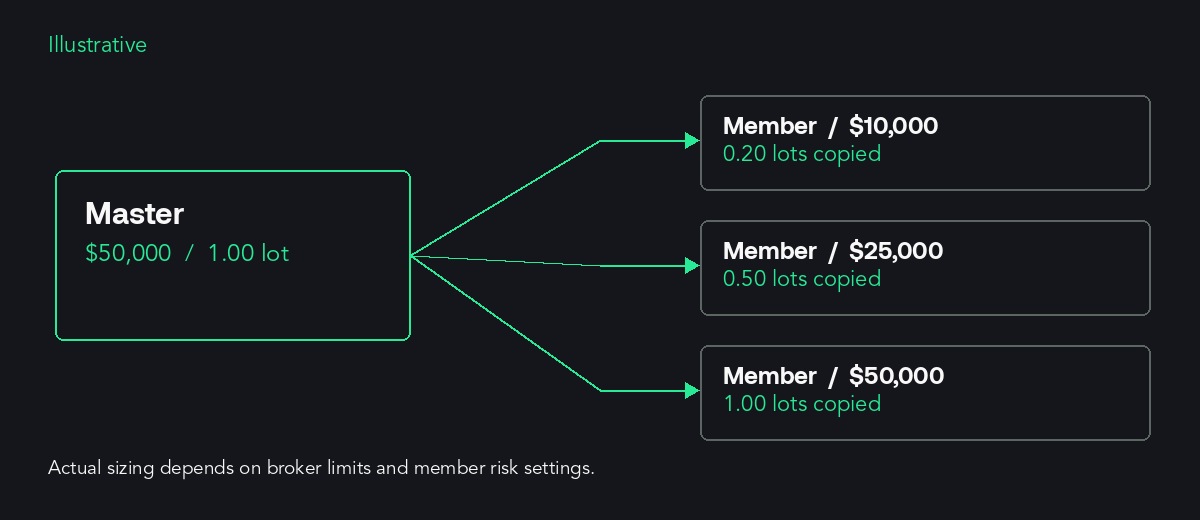
A member with $1,000 cannot take the same position as a member with $50,000. Copy trading typically scales positions to each account. As a hypothetical illustration only: if your master account opens 1.00 lot on $50,000, a member with $10,000 would be copied at roughly 0.20 lots. Everyone carries a similar relative exposure; nobody carries the same lot size.
Two limits matter. A small account may be restricted by the minimum trade size its broker allows. And the member's own risk settings can change the outcome. Write your explanation down in two sentences; if you cannot, members will fill the gap with assumptions.
/Decision 3: What will you tell members about risk?
Copying does not remove trading risk. Latency, slippage, liquidity and leverage can make a member's result differ from yours, and past performance does not predict future results. Say that where members will see it before they connect, in plain language, not only in the legal terms.
Avoid describing copy trading as a way to "get my results". Describe what it does: it reduces delay and sizing guesswork. It does not guarantee anything about outcomes. This also protects you: a member who was told what to expect is less likely to feel misled when a month goes badly.
/Decision 4: How does a member leave?
A member should be able to stop copying whenever they choose, without asking you. This is a trust question first and a technical one second. A service that is hard to pause turns a bad month into a bad reputation. Decide, and write down, what happens to positions that are already open when a member stops, and make sure that is also a thing the technology supports. Ask your provider rather than assuming.
/Decision 5: What will you measure?
Signals give you almost no data. Copy trading can show you more, and the risk is measuring the wrong thing. Keep these stages separate:
| Stage | What it tells you | Common mistake |
|---|---|---|
| Members in the community | Reach | Reported as “active” |
| Members who connected an account | Interest turned into action | Counted as copying |
| Members copying now | Current participation | Paused members included |
| Volume copied in the period | Trading activity | Treated as profit or as quality |
This table is a starting point, not a benchmark. If you are an IB, volume is what rebates depend on, but volume is not a measure of your members' results or of whether they stay. Watch retention over a period you define in advance: how many members who started copying are still copying 30, 60 and 90 days later.
A rough way to think about the economics, without any figures: connected members × share who actively copy × lots per copier per month × rebate per lot under your agreement. Every term in that line is an assumption until you have your own data. Change one and the result moves.
/A checklist before you launch
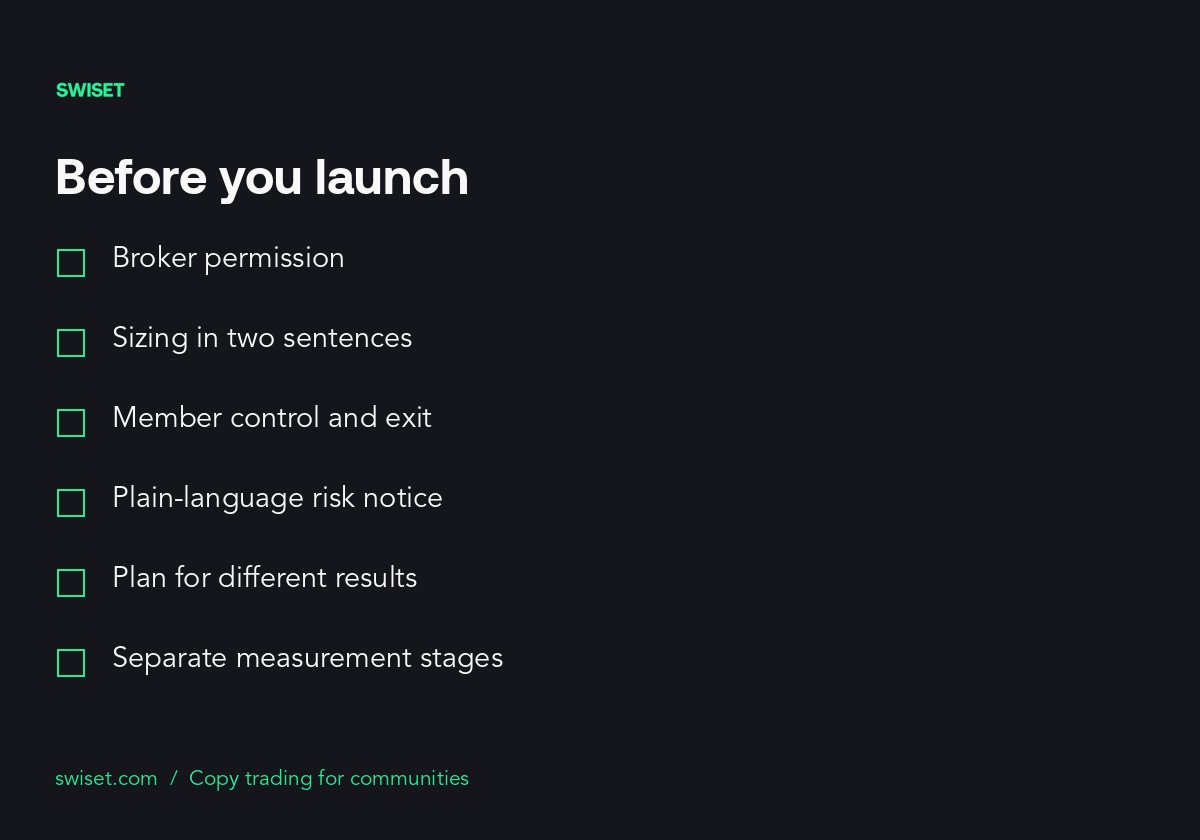
- Does your broker allow copy trading under your agreement, in the jurisdictions of your members?
- Can you explain sizing in two sentences?
- Do members keep funds in their own broker accounts, and can they stop whenever they want?
- Does your risk wording say, plainly, that copying does not remove risk?
- Have you decided what you will do if copied results differ from yours?
- Do you know which of the four stages above you will report?
/Common mistakes
Promising that members will match your results. Skipping the broker conversation. Promoting rebates instead of the member experience: members stay for how the community works. Measuring volume and calling it success. Launching to the whole community at once instead of starting with a small group and watching how sizing and execution behave.
/Where Swiset fits
Swiset Copy is copy trading software for community leaders and IBs. You set up your community with your own name, logo and colors and define the rules members copy with, connect the broker account you trade from through a broker API connection as the master, and invite members with a link you can share in Telegram, Discord or WhatsApp. Members connect their own broker accounts, and your open, modify and close orders are replicated to them, scaled to each balance and risk setting. The model is non-custodial: neither you nor Swiset holds member funds, and members can stop copying at any time. A community dashboard shows total volume, members copying and the status of each member (copying or paused).
In practice, the five decisions above are a good agenda for a demo with any provider, Swiset included: which broker connection applies, how sizing is calculated, how members pause, what the dashboard shows. The expected benefit is a more consistent experience for members and visibility for you. The limits stay the same: trading risk remains, copied results can differ, and your broker agreement and local rules decide what you can offer. Swiset is a technology provider, not a broker, advisor or signal provider.
Explore Swiset Copy and Swiset for IBs & communities to review your setup.
/Closing
Moving to copy trading is a decision about what you are willing to be responsible for. Settle the five decisions first, start small, measure the stages separately and keep your risk language honest.
Review your copy trading setup
Walk through how copy trading would work for your community or IB network.
Book a Demo/Related reading
- [Should Your IB or Trading Community Launch Its Own Prop Firm?](/blog/should-ib-trading-community-launch-prop-firm)
- [Your IB Program Has Outgrown the Spreadsheet](/blog/ib-program-management-brokers-prop-firms)
- [IB Trading Competitions: A Broker’s Guide](/blog/ib-trading-competitions-broker-guide)
FAQs
Is copy trading better than sending signals?
It removes manual delay and guesswork in entries and sizing. It also raises your responsibility, because your trades now act on members' accounts. The better option depends on your group, your broker and your readiness to run a service.
Do members hand their money to the leader?
Not in a non-custodial setup: funds stay in each member's own broker account and trades are replicated. Check how any provider you use is set up before describing it to members.
Can an IB earn from copy trading?
An IB may earn rebates or commissions from the broker on the volume members trade, if the broker agreement provides for it. The amount depends on that agreement and on member activity; it is never guaranteed.
Will members get the same results as the master account?
Not necessarily. Latency, slippage, liquidity, leverage and each member's settings can produce different results.
Is copy trading legal?
It depends on your jurisdiction, your broker and how the service is offered. Speak to your broker and, where needed, a legal adviser; leaders and IBs are responsible for their own compliance.