Trading Community Metrics: How to Tell Whether Your Community Is Actually Healthy
Members and messages are easy to count and easy to misread. Here are the five groups of metrics that show whether your community trades, stays and grows, and the decision each one should drive.
Your Discord just passed 8,000 members. The welcome channel is busy, the signals channel gets reactions, and the monthly call fills up. Then your broker partner sends the monthly report: rebates are flat for the third month in a row, and the number of members trading through your link has barely moved.
Both reports are accurate. They are just measuring different things. Member count tells you how many people joined. It doesn't tell you how many trade, how many stopped, or which of your activities brought them back. A community can grow on the outside while it quietly empties on the inside.
This guide is for people who run trading communities and introducing brokers who manage their own audience. The short answer: a healthy trading community is one where a growing share of members trade, keep trading over time and come back to the activities you run. You can see that with five groups of metrics: reach, activation, trading activity, participation and retention, measured by cohort and by acquisition channel. The rest of this article explains each group, what can mislead you and which decision each metric should inform.
/Why member count misleads
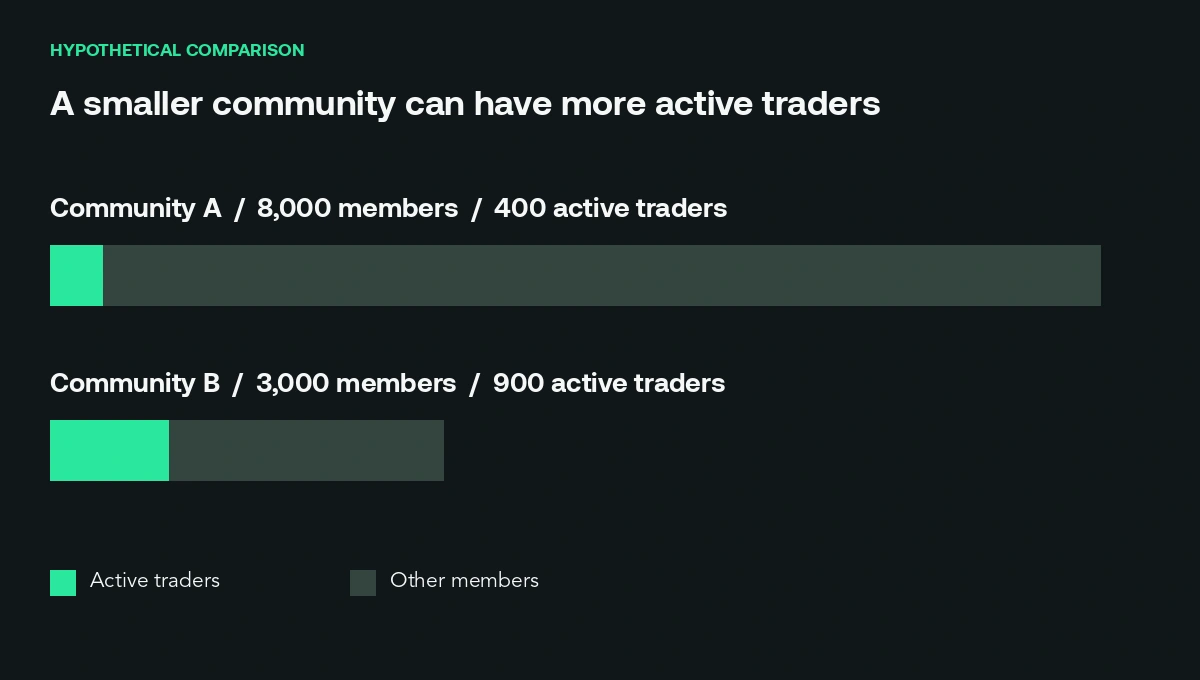
Member count only goes up unless people actively leave, and most people in a chat server don't leave; they mute. A server with 8,000 members and 400 active traders is a very different business from one with 3,000 members and 900 active traders, yet the first looks bigger on every public number.
Messages have a similar problem. A busy channel can mean an engaged community, a small group of very active members, or a bad trade that everyone is arguing about. Activity in the chat is a signal worth tracking, but it isn't a proxy for trading.
The fix isn't to stop counting members. It is to stop treating that count as the result, and to measure the stages between joining and trading.
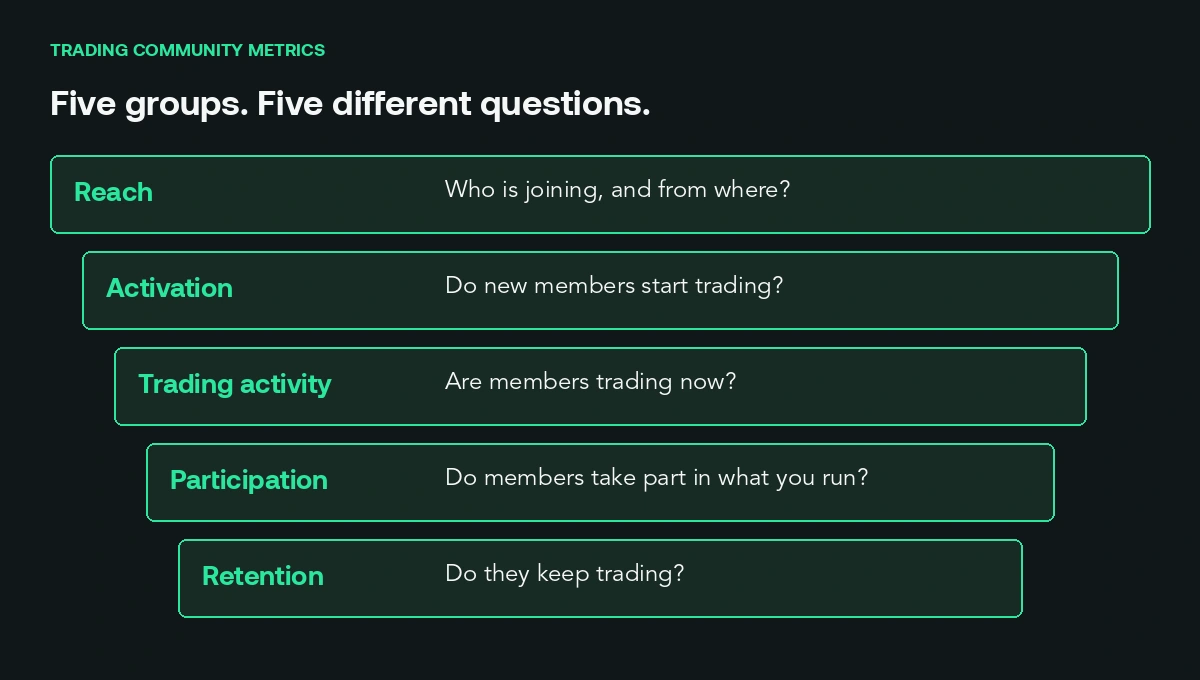
/The five groups of trading community metrics
| Group | What it answers | Example metrics |
|---|---|---|
| Reach | Who is joining, and from where? | New members by channel or referral link; share of new members who completed onboarding |
| Activation | Do new members start trading? | Share of a monthly cohort that opened an account with your broker partner, connected an account or placed a first trade; time from joining to first trade |
| Trading activity | Are members trading now? | Active traders this period (with your own definition of "active"); active trading days; volume per active trader |
| Participation | Do members take part in what you run? | Competition entries and completions; members copying a strategy; attendance at sessions; share of active traders who took part in at least one activity |
| Retention | Do they keep trading? | Share of each cohort still active after 30, 60 and 90 days; members who stopped copying or stopped trading, and when |
Keep each stage as its own number. A sign-up, a first trade and an active trader are different stages, and adding them together hides where people stop.
/Define "active" before you measure it
Every metric above depends on what you call an active trader. One trade in the month? Trading on at least a few days? A minimum volume? There is no industry standard, and the right answer depends on how you earn: a community paid through rebates cares about volume, one that sells copy trading cares about members who keep copying, and one built around education may care about members who practise on demo.
Write your definition down, keep it stable for at least a few months and apply it to every channel. Changing the definition when the numbers look bad is the fastest way to stop learning from them.
/Measure by cohort, not only in totals
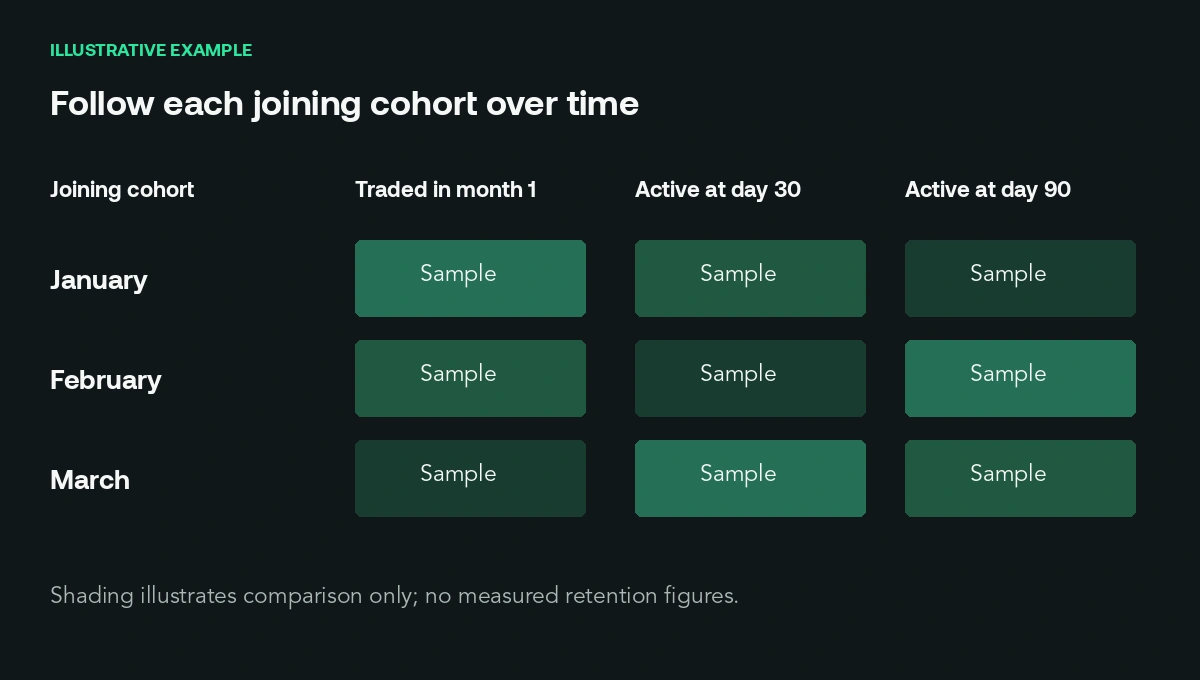
Totals mix people who joined last week with people who joined a year ago. A cohort view groups members by the month they joined and follows each group over time. That is how you see whether last month's newcomers activate faster than the ones before, or whether members who arrived through a competition stay longer than those who came from a free signals campaign.
You don't need sophisticated tooling to start. A table with one row per joining month and columns for "traded in month 1", "active at day 30", "active at day 90" will already show you trends that totals hide. Our framework for trader performance analytics goes deeper into segmenting traders by behaviour.
/Measure by acquisition channel
Communities grow through very different doors: referral links from existing members, partnerships with other creators, free competitions, paid ads, content. Each door brings people with different intent. If your referral links carry tracking, you can compare channels on the metric that matters, such as active traders at day 30, instead of on raw joins.
This is often the most uncomfortable analysis. The channel that brings the most members may bring the fewest traders. That doesn't make it worthless, but it should change how much you invest in it.
/Turn each metric into a decision
A metric is only useful if a change in it would make you do something different. Some examples:
If activation is low, the problem is usually the step between joining and trading: onboarding is unclear, the broker account process is long, or new members don't know where to start. A beginner competition on demo or a guided first week can help, and our guide to running a trading competition for your community covers formats for this.
If trading activity is concentrated in a small group, the community depends on a few people. Consider activities that give mid-level members a reason to trade regularly, such as recurring leaderboards with time periods short enough that newcomers can compete.
If participation is high but retention is low, your events attract people but don't create a habit. Look at what happens in the weeks between events.
If members stop copying after the first losing streak, the issue is expectations, not the tool. Our guide on offering copy trading to your community covers how to set risk messages before members start.
/What to show your broker partner
If you work with a broker, your metrics are also your negotiating position. A partner looking at your community wants to know how many active traders you bring, whether they stay and how the trend is moving, not how many members your server has. Showing cohort retention and active traders by channel tells the broker you understand your audience, and gives you a stronger basis to discuss conditions or support for joint activities such as competitions. Our article on growing rebate income without burning through your client base looks at the same relationship from the IB's revenue side.
Be careful with what you share. Aggregated metrics are usually enough; individual members' trading details should stay within what your agreements and data-protection rules allow.
/Common mistakes
Reporting member count as the headline number. Treating chat activity as trading activity. Changing the definition of "active" from month to month. Looking only at totals instead of cohorts. Comparing channels by joins instead of active traders. Running events without measuring what participants do afterwards. Measuring only the metrics your tools happen to produce instead of the ones that would change a decision.
/Checklist: is your trading community healthy?
- Do you have a written definition of an active trader?
- Can you see, for each monthly cohort, how many traded in their first month and how many are still active at 30, 60 and 90 days?
- Do your referral and campaign links tell you which channel each member came from?
- Can you compare channels by active traders, not only by joins?
- Do you know what share of active traders took part in at least one community activity this month?
- Do you know when members stop trading or stop copying, and what happened before?
- Could you send your broker partner a one-page summary of active traders and retention today?
/Where Swiset fits
Swiset provides tools for trading communities and introducing brokers that cover several of the activities and signals in this guide. Communities can run branded trading competitions with configurable rules and rewards, and leaderboards that rank members by PnL, volume or win rate over the periods they choose. Referral links come with conversion analytics, and performance analytics track trader activity and engagement. With Swiset Copy, community leaders can offer non-custodial copy trading under their own brand, with invite links for Telegram, Discord and WhatsApp, and members can stop copying at any time. In practice, a community leader can use the five groups above to decide what to measure, and then use competitions, leaderboards and copy trading as activities whose participation and trading activity can be tracked. Definitions of "active", cohort design and what to share with a broker partner remain each community's decisions. Swiset is a technology provider, not a broker.
/Closing
A trading community doesn't fail when people leave the server. It fails when they stop trading and nobody notices because the member count keeps rising. Define what active means for your community, follow each cohort over time, compare channels by the traders they bring and tie every metric to a decision you would actually make. If you want to look at how competitions, leaderboards and copy trading could fit into the way you measure and grow your community, talk to Swiset about measuring your community.
Talk to Swiset about measuring your community
Review how competitions, leaderboards and copy trading could fit into the way you measure and grow your community.
Book a DemoFAQs
What are the most important trading community metrics?
Active traders, the share of each new cohort that starts trading, retention of active traders over 30 to 90 days, participation in community activities and active traders by acquisition channel.
How do you measure engagement in a Discord or Telegram trading community?
Chat activity is a starting signal, but engagement in a trading community is better measured by trading activity and participation in activities such as competitions, copy trading or sessions, compared across cohorts.
What is a good retention rate for a trading community?
There is no reliable public benchmark; it depends on your definition of active, your audience and your offer. Compare your own cohorts over time instead.
What is the difference between members and active traders?
Members joined your community; active traders meet your definition of trading activity in a given period. The gap between the two is one of the most useful numbers you can track.
What should an IB share with its broker partner?
Usually aggregated figures: active traders, cohort retention and trends by channel, within the limits of your agreements and data-protection rules.
Related posts

Should a Broker Launch a Prop Firm? A Decision Guide for CEOs
November 10, 2026
IB Portal: What Your Introducing Brokers Should See Before They Email Your Partner Team
November 19, 2026