How to Run a Trading Competition for Your Community: Duration, Scoring and Prizes
Launching a competition is the easy part. The decisions that matter are what you reward, for how long and how you will know it worked.
A community leader announces a trading competition on Telegram. Two hundred members react, thirty join and, a week later, half of them have stopped checking the leaderboard. The prizes were fine. The tool worked. What failed was the design: nobody had decided what behavior the competition was meant to encourage, so it rewarded whatever happened to be easiest to measure.
That decision is becoming the main one. Tools that let a community set up a branded competition with a public leaderboard in a few steps have lowered the technical barrier, which leaves the harder questions to the organizer. If you are working out how to run a trading competition for a community, this article walks through them in order: the goal, the duration, the ranking metric, the prizes, the rules and the measurement.
/What is a community trading competition?
A community trading competition is a time-limited contest in which members trade and are ranked on a leaderboard according to a metric the organizer chooses, with or without prizes. Unlike a broker's campaign, the organizer is usually a community leader, IB or creator whose goal is member activity and loyalty, not deposits alone. That changes what a good design looks like: smaller scale, a shared identity and recurring formats rather than one big event.
/Start with the behavior you want to change
Before choosing anything, write one sentence: after this competition, I want members to do X. X might be "trade at all", for a community where many members are passive; "come back weekly", for one with a drop-off after onboarding; or "bring a friend", for one that wants to grow. Each points to a different design. A one-day event creates a spike of attention. A longer one rewards consistency. A competition with referral prizes rewards growth, not trading quality. If you cannot state the behavior, you are not ready to pick the format, and the leaderboard will end up deciding it for you.
/Choose a duration that matches the behavior
Duration sets the rhythm. A short competition, such as one day, suits a live event, a market session or a launch, and it favors members who can be online. A mid-length one, such as five days, fits a working week and gives members time to recover from a bad start. A long one, such as thirty days, rewards steadiness and suits communities that want to build a habit, but it demands more communication to keep people interested. These are design judgments, not benchmarks. The builder Swiset offers for communities, for example, lets organizers pick 1, 5 or 30 days. Whichever tool you use, a practical test is whether a member who joins on day one will still have a reason to check in on the last day.
| Behavior | Duration | Metric | Supporting rule to consider |
|---|---|---|---|
| Create a burst of participation | 1 day | Percentage return | Clear trading window and risk notice |
| Encourage weekly return visits | 5 days | Percentage return | Minimum trading days, where supported |
| Build a recurring habit | 30 days | Percentage return | Consistent participation criteria, where supported |
These are illustrative design choices, not benchmarks. Supporting rules must be checked against your chosen platform; they are not a claim that the free builder enforces additional custom rules.
/Pick a ranking metric, and know what it rewards
Every ranking metric is an incentive. Ranking by percentage return puts different account sizes on a single scale, which is why it is common in community competitions, and Swiset's builder ranks by equity growth percentage. But a leaderboard based on return alone can reward the member who takes the largest swing, because the best result of a group of risk-takers is usually a risk-taker. Volume rewards activity but can push members to trade more than they would. Our guide to trading competition scoring methods compares what each method rewards. For a community, a simple rule of thumb: pick the metric you would be comfortable seeing a member try to maximize, then add a rule, such as a minimum number of trading days, that blocks the obvious shortcut.
/Why risk design matters, and what the research says
Leaderboards and prizes work because they change behavior, and that cuts both ways. In a 2024 research note, the UK Financial Conduct Authority published an online experiment with more than 9,000 consumers testing digital engagement practices in trading apps, including a leaderboard and points and prize draws. It found that some practices can change trading frequency and risk. The note states that it may not represent the FCA's position and concerns trading apps in a UK context; it is not a rule for community competitions. The practical takeaway for an organizer is modest: avoid framing that pushes members to take more risk than they otherwise would, and say clearly that trading carries risk.
/Design prizes that fit your community
Prizes can be cash, funded accounts, gadgets or community perks such as access to a private channel or a session with a guest analyst. The cheaper the prize, the more it depends on status; the more valuable, the more it attracts members who only want the prize. A small set of prizes, awarded for clear criteria, usually keeps the focus on the competition. If a broker or prop firm sponsors the prizes, define in writing what the sponsor receives, such as co-branded placement or lead capture, and what members are told about it. Prizes with monetary value can be subject to local rules on promotions or contests, so check the rules where your members live before you announce them. This article is not legal advice.
/Write the rules before you announce
State who can join, the start and end times, what is ranked, how ties are resolved, what disqualifies a participant and how prizes are decided and delivered. Keep it short enough that members read it. Include a risk notice: participation is not investment advice and trading carries risk of loss. If members use accounts at a broker, confirm that the broker's terms allow the use you are proposing. Ambiguity is the most common source of conflict after the final bell, so write rules a member could apply without asking you.
/Share where your members already are
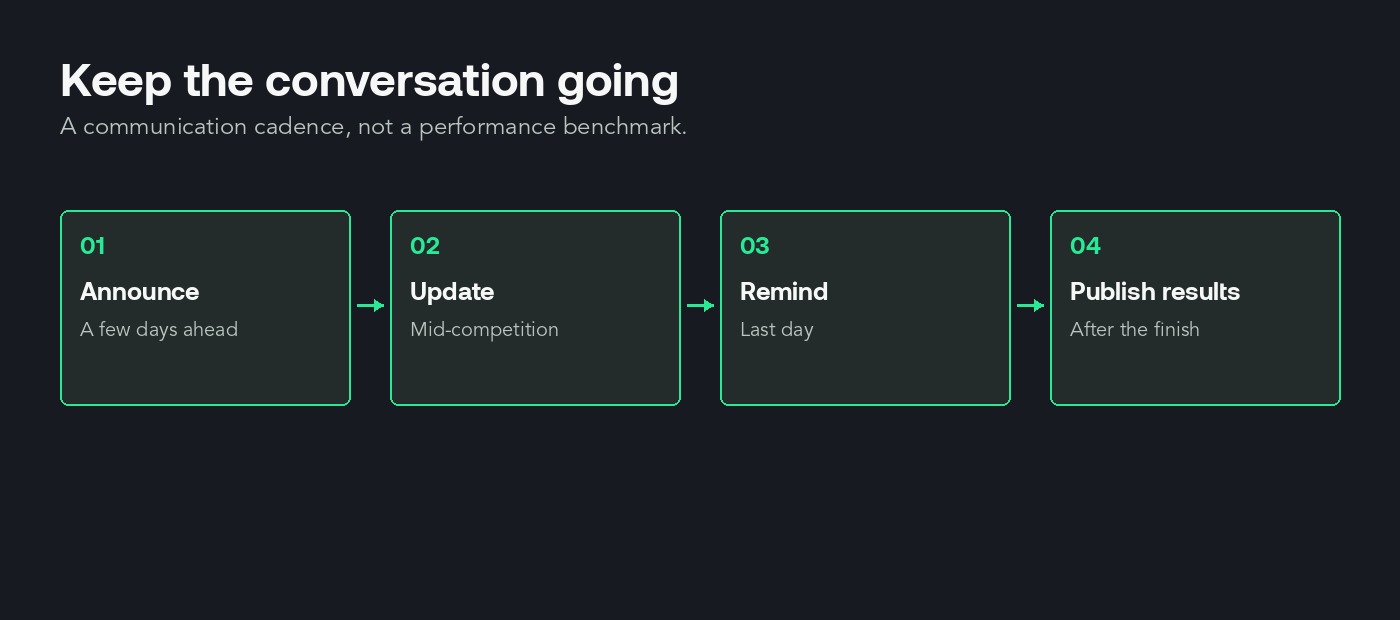
A competition needs a link and a message. Most communities already gather on messaging apps, so the announcement, the reminder and the results should go where members read them. The builder offers sharing links for WhatsApp, Telegram and X. A simple cadence works: announce a few days ahead, post a mid-competition update with the top of the leaderboard, send a last-day reminder and publish the results with a thank-you. If you also run copy trading for the community, keep the two programs clearly separate so members know which one they are in; our guide to offering copy trading to your community covers that side.
/Measure what happened, not just how many joined
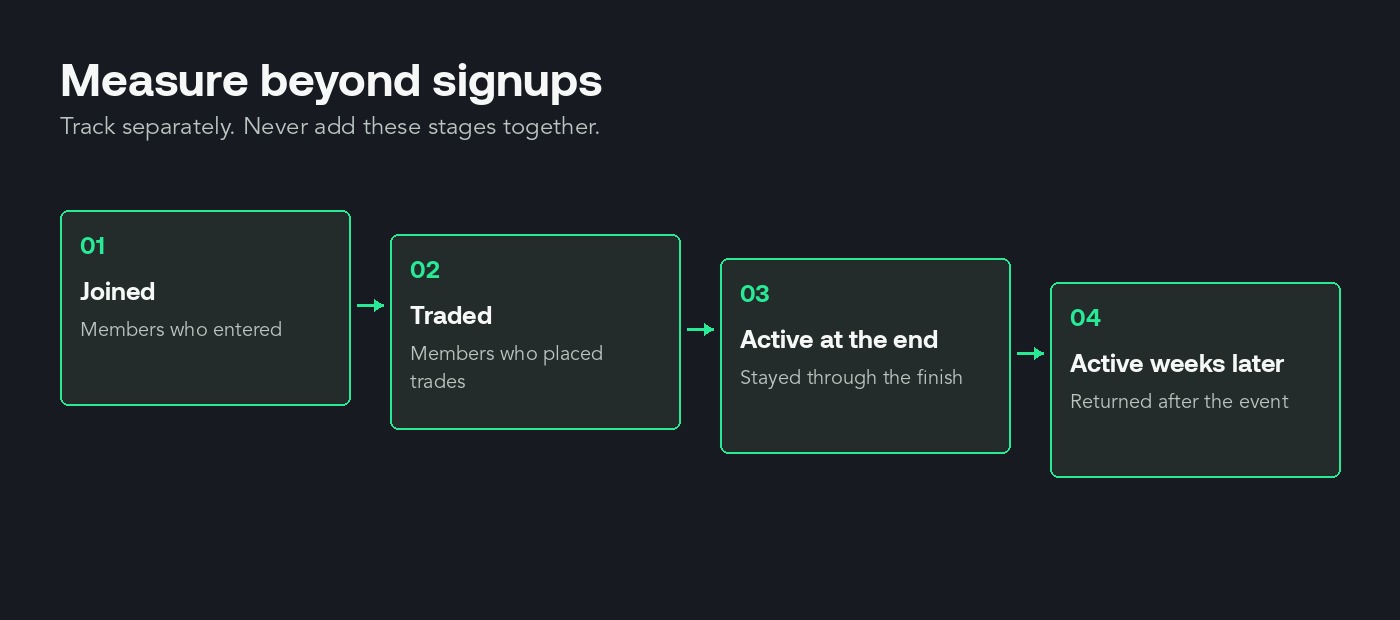
Joining a competition and trading in it are different things, and so are trading in it and still being active afterward. Track, side by side and never added together: members who joined, members who actually traded, members who stayed active until the end, and members who were still active some weeks later. Compare with your own previous period and keep your definition of "active" fixed. This article gives no benchmarks, because results depend on your audience, region and rules. If you work with brokers, an IB-focused view is in our guide to IB trading competitions.
/Common mistakes
Choosing the prize before the behavior. Ranking on return alone and being surprised by reckless trades. Running one big event with no follow-up. Announcing without written rules. Measuring signups and calling it engagement. Mixing a competition with copy trading or signals without explaining the difference. Promising prizes you have not confirmed you can fund or are allowed to give.
/Where Swiset fits
Swiset offers a free trading competition builder for communities, IBs and creators. According to the product page, organizers name the competition, choose a theme, set a start date, a duration of 1, 5 or 30 days and up to five optional prizes, add their brand, and share a public link, with a leaderboard ranked by equity growth percentage that updates during the competition. For organizers who need a custom domain, API integration or a success manager, there is a separate custom option. In practice, that lets a community leader run the format described above without building the tracking themselves, and focus on the decisions that matter: behavior, rules, prizes and measurement. The expected benefit is a repeatable competition format you can run again and compare with the last one. Prizes, eligibility, disclosures and compliance with local rules remain the organizer's responsibility, and Swiset is a technology provider, not a broker.
/The competition is only the beginning
The competition itself is the easy part. The value comes from deciding the behavior first, then choosing a duration, ranking metric and prizes that reward only that.
Plan your community competition with Swiset
Map your community's goal to a competition format and measurement plan with the Swiset team.
Plan your community competitionFAQs
How long should a community trading competition last?
It depends on the behavior you want. Short formats create a burst of attention, longer ones reward consistency. Choose by goal, not by habit.
What should a community trading competition be ranked on?
On the metric you want members to maximize, with a rule that blocks the obvious shortcut. Percentage return is common but can reward risk-taking if it is the only criterion.
Do I need prizes?
No. Many communities start with recognition or perks. Prizes with monetary value need clear rules and a check of local requirements.
Can a broker or prop firm sponsor a community competition?
It is common for sponsors to co-brand prizes, but the terms, what the sponsor gets and what members are told should be written down first.
How do I know if the competition worked?
Compare joined, traded, still active at the end and still active weeks later with your own previous period, with a fixed definition of active.